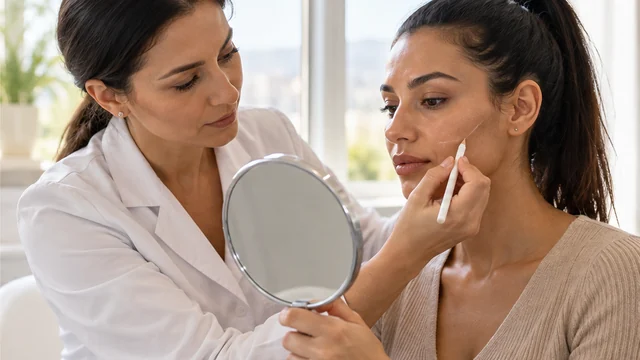

Collagen biostimulators and Radiesse: what they change
Have you heard that Radiesse “stimulates your own collagen” and hoped for a sharper contour without looking like somebody else? First distinguish immediate volume from slower changes in tissue quality. Collagen biostimulators are injected products that may stimulate components of the extracellular matrix, the structure surrounding cells. Calcium hydroxylapatite (CaHA)-based Radiesse also acts as a filler in certain uses. It is neither a risk-free alternative to a filler nor a guaranteed way of restoring firmness.
The word “collagen” alone cannot determine your choice. It depends on the area, injection technique, exact product and whether the concern is volume loss, a fold, an undefined jawline or thin skin. This page discusses the method's limits, Radiesse and its lidocaine-containing version, recovery and rare but serious risks. It does not claim that any particular Armenian clinic stocks these products.
What are biostimulators, and how does Radiesse work?
“Biostimulator” is not one substance or treatment. Aesthetic medicine uses calcium hydroxylapatite (CaHA), poly-L-lactic acid (PLLA) and other materials with different formulas, indications, onset and risks. In Radiesse, CaHA microspheres sit within a gel carrier. With certain injection techniques the gel provides mechanical filling, while the particles may contribute to tissue remodelling. That means a change in the organisation of collagen and related structures, not an instant creation of “young skin.”
“Your own collagen” needs careful explanation: the response depends on the body and cannot be ordered in a fixed percentage or made permanent. Radiesse is not the same as a hyaluronic acid (HA) filler. Some HA fillers can be broken down with hyaluronidase, whereas there is no equally dependable rapid enzyme-based way to dissolve CaHA completely. That difference matters particularly if a large correction is proposed in one sitting.
Radiesse and Radiesse (+) are not fully interchangeable. The “plus” product contains lidocaine, a local anaesthetic, and has distinct indication and contraindication details. The US regulatory status below is an independently checkable example, not a statement of the law in other countries.
What might change, and will I still look natural?
Volume correction may soften certain folds or support a particular contour. Diluted injection approaches more often aim at gradual improvement in the appearance of lax skin rather than obvious fullness. Outcomes vary with anatomy, tissue density, age, sun exposure, weight and previous injections. When deep anatomical changes or substantial excess skin are responsible, a biostimulator cannot substitute for surgical lifting.
| What you want | What to discuss | What not to promise |
|---|---|---|
| A more defined jawline | Whether volume or support is actually needed and whether a specific product and technique is indicated. | Identical contours for every facial shape or degree of sagging. |
| Thin skin and fine creases | How well diluted CaHA has been studied for this precise area. | Complete wrinkle removal or restoration of the skin's original thickness. |
| Volume loss and pronounced folds | Whether an injection is appropriate at all and which material fits. | Perfect symmetry or a permanently fixed result. |
| Sagging with excess skin | Whether a nonsurgical treatment can make a meaningful difference. | The same effect as an operation that removes excess skin. |
Naturalness is about choosing the correct goal as well as the quantity injected. If you want to preserve familiar facial expression, ask where the result should show at rest and on smiling, and what changes are not planned. A small correction may still be noticeable early on because swelling can temporarily alter proportions.
Standard versus diluted Radiesse: what is approved, and what is less established?
The FDA regulates Radiesse in the US as an injectable implant. Standard Radiesse has US indications for specified moderate-to-severe wrinkles and folds and for volume loss on the backs of the hands. Radiesse (+) has a separate indication for moderate-to-severe loss of jawline definition in adults over the age of 21. On 31 March 2026 the FDA approved an additional, specific indication: standard Radiesse diluted 1:2 with sterile 0.9% saline for décolleté wrinkles in patients aged 22 and older. This does not authorise every diluted application to the neck, arms or abdomen.
Professional literature discusses hyperdiluted CaHA for the face and body. Studies and expert recommendations exist, but systematic reviews identify too few randomised controlled trials for many of these areas. “Used for years” is not the same as “approved for your treatment site.” The clinician should state the exact formulation, goal, regulatory limits and strength of evidence, and disclose off-label use when applicable.
If you live in Yerevan or elsewhere in Armenia, FDA approval does not establish Armenian registration, local legal conditions or a clinic's inventory. Ask for documentation of the supplied product and an explanation of whether the proposed use is permitted locally. Do not accept a change from one filler to another under the vague label “collagen stimulator.”
Who may not be a suitable candidate?
Consider injection only after a review of your anatomy and medical history. According to the Radiesse instructions, certain severe allergies, known hypersensitivity to components and bleeding disorders are contraindications; Radiesse (+) also raises lidocaine or related anaesthetic allergies. Postpone injection during an active infection or inflammation at the site. Disclose herpes, autoimmune conditions, problematic scars, previous fillers and surgery even if they seem long resolved.
Safety in pregnancy and breastfeeding has not been established, so it is reasonable to defer an elective Radiesse treatment. Blood-thinning medicines may increase bruising. Never stop prescribed anticoagulants yourself; changes require the prescribing physician's judgement. Tell the clinician about planned dental work, further injections or device treatments near the area because compatibility and intervals need individual assessment.
Décolleté treatment has a specific restriction: Radiesse diluted 1:2 must not be injected into or over breast tissue. Tell the clinician if you have had breast cancer, radiation treatment to this area or a family history of breast cancer; safety for décolleté use in these groups has not been established. Approval for décolleté wrinkles does not mean every woman is a suitable candidate.
Do not transfer results from approved areas to the lips or around the eyes: the manufacturer says Radiesse safety and efficacy have not been established there. Nodules in inappropriate tissues are an important concern. Images of somebody with different anatomy or skin thickness cannot tell you whether you are a candidate.
What happens during injection: pain, anaesthesia and monitoring?
The consultation begins with assessment of the face or other chosen region, skin and previous work. The practitioner should say whether the aim is filling or skin-quality improvement, which product is proposed, the planned depth and why. Injection may use a needle or a cannula, a thin blunt-tipped tube; neither removes vascular risk. Never copy doses, injection locations or protocols from social media.
You might feel a needle prick, pressure, stretching or soreness. Some products contain lidocaine; additional pain relief may be considered if suitable. Clarify allergies and anaesthesia history first. Agree on a stop signal: unusual intense pain or a change in vision is not normal discomfort to endure silently.
Afterwards you need clear instructions and contact information if symptoms worsen. A beautiful room is not a safety plan: appropriate clinical qualifications, knowledge of vascular anatomy and an actual response protocol matter. If someone promises they “cannot possibly enter a blood vessel,” they have not explained the risk properly.
When will I see a result, and how should I plan recovery?
The gel carrier can give CaHA an early filling effect; tissue remodelling is assessed later. A picture taken immediately afterwards therefore shows only part of the story and may include swelling. Compare results at an agreed time after reactions subside and, when appropriate, after the full treatment plan. Duration depends on the material, technique, area, amount, individual biology and later tissue changes. “Exactly two years for everyone” is not credible.
| When | What might happen | How to plan |
|---|---|---|
| Immediately afterwards | Swelling, redness, tenderness, entry marks and temporary asymmetry caused by tissue response. | Do not expect your final contour in the mirror on the day. |
| The next few days | Bruising and puffiness may be obvious to others even if you can resume routine activities. | Do not make your first injection immediately before a shoot, presentation or important event. |
| The following weeks and months | Swelling settles; gradual tissue changes cannot be judged from one day. | Arrange follow-up and photographs taken under comparable conditions. |
For approximately the first 24 hours, and while early reactions remain, the manufacturer recommends avoiding intense exercise, excessive heat and sun exposure after Radiesse. This is guidance from US product information, not a universal instruction for every protocol. Do not massage the area without explicit directions: aftercare differs across injectables. Do not try to “break up” a new lump at home.
Which reactions are common, and which need emergency care?
Temporary redness, swelling, tenderness, bruising and firmness at injection sites are relatively common. Nodules, asymmetry, inflammation and infection are also possible. Some lumps persist longer than anticipated and need examination rather than simply more filler injected over them. Nodules and temporary movement difficulties have been described on the backs of hands; hand data must not be passed off as facial statistics.
The key rare but severe risk is unintentional injection of filler into a blood vessel. It may interrupt skin circulation and cause tissue death; injections in the face have been associated with visual impairment, blindness and stroke. Seek immediate medical help for unusually severe pain, pale or mottled skin, sudden vision changes, one-sided facial weakness, speech disturbance or other stroke symptoms. Do not wait overnight for a reply from your injector; call emergency services for visual or neurological signs.
Unlike some HA fillers, CaHA cannot be reliably and rapidly dissolved with hyaluronidase. That makes informed consent particularly important: your doctor must be able to recognise vascular injury and immediately arrange appropriate emergency care, not merely know how to inject. Avoid a “try it now and dissolve it in five minutes if needed” promise.
What else should you compare if you want a subtle result?
Hyaluronic acid fillers may be worth discussing when the priority is specific volume or contour and a different correction strategy matters. They are not risk-free: vascular complications can occur with HA too. PLLA biostimulators have different mechanisms and treatment schedules; “both stimulate collagen” does not make them substitutes for Radiesse. Skin-surface treatments cannot provide the same support as fillers but may better match a texture concern.
Sometimes skincare and watchful waiting are better when the concern is slight and you are not ready to accept a potentially hard-to-reverse outcome. For major excess skin, discuss surgical assessment instead of progressively more injected material. If even a temporary asymmetry would distress you, consider whether you can tolerate the time needed for a result to settle.
A brand name or claimed longevity on a price list is insufficient. Ask about the complete course budget and follow-ups rather than a made-up fixed price, possible management of complications, and what happens if you decide to stop after the first session.
What should you ask before agreeing?
- Which of my features actually needs added volume, and which concerns skin quality? How did you assess that?
- Which exact product, with or without lidocaine, would you use and where? Is the protocol authorised in this country?
- What studies exist for this exact area, and what remains a hypothesis or expert consensus?
- How will you reduce vascular risk, what signs should I report immediately and whom do I contact at night?
- When should we judge the result without swelling, how many visits might be needed, and when would we stop if I dislike the effect?
- What are the alternatives, including no injection, and what can or cannot be corrected if I am unhappy?
Informed consent is more than signing beneath the word “rejuvenation.” It must identify the actual product, area, objective, variability and known risks. Vague answers are a sound reason to postpone a decision.
An additional question about biostimulators
Will CaHA show up on medical imaging?
CaHA particles may be visible on X-rays or CT scans. Tell your treating doctors and radiology staff about past injections, particularly when they were close to the area being imaged.
Sources and limits of evidence
- FDA: 31 March 2026 approval for diluted Radiesse in the décolleté.
- Radiesse: formulation differences, warnings and aftercare.
- FDA: dermal filler indications and hazards.
- 2023 systematic review: CaHA facial applications.
- 2024 systematic review: CaHA body applications.
- Radiesse: current indications and décolleté-specific restrictions (manufacturer information)