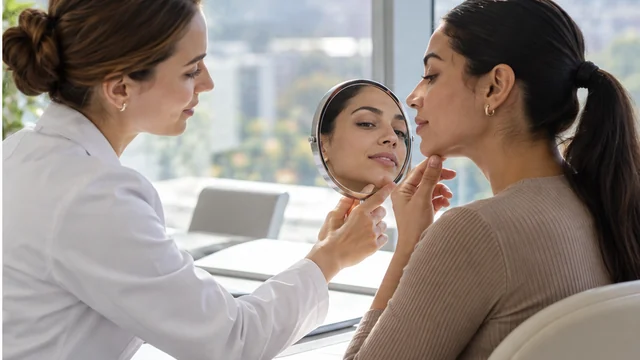

Korean botulinum toxins: Nabota, Jeuveau and other brands
You look up Nabota and soon encounter Jeuveau, Nuceiva and other products advertised as “Korean Botox.” They can sound alike in adverts, but the country of manufacture is not enough to make a safe choice. Nabota is a botulinum toxin type A brand associated with South Korean manufacturer Daewoong; in the United States a related prabotulinumtoxinA-xvfs medicine is marketed as Jeuveau. This does not mean that names, permitted indications, instructions or formulations are identical across markets. The product and package you are actually offered must be checked.
If you hope to soften the line between your eyebrows while keeping an expressive face, “Korean or not?” is less useful than three questions: what causes the line, whether the precisely identified registered medicine is appropriate for that goal, and how much reduction in facial movement you would welcome. No brand alone guarantees a natural-looking outcome, prevents eyelid drooping or predicts the exact duration for you.
Nabota, Jeuveau and other brands: what is actually known?
Botulinum toxin type A is a medicinal protein that temporarily reduces signalling from a nerve ending to a muscle. When the muscle contracts less strongly, dynamic wrinkles—those formed during frowning or smiling—may become softer. It is not a filler: it does not add volume or fill a deep groove. Nor does it treat pigmentation, loose skin or the consequences of lost cheek volume. An old line visible even when the face is still may persist despite reduced movement.
Jeuveau has a US prescribing label: the FDA authorised it for temporarily improving moderate to severe glabellar lines in adults, when those lines are associated with contraction of the relevant muscles. That US authorisation does not mean that every Nabota-labelled pack is authorised in Armenia for the same use, that it carries US labelling, or that it may be used in every other area without its own assessment. The trade name, formulation, country and marketing-authorisation holder matter for the exact medicine being used. For comparison, Nuceiva has its own EU product information: its authorised aesthetic indication covers moderate to severe glabellar lines in adults under 65 when those lines have an important psychological impact. These are European authorisation conditions, not instructions for using Nabota in Armenia.
| Label or group | What it establishes | What it does not establish |
|---|---|---|
| Nabota | A botulinum toxin type A brand associated with Daewoong | That the specific batch is registered and legally available for injections in Armenia |
| Jeuveau (prabotulinumtoxinA-xvfs) | In the US, a prescription medicine with an FDA label for adult glabellar lines | That every indication or dosing unit transfers to another label or market |
| Other South Korean products | They may contain the same toxin serotype A | That they are biologically or clinically equivalent to Jeuveau or to each other |
| Botox, Dysport, Xeomin | Separate branded medicines with their own instructions and dosing schemes | That potency units can be exchanged one for one |
The last distinction is especially important. Botulinum toxin potency units depend on product-specific laboratory assays and are not interchangeable between medicines. Even a head-to-head study using the same nominal number of units for two products does not establish a universal conversion formula for practice. The prescriber must use the current label for that product and a clinical assessment, not an injection chart circulating on social media.
Does Nabota work? What trials show—and what they cannot show
Randomised trials have been published for prabotulinumtoxinA in glabellar lines. One multicentre study enrolled 540 adults and compared prabotulinumtoxinA, onabotulinumtoxinA and placebo. For its predefined outcome on day 30, prabotulinumtoxinA met the study's non-inferiority criterion against the active comparator in those conditions. Two other phase III trials found prabotulinumtoxinA more effective than placebo using an agreed investigator-and-participant measure of glabellar line improvement. These are genuine clinical findings, but they do not prove that every Korean toxin outperforms Botox, or that one woman's outcome will match the trial average.
Keep three things separate: the formulation studied, the authorisation in a particular market and the vial shown at your consultation. Even a strong study of one formulation does not establish the storage quality or supply chain of another package. Research may describe other treatment areas, but publication alone does not turn an indication into an authorised cosmetic use in your country.
How do you choose between brands in practice? Ask which options have verifiable legal status, which leaflet belongs to the offered vial, what training the clinician has with it and what treatment is proposed for your own facial movement. A price per “unit” says little about quality or total cost without explaining dose, reconstitution, treatment areas and follow-up.
When will you notice a difference, and can you keep your expression?
The change is not immediate: toxin effects develop gradually after injection. In Jeuveau studies, onset was assessed during the first few days, while a main assessment took place around one month; the effect is temporary, and it fades at different rates in different people. A photograph taken on injection day mostly documents the puncture sites, not the eventual degree of muscle relaxation. Do not request an immediate “top-up” merely because you can still frown that evening.
Your face does not have to become motionless. You might want a strong vertical frown line to soften while retaining the ability to look surprised or thoughtful. The more clearly your goal is defined, and the more carefully eyebrow position, forehead muscle activity and smile symmetry are examined, the more meaningful the decision. Still, even careful technique cannot exclude temporary asymmetry, a change in brow height or eyelid drooping. Nobody can promise an “absolutely natural” result; muscle anatomy varies.
If your eyebrows sit low, an upper lid already overhangs, or you habitually raise your forehead to see more clearly, relaxing the relevant muscles may be undesirable. A clinician should assess the functional role of those muscles, and you are free to decline or choose a more limited correction. If a crease is deeply visible at rest, toxin treatment may reduce the repetitive movement that accentuates it but may not erase it completely.
What happens at the appointment, and will coworkers notice?
Before treatment the clinician examines your face at rest and while it moves, asks about previous injections, illnesses and medication, and selects injection sites for the exact product. You may feel brief stings or discomfort. Small raised spots, redness, tenderness, puncture marks, headache or bruising can follow. A lengthy recovery is not usually required, but not needing time off work does not mean everyone looks unchanged straight away.
If you have a close-up shoot or brightly lit appearance tomorrow, remember that two processes differ: visible injection marks may fade before the muscle effect fully develops. Makeup will not always conceal a bruise; early unevenness can also be unsettling before follow-up. Allow a margin of time, especially before an event where you want to look exactly like yourself. Ask your clinician about exercise, skincare and medication afterward; do not replace tailored advice with viral rules such as “never bend for four hours” or “avoid everything for a week.”
| When | What you might notice | What to do |
|---|---|---|
| Immediately after injections | Local tenderness, tiny puncture marks or a bruise are possible | Follow written aftercare advice; do not judge the final result in the mirror that evening |
| First days | The effect may strengthen gradually, and the two sides may change at different speeds | Do not inject anything yourself or insist on early adjustment before clinical review |
| Once the effect has developed | The clinician reviews the line at rest and with movement, eyebrow position and your goal | Discuss whether any further step is needed or whether to leave the result alone |
| Hours to weeks if unusual symptoms develop | Marked weakness or difficulty swallowing, speaking or breathing is not an ordinary cosmetic reaction | Seek emergency medical care immediately |
When is botulinum toxin contraindicated or in need of special assessment?
The US Jeuveau label lists known hypersensitivity to any botulinum toxin preparation or its components, and infection at the planned injection site, as contraindications. It separately warns of increased risk in some neuromuscular disorders and in people who have trouble swallowing or breathing. If you have myasthenia gravis, Lambert–Eaton syndrome, another condition affecting nerve-to-muscle transmission, or significant breathing or swallowing difficulties, say so before any cosmetic decision. Hiding such information for a “small correction” is unsafe.
Discuss your medications, especially aminoglycoside antibiotics, medicines that affect neuromuscular transmission, muscle relaxants and recent injections of any other botulinum toxin. Interactions and cumulative muscle weakness depend on the combined exposures. Do not stop prescribed treatment on your own: changes must be agreed with your treating doctor. During pregnancy and breastfeeding, clinical evidence is insufficient to give confidence about the safety of elective aesthetic toxin injections; deferring the optional procedure and discussing individual circumstances with your doctor is generally prudent.
Breathing, swallowing or speaking difficulties, progressive widespread muscle weakness, double vision or other severe symptoms after injection need urgent assessment. Jeuveau's official label warns that toxin effects may spread beyond the injection area; such symptoms have been described from hours to weeks afterward. This does not mean they occur in most people receiving cosmetic doses. It means you should recognise warning signs instead of assuming sudden weakness is part of ordinary recovery.
A safe consultation—or a sales pitch for the “best Korean toxin”?
“It's just Botox but cheaper” conceals important distinctions. Products may share a toxin serotype but differ in their regulatory dossiers, formulations, potency units, instructions and supply requirements. The cost of treatment is not merely the cost of a vial: it covers professional assessment, an authentic legally supplied medicine, correct storage, injection and follow-up. It is not possible to quote an honest local price or confirm Nabota availability in Yerevan without a separate check.
- Name the full medicine. Check the trade name, manufacturer, version, country of authorisation, batch number and expiry date. Ask to see the sealed packaging and market-specific leaflet.
- Explain my goal. Which muscle will be weakened, why is this reasonable for my eyebrow position, and how much of my usual facial expression might remain?
- Check exclusions. Which diseases, drugs and previous injections change the plan, and can I choose not to be treated?
- Plan for an unwanted result. Who will assess asymmetry, when should I return, and which symptoms mean emergency care?
- Challenge promises. What label or study supports claims such as “lasts longest,” “never stops working,” or “cannot make eyelids droop”?
Reviews and photos can prompt useful questions; they are not a medical test. Lighting, head angle and how forcefully someone frowns may differ between before-and-after images. Other people's brand comparisons cannot tell you which drug is safe for you. Separate articles discuss Nabota before-and-after photographs and Nabota reviews; the decision here is about the medicine and its safe use, not a ranking of experiences.
If you are uncertain, what are the alternatives?
You may defer injections, discuss protective skincare including sun protection and appropriate products, or choose a smaller intervention. If the issue is a static crease or missing volume rather than movement, you need a different assessment—not simply another toxin brand. If you previously experienced unusual weakness or eyelid drooping, tell the clinician before considering treatment again. A new trade name is not evidence that the next injection will be gentler.
For someone who values a natural appearance, the best outcome of a consultation is not necessarily a needle. Sometimes understanding why a line appears under particular lighting is enough to decide you are content as you are. A trustworthy comparison starts with an exact product identity, verified instructions and an open discussion of expression—not a country-of-origin label.
Frequently asked questions
Can a product “stop working” after repeated sessions?
A change in response can have several explanations, including technique, dose, assessment timing and, rarely, an immune response. Do not assume antibodies are the cause or switch brands yourself without examination.
Can Nabota be injected on the same day as a filler?
Combining procedures needs its own plan, taking into account the areas, tissue condition and instructions for each product. Sharing the same face as a treatment area does not establish compatibility.
Do I need a botulinum toxin test before my first cosmetic treatment?
There is no routine laboratory test that can guarantee effectiveness or freedom from adverse effects beforehand. Medical history, examination and checks for contraindications matter much more.
Why is the vial small but the treatment price different from the pack price?
This is a prescription biological medicine requiring proper storage, preparation and administration. The service fee may include qualified care and follow-up; vial size does not measure the result.
Sources and verification
- DailyMed / FDA: official Jeuveau prescribing information — indications, contraindications, interactions, warnings and non-interchangeable potency units.
- Randomized comparison of prabotulinumtoxinA and onabotulinumtoxinA — glabellar area under defined study conditions.
- Two phase III trials of prabotulinumtoxinA for glabellar lines .
- Evolus: manufacturer information about Jeuveau — for checking names and manufacturer-stated uses only.
- European Medicines Agency: Nuceiva, the EU-authorised indication and its limits.