
The Best Botox: Why There Is No Universal Choice
Someone recommends the “best Botox”, yet several products sit behind that expression and your friends' experiences conflict. There is no single best botulinum toxin for everyone. A more useful choice is a clearly identifiable product authorised for its intended use in the country where you are treated, administered by a qualified clinician who can explain how it suits your facial movement. The muscles selected, injection sites and dose matter as much as the vial when you want a natural-looking result.
“Botox” is often used casually for the whole group of injectable botulinum toxin type A products. Botox Cosmetic, however, is a particular brand containing onabotulinumtoxinA. Other products are not identical copies just because they act through the same nerve–muscle mechanism. If someone promises “exactly the same, but twice as strong”, ask what evidence supports that comparison.
What would “best” mean for your face?
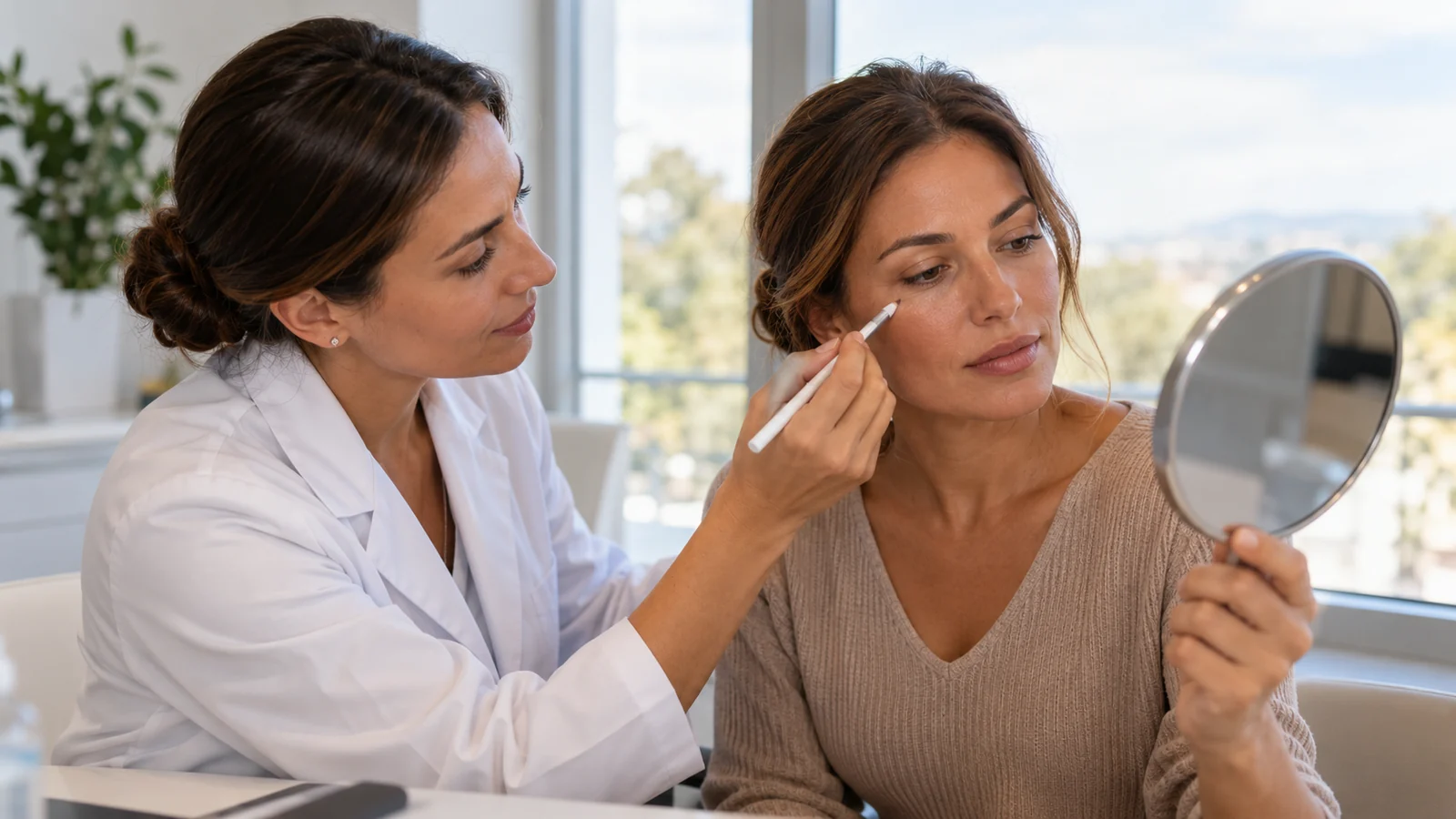
Begin with the change you want. You may want a softer frown between your brows, movement in your forehead when speaking on camera, or less prominent lines at the outer eye corners. A proper conversation about an individual result requires looking at your face at rest and in motion. A deep line visible even when your face is relaxed may not disappear fully when a muscle relaxes: an injection acting on facial movement cannot by itself reverse a crease already established in the skin.
| Criterion | What to establish | What not to rely on |
|---|---|---|
| Product | Exact brand, active substance, origin, batch and expiry date | An unidentified “premium Botox” label |
| Regulatory position | Status of the specific product and indication in the country of treatment | “Approved in the US” as proof of registration in Armenia |
| Plan for your face | Which muscles will be relaxed, how desired expression will be preserved, and how heavy-looking brows will be avoided | An identical injection map for every face |
| Practitioner | Relevant medical qualifications, experience, complication-management procedure and follow-up | Follower counts or attractive photos alone |
| Cost | Whether the quote includes the product, amount used, assessment and possible adjustment | Directly comparing prices per “unit” across different brands |
Botox, Dysport, Xeomin and others: why is there no fair overall winner?
Well-known international products include Botox Cosmetic (onabotulinumtoxinA), Dysport (abobotulinumtoxinA), Xeomin (incobotulinumtoxinA), Jeuveau (prabotulinumtoxinA-xvfs), and Daxxify (daxibotulinumtoxinA-lanm). These are examples of products used internationally, not a verified list of products available in Yerevan. Each has its own product information, authorised indications, preparation and dosing instructions, and research base. Evidence for one brand, facial area or age group cannot automatically be transferred to another.
Potency units of different botulinum-toxin products are not interchangeable. The US Botox Cosmetic label explicitly warns that its units cannot be directly converted to units of another product using a convenient ratio. “You will need exactly the same number of units of a different product” is therefore not a sound assurance without a product-specific clinical plan. Some brands have been studied for a longer duration of effect in particular indications; differences between study designs and individual responses mean this is no guarantee of an advantage for you.
The formulation deserves a precise conversation too. The absence of certain complexing proteins in one product does not alone prove greater safety, an absence of antibodies or a consistently more natural result. Head-to-head evidence on duration, spread and immune responses has limitations and does not establish a universal ranking as of October 2026. For your treatment area, product-specific instructions and the clinician's careful assessment matter more than promotional star ratings.
When will the result look natural—and when might it not?
“Natural” does not necessarily mean “as little change as possible”. You might prefer to keep an expressive look of surprise, even if forehead lines remain visible, or choose a smoother forehead with less movement. Either preference is valid and worth discussing before injections. A conservative approach sometimes gives a less dramatic effect; it cannot promise to eliminate asymmetry but does avoid pursuing total immobility as the goal.
Brow position depends on several muscles working together. That is why “just inject my forehead” is not always the best plan: the clinician must check whether your forehead muscles help hold your brows up. Existing hooded eyelids, small asymmetries and a habit of raising the eyebrows also matter. The precise plan and risks require an in-person assessment, not just a phone photograph.
What will people notice afterwards, and when should you judge the effect?
The injection appointment is usually brief; it can feel like a series of small pinpricks. Tiny puncture marks, tenderness or mild swelling may be visible over the first hours. A bruise may remain noticeable for roughly a week even if you need no time off work. A medical break is often unnecessary for office work, but before a wedding, important photographs or a presentation, allow time both for the effect to develop and for any marks to settle. Avoid scheduling injections the day before.
According to the American Academy of Dermatology, many people first notice a difference within 3–7 days; the clinician will generally assess the result later, when the effect has developed. For Botox Cosmetic, the US prescribing information describes an effect on frown lines of approximately 3–4 months. Duration differs by person, product and treatment area, so it is not a fixed expiry date. Do not arrange an extra injection yourself just because you can still frown on day two.
Follow your own clinician's aftercare plan. Patients are generally advised not to rub the injection areas; advice on makeup and exercise depends on the procedure and clinician. The AAD says most routine activities can be resumed immediately and advises avoiding strenuous exercise for the first two hours. If your clinician gives more restrictive personalised directions, follow those instead.
When should you put even a well-known brand on hold?
Injection is contraindicated when there is an infection at the planned site or a known serious allergy to the product or its ingredients. Neuromuscular transmission disorders, swallowing or breathing difficulties, and certain antibiotics, muscle relaxants and other medicines call for particular medical caution. Tell the clinician about earlier botulinum-toxin treatments, even if a different brand was used or the injection was for a medical rather than cosmetic purpose.
For Botox Cosmetic, adequate human data on pregnancy risk are lacking; information on transfer into breast milk is limited, although small studies of onabotulinumtoxinA during breastfeeding have been published. For an optional cosmetic procedure it is reasonable to postpone treatment and discuss your circumstances with your clinician. This is not evidence that an exposure which has already happened will necessarily harm a baby, but it does not justify a blanket promise of safety either.
Temporary drooping of a brow or eyelid, uneven expression, tenderness and headache are possible. Breathing, speech or swallowing difficulty, double vision or unusual generalised muscle weakness following injections requires immediate medical attention. These symptoms are listed in serious warnings for botulinum toxin products; a “cosmetic dose” is not a reason to dismiss them.
What should you ask at a trustworthy consultation?
Ask for the exact product name and packaging, and how its origin and local eligibility for use have been checked. Discuss precisely which lines may improve, which may stay, and what you can expect to happen to your smile and brows. Ask what the clinician will do if an eyelid droops, marked asymmetry occurs or the effect disappoints, and whether a follow-up assessment is included.
You can ask to see that clinician's results in people with similar facial movement, using comparable lighting and expressions—not as a guarantee but as a way to discuss the range of possible outcomes. Avoid “secret cocktails”, unnamed products, injections at parties and appointments with no medical history taken. A respectful clinician gives you time to decide rather than insisting that all age-related changes need treatment.
If botulinum toxin is not the right choice for now
If maximum facial movement matters to you, choosing no injections is perfectly reasonable. You could use skin care and sun protection or discuss methods aimed at skin quality. Skin care does not relax expression muscles as botulinum toxin does, so it will not reproduce the same effect on dynamic wrinkles. But it may be sufficient if your goal is comfortable skin, rather than reducing muscle movement.
If the main concern is a deep line visible at rest, changes in facial volume or loose skin, ask why toxin alone would or would not address it. Other procedures also carry risks: declining injections should not automatically lead to pressure for a more invasive treatment. The best decision is one whose likely changes, limitations and risks you understand before agreeing—even if your decision is to wait.
Additional questions
Can a photograph of a branded vial prove authenticity?
No. A photograph of the label cannot establish the supply chain or storage conditions. Ask how the origin, batch and documentation of the actual product to be used are verified.
Can an unwanted botulinum-toxin result be “neutralised” immediately?
There is no specific cosmetic procedure that instantly reverses the action of botulinum toxin. An adverse result needs examination and a follow-up plan; do not try to “dissolve” it yourself.
If a product has worked well before, should I switch brands for a new release?
Not necessarily. Changing only makes sense when there is a clear clinical reason, relevant evidence for the particular product and an agreed plan—not merely because a newcomer is heavily advertised.
Sources
- FDA: Botox Cosmetic prescribing information (US, revised 2024).
- American Academy of Dermatology: Botulinum toxin therapy, FAQs.
- American Academy of Dermatology: Botulinum toxin therapy, overview.
- DailyMed: Daxxify prescribing information (US, 2026).
- DailyMed: Dysport prescribing information (US, 2024).
- FDA: Xeomin prescribing information (US, 2024).
- DailyMed: Jeuveau prescribing information (US).
- Systematic review comparing botulinum toxin A formulations (PubMed).
- LactMed: botulinum toxins during lactation, 2026 update.