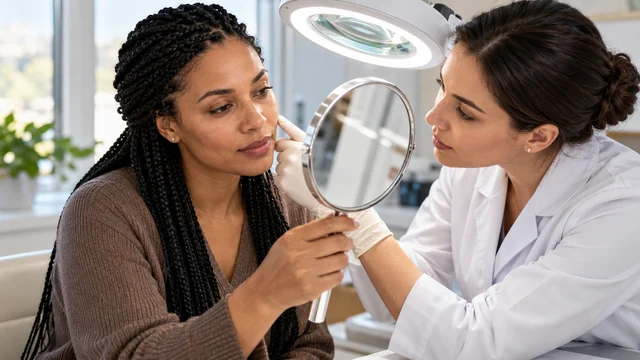

Mesotherapy Before and After: What Really Changes in Photos
You are looking at “mesotherapy before and after” photos and wondering whether your skin might become smoother, look fresher and feel less dry—and whether other people will notice the treatment. In short, some injectable formulations can improve hydration and certain measures of skin quality, but results depend on the exact formulation, injection technique and starting skin condition. Photographs alone cannot justify promises of a dramatic lift, disappearance of deep creases or a changed facial outline. A picture taken immediately after the injections cannot show the final cosmetic outcome.
“Mesotherapy” covers different treatments: multiple superficial injections of products that may contain hyaluronic acid, amino acids and other ingredients. The same word is sometimes applied to microneedling, even though its technique and evidence are not equivalent. That is why the first question is not merely which service is advertised, but precisely which product will be injected and for what purpose. Research on certain hyaluronic-acid products is encouraging; it does not establish that every offered cocktail works.
What can genuinely change in a before-and-after photograph?
| The concern | What you can reasonably assess | What photographs cannot prove |
|---|---|---|
| Dryness, tightness and uneven texture | Some studies of specified injectable products found measurable improvements in hydration; visible improvement may be subtle. | That every form of mesotherapy will hydrate skin or deliver the same effect. |
| Fine lines associated with dryness | Lines may look softer when hydration improves and temporary swelling has resolved. | That deep expression lines and etched wrinkles will disappear. |
| Pores, acne marks and uneven tone | Visible texture needs consistent lighting and longer follow-up; the right method depends on the type of change. | That scars, melasma or persistent pigmentation respond to any injectable cocktail. |
| Volume loss and pronounced sagging | An image may show the outline only when the shooting conditions match. | That superficial microinjections can replace volume restoration or lifting procedures. |
A practical detail: first impressions can mislead. Mild puffiness temporarily smooths contours, while dehydrated skin looks more wrinkled under different lighting. If the “after” face is simply shinier because of cosmetics or photographed closer to a window, that is not proof of a clinical effect. A modest improvement need not make you look like a different person; for many people, this is exactly the desired outcome.
How do you distinguish a fair comparison from clever photography?
Ask to see photographs taken at clearly stated intervals rather than the two most contrasting frames. Pose, expression, camera distance, lens or phone mode, lighting direction, makeup and ideally time of day should match. For the forehead, the muscles should be equally relaxed; for the cheeks, the smile should not change; when assessing texture, filters and digital smoothing must be absent. Dates since the last session matter more than dramatic captions.
The most useful record has three stages: a baseline photo before treatment, a separate record of the initial healing phase, and a comparison photo after healing at an agreed follow-up point. If there was a series of sessions, record exactly what treatment was used and when the last session took place. Otherwise, an injection reaction may be mistaken for a product effect. Keep your own photographs under consistent conditions and avoid exaggerating contrast; even a fair comparison cannot identify which ingredient in a mixture produced a change.
A selection of only the most successful examples has another weakness: it does not show how many people experienced barely visible changes or stopped treatment. Ask whether peels, laser procedures, retinoids, fillers or changes to home skincare were used at the same time. With multiple interventions, the improvement cannot be attributed to mesotherapy alone.
When can you assess your face, and when should you avoid scheduling a photo shoot?
Immediately after multiple microinjections there may be small bumps at injection sites, redness, tenderness and pinpoint marks. Bruises sometimes appear and can be more conspicuous than the intended effect. For some people these signs are barely visible; for others they last longer. There is no universal day on which everyone looks fully recovered: the area, technique, product properties, tendency to bruise and individual healing all matter.
| Time point | What may be visible | What this helps you assess |
|---|---|---|
| The day of injections | Redness, puncture marks, papules (small raised bumps), sometimes swelling. | Document healing, not the final aesthetic result. |
| The following days | The marks change gradually; a bruise does not disappear on a fixed timetable. | Decide whether you feel comfortable going out without concealing makeup or should reschedule an event. |
| After the reactions settle, at the agreed review | Texture and hydration are easier to compare without the distortion of temporary swelling. | Compare with baseline and discuss whether there was any meaningful benefit. |
If you have a meeting, celebration or professional photo shoot, leave a reasonable buffer rather than assuming that a lunchtime procedure will mean flawless skin by evening. Do not put makeup over fresh punctures unless the clinician allows it; ask for written guidance about when to resume familiar products. Pain is often felt as repeated pricks or stinging, but depends on sensitivity, the area and anaesthesia. Tell the clinician in advance if injections are difficult for you; there is no reason to suffer in silence.
What does research show—and why is it not a guarantee?
A randomized study published in 2026 reported better hydration and elasticity with a particular sodium-hyaluronate and amino-acid solution than with no injection treatment. This supports the studied formulation and protocol, not all products marketed as mesotherapy. Its control group received no injections, so expectations and the procedure itself could account for some differences. Follow-up was limited, and the study was funded by a manufacturer; independent confirmation is important. An earlier review instead stressed the weakness of evidence for mesotherapy as a broad category. These findings differ partly because unlike products and methods share the same name.
There is another side to the comparison: the trial of this particular formulation reported cases of darker skin patches (hyperpigmentation) and an allergic reaction. The absence of severe complications in the study group does not mean that every injectable product carries zero risk. If a new pigmented mark appears after treatment, do not automatically call it expected “skin renewal” or disguise it by changing the light in photographs; discuss it with your clinician.
Do not confuse a cosmetic trial with legal authorization for a specific product in a specific country. A published paper, supplier certificate or the words “hyaluronic acid” do not by themselves prove that a product is registered and permitted for the proposed injection route in Armenia. Before consenting, ask for the exact trade name, full ingredients, origin, registration information and manufacturer instructions. Do not agree to an unidentified mixture presented in a syringe without accessible information about what it contains.
When is a different approach more appropriate?
If your primary goal is to reduce pronounced expression wrinkles, improve pitted acne scars, treat melasma or restore lost volume, mesotherapy photographs do not answer the treatment-choice question. A suitable basic skincare routine and sun protection, medical treatment of a skin condition, a different procedure—or no procedure for now—may be more useful. The decision depends on the diagnosis and your willingness to accept risk, not on attractive photos online.
With an active infection, inflamed lesions at the planned injection sites or significant illness, injections should not go ahead without medical assessment. Pregnancy and breastfeeding call for particular caution: reliable safety data are missing for many aesthetic mixtures, so elective injections are usually deferred and discussed with a doctor. Disclose prior allergic reactions, medications affecting clotting, medical conditions and a tendency to prominent scarring. Do not stop prescribed medication on your own for a cosmetic treatment.
Every injection breaches the skin barrier. Sterile single-use equipment, aseptic product preparation and a suitably medically qualified practitioner are essential. If redness spreads instead of fading, the skin becomes increasingly hot and painful, or pus, fever or marked illness develops, seek prompt medical assessment; this is no longer a photo-comparison issue. Sudden breathing difficulty or signs of a severe allergic reaction require emergency help.
Questions to bring to your consultation
- What single measurable goal have we chosen—hydration, texture or something else—and how will we decide whether continuing makes sense?
- What is the exact product, and what supports its effectiveness and safety for this particular injection technique?
- Can we discuss real examples photographed in matching conditions with known follow-up periods, including modest results?
- Which marks and restrictions should I expect, and when may I wear cosmetics, exercise and go into the sun?
- What should I do if a reaction occurs, and how can I reach medical staff afterwards? What could I choose if I decline?
A good decision may be modest: agree on how to measure change, start with understandable skincare and consider injections only afterwards. Compare the option that suits you, including its limitations, rather than someone else's “perfect” photos. For broader indications see the mesotherapy overview; for seasonal timing see Mesotherapy in summer.
Frequently asked questions
Can I ask that my photographs not be published?
Yes. Photographs for clinical follow-up and consent to public publication are separate matters. Ask which images are needed for monitoring, who can access them and whether you can refuse advertising use.
Why might one side of the face look different from the other?
Faces have natural asymmetry; slight swelling, the direction of light and a change of head position can accentuate it. New or worsening painful asymmetry after a procedure needs medical assessment rather than being blamed on photography alone.
Should I repeat injections immediately if the improvement seems small?
No. First wait until the agreed assessment point and review the original goal and exact formulation. Repeating injections without examining the benefit adds interventions without guaranteeing a visible result.