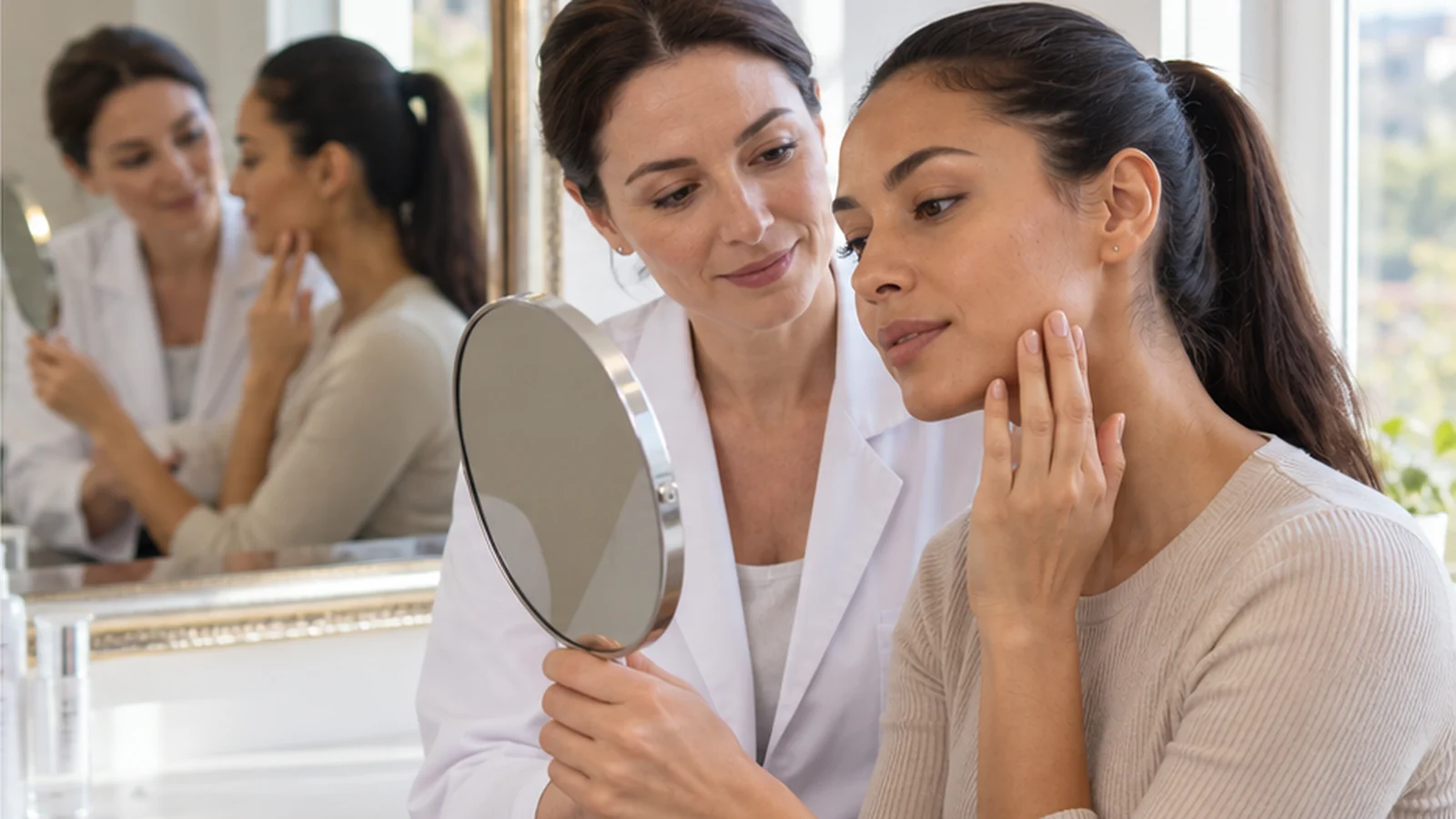

Mandelic Peel During Pregnancy: Why It Is Better to Wait
If dark patches, breakouts or an unfamiliar dull appearance have developed during pregnancy, a “gentle” mandelic acid peel may sound appealing. The practical answer is to postpone an elective professional mandelic acid peel until after pregnancy. In the pregnancy-related reviews checked through October 2026, there is not enough direct safety evidence specifically for professional mandelic acid peels. “Superficial,” “natural” and “mild” do not substitute for that evidence. This does not mean that an accidental exposure necessarily harms the baby; it means an optional cosmetic procedure does not justify taking a poorly studied risk.
There is an important difference between everyday skin care with a small amount of acid and a professional procedure in which a more concentrated formula is applied to prepared skin. They should not be treated as equivalent exposures. For persistent pigmentation or significant acne, rather than choosing a peel at random, discuss the symptoms with a dermatologist and the clinician managing your pregnancy. If pregnancy is possible but not yet confirmed, tell the clinician before booking; clarify your situation before choosing a peel date.
Why mandelic acid is not the same as proven safety
Mandelic acid is an alpha-hydroxy acid (AHA), an ingredient that helps shed cells from the skin's surface. In aesthetic practice it is used for uneven texture and some superficial marks. However, evidence about other acids cannot automatically be applied to mandelic acid: the formula, concentration, acidity, contact time, treated area and condition of the skin barrier all differ.
Reviews of cosmetic procedures during pregnancy cautiously describe some superficial glycolic and lactic acid peels as potentially acceptable after individual assessment. Those judgements rely mainly on low penetration and indirect evidence, not large clinical trials in pregnant people. They do not separately establish that professional mandelic acid peels are safe. Saying “all AHAs are approved during pregnancy” would be an overgeneralisation.
There is another consideration: skin may become more sensitive during pregnancy, and melasma—uneven pigmentation influenced by hormonal changes—may appear or intensify. Irritation after a peel can leave additional dark marks, particularly if you are prone to post-inflammatory hyperpigmentation. Even when someone else has had an even result, that does not predict yours.
What to do in your situation
| Situation | Reasonable next step | Why |
|---|---|---|
| You are pregnant and considering your first peel | Postpone the optional procedure and use gentle basic skin care | Direct pregnancy safety data for a professional mandelic peel are insufficient |
| Your peel was booked before you knew you were pregnant | Tell the provider before the session and reschedule | The ingredients and protocol can be reconsidered without unnecessary exposure |
| You already had a peel without knowing you were pregnant | Do not panic; keep the product name, concentration and date, and discuss them with your obstetric clinician | A lack of studies is not proof of harm; the individual exposure should be assessed using the facts |
| You have painful inflammation, a widespread rash or rapidly changing patches | See a dermatologist for diagnosis and pregnancy-compatible treatment | A cosmetic procedure is no substitute for diagnosis |
| You are breastfeeding | Do not equate lactation with pregnancy; discuss the specific product and treated surface area with a clinician | Theoretical systemic risks and the baby's contact with treated skin need separate consideration |
Melasma, spots and dryness: one peel cannot solve everything
If brown patches bother you: first determine whether they are melasma, marks left by inflammation or a different kind of pigmentation. Melasma is related in part to hormones and sunlight; some changes may fade after childbirth, but complete clearance cannot be promised. Aggressive exfoliation is not guaranteed to lighten patches and can sometimes make them worse. A better starting point is sun protection you can consistently follow every day.
If you have developed acne: controlling inflammation matters more than achieving a “polished” feel. The American Academy of Dermatology and ACOG discuss azelaic acid as a possible topical option in pregnancy, but the regimen, strength and other products should be agreed with a clinician. Do not replace prescribed acne treatment with an acid procedure or combine several active formulas on your own.
If your skin is tight and flaky: a peel may worsen the discomfort. A mild cleanser, plain moisturiser and sun protection often address the immediate problem better. If cracks, weeping, intense itching or eruptions appear, get examined first: what looks like “dry skin” may be dermatitis.
Care for the coming weeks instead of a peel
In the morning, gently cleanse if needed, apply moisturiser and a broad-spectrum sunscreen with SPF 30 or higher . If you are sensitive to irritation, ask a dermatologist about mineral filters containing zinc oxide or titanium dioxide. Shade, a hat and avoiding deliberate tanning matter as much as sunscreen: sunlight can aggravate pigmentation.
In the evening, do not compensate for skipping a peel by adding a scrub, cleansing brush and “active” serum at once. Keep cleansing and moisturising simple; if acne medicine is needed, select it with your doctor. Products containing retinoids, including retinol and tretinoin, should be avoided during pregnancy. Check products containing hydroquinone separately. A particular acid percentage in an at-home formula does not by itself make the product safe: instructions, combinations and your skin's response matter too.
If you have a photo shoot or family celebration coming up, this calmer routine is especially practical: it is less likely to produce unexpected irritation over the following days. The realistic aim is skin comfort and barrier support, not instant removal of patches. Makeup can be used as tolerated if the skin is intact and not inflamed.
What if you have already had the peel?
Assess the actual circumstances instead of assuming danger from the name of the acid: the date, gestational week, treated site, concentration, number of applications, whether other acids or retinoids were included, how the product was removed, and whether irritation occurred. This information lets your obstetric clinician and dermatologist decide whether any follow-up is needed. Do not try to “neutralise” an already completed peel with another acid or harsh cleansing.
Brief mild stinging or moderate redness can occur after a superficial peel, but it is not possible to distinguish an ordinary reaction from a developing chemical burn remotely. Severe or increasing burning, blisters, marked swelling, pain, weeping or signs of infection require prompt medical assessment; breathing difficulty, fainting or rapidly increasing facial swelling require emergency help. Do not pull off peeling skin if it is damaged.
Can you reconsider the peel after giving birth?
After delivery, the decision depends on more than the date: whether you are breastfeeding, how well your skin has recovered, whether melasma or sensitivity persists, and which products you are using. Lactation is not the same as pregnancy: many topical exposures are expected to produce little systemic absorption, but direct research specifically on professional mandelic peels during breastfeeding remains limited. Do not treat breast or nipple skin, and prevent infant contact with a product that has not been rinsed away. Have a clinician assess the exact formula before deciding.
If you want to revisit peeling, first ask the specialist to identify the diagnosis and goal: reduce comedones (blocked pores), improve superficial marks or treat persistent melasma. Then discuss the product, acidity and concentration, number of passes, the plan if irritation occurs and pigmentation risks for your skin type. A separate article, Mandelic peel before and after , explains potential visual changes; Mandelic peel in summer covers seasonal issues. During pregnancy, the priority remains whether the intervention is necessary, not how dramatic the result might be.
Questions to ask before agreeing to a procedure
- Why do I need this particular peel now, and can I postpone it without medical consequences?
- Is there evidence for the safety of this product and entire protocol in my situation, not merely the acid as an ingredient?
- Does the mixture contain salicylic acid, resorcinol, retinoids or any other ingredients that change the risk assessment?
- How did you distinguish melasma from other pigmentation, and what would you do if it worsened?
- What might my skin look like after one day and one week, and whom do I contact if irritation becomes severe?
If these questions cannot be answered clearly, declining or rescheduling is reasonable. A cosmetic procedure can wait; caring for your skin during pregnancy is no less worthwhile without it.
Frequently asked questions
Does “enzyme peel” mean there are no restrictions?
No. Products described as “enzyme” vary in formulation, acidity and additional active ingredients. Check the specific product, not just the category name.
Is any trimester considered safe specifically for mandelic peels?
The direct evidence is insufficient to declare any trimester safe for an elective professional mandelic acid peel. Simply rescheduling to the second trimester does not replace assessing whether it is needed.
Can I patch-test a small area myself and then have the peel?
A patch test may identify certain local reactions, but it cannot establish pregnancy safety and does not replace medical advice.
Sources
- Kovacs et al., Cosmetic Dermatology in Pregnancy and Lactation, 2026 — risk–benefit appraisal of cosmetic procedures.
- A review of the safety of cosmetic procedures during pregnancy and lactation, 2017 — limitations of the evidence on peels.
- American Academy of Dermatology: pregnancy skin care — everyday routines and ingredients.
- ACOG: Skin Conditions During Pregnancy — acne treatment choices in pregnancy.
- American Academy of Dermatology: Chemical peels FAQ — recovery and possible reactions.