
Temporal Lift Before and After: How to Evaluate the Photos
You are comparing photographs labelled “temporal lift before and after”, wondering why some eyes look a little more open while others appear to have a very different outer brow shape. A surgical temporal brow lift generally aims to raise the outer eyebrow and nearby temple tissues. It does not promise identical “fox eyes”, removal of every wrinkle or someone else’s face. Your initial brow position, upper eyelid skin, anatomy and technique all influence the outcome. Early photographs may show swelling and temporary over-elevation rather than the final result.
What is actually supposed to change afterwards?
“Temporal lift” is used for different procedures. Surgically, it generally means elevation of the lateral (outer) part of the eyebrow and tissue near the temple, often using an incision along or within the hairline. A complete forehead/brow lift addresses a broader area, while thread techniques marketed using similar language are not the same operation. Before judging a gallery, ask exactly which procedure was performed, whether it involved skin removal and whether there were additional interventions.
With suitable anatomy, the outer eyebrow may sit higher and the fold of skin above the outer corner of the eye may seem lighter. The gaze may look more open without a major expression change. But the inherent shape of the eyes, the inner eyebrow position and excess upper-eyelid skin will not necessarily change much. A temporal lift is not a whole-face lift, eyelid surgery or treatment for skin texture.
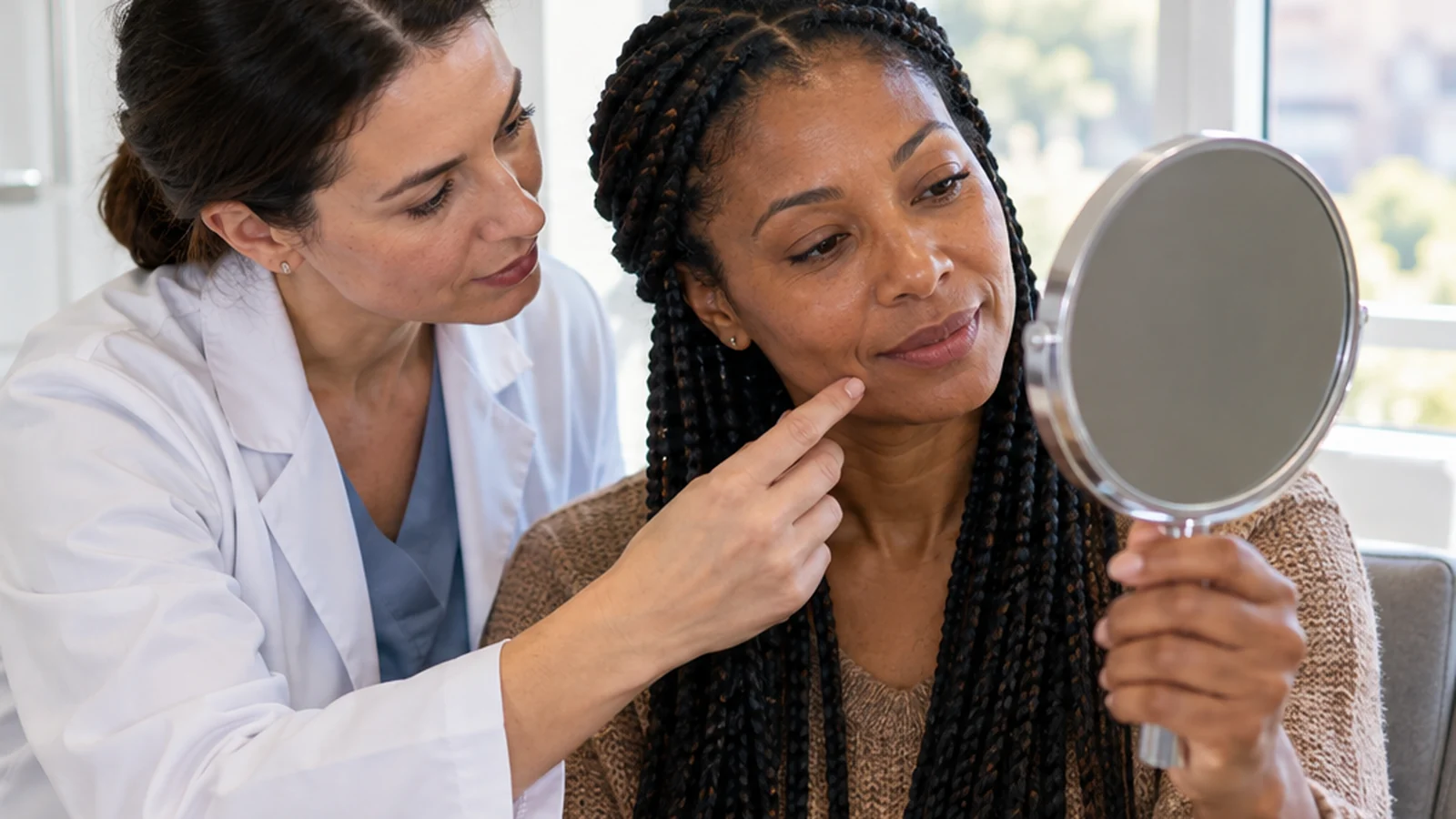
Ask the surgeon to demonstrate in the mirror what is actually descending: the brow or the eyelid skin. That distinction influences whether brow lifting, blepharoplasty (eyelid surgery), a combination or no surgery is appropriate. If fine skin wrinkles are your chief concern, moving the eyebrow may solve the wrong problem. The broader brow-lift decision belongs to a separate article. Related article.
Five signs of trustworthy before-and-after photographs
A useful photo pair lets you compare the brow's position relative to the eye rather than just make-up. Seek straight-on images and comparable three-quarter views with the same head tilt, relaxed forehead and no raised eyebrows. Lifting the chin or changing facial expression can make brows look different even without surgery.
| Photographic detail | What to look for | What it cannot establish |
|---|---|---|
| Outer brow tail | Change relative to the outer corner of the eye. | That the same lift angle would suit you. |
| Expression and gaze | Is the forehead equally relaxed; is the person squinting? | That surgery caused every difference in expression. |
| Time since surgery | Was “after” taken once swelling had substantially improved? | That an initially very high brow will remain so. |
| Make-up, eyelashes, light | Are eyeliner, brows, lighting and retouching comparable? | That the whole visual effect is due to lifting. |
| Other procedures | Were blepharoplasty or other operations done as well? | That all the change comes from the temporal lift. |
A series featuring several people with comparable original brows is more useful than one dramatic pair. But photographs cannot convey scalp sensation, pain, dry eyes, scars within the hair or satisfaction years later. A review captures a person's experience; the actual photographic comparison and technique need discussion with the surgeon. Reviews are a separate question from image evaluation. Related article.
When to assess the result without being misled
Swelling, bruising, tightness, temporary numbness and tenderness may follow surgical brow elevation. In the first few days the face can seem unfamiliar, partly because of swelling or asymmetry. That does not prove the final brow angle will be the same. However, marked or worsening changes should not be dismissed as “normal healing” without contacting the surgical team.
The American Society of Plastic Surgeons describes roughly 10–14 days as a general guide to initial healing and possible return to routine activities after brow lift, while noting that recovery and swelling continue for weeks or months. A limited temporal approach may differ; the broad figure is no guarantee for any particular surgery. Agree your own recovery plan with the operating surgeon.
| When taken | What it may show | How to interpret it |
|---|---|---|
| First few days | Tissue position with swelling, surgery marks and bruising. | Not proof of the final shape. |
| Early weeks | Swelling gradually settling, residual asymmetry and visible scars. | An intermediate stage only. |
| Following months | More stable brow position and evolving scars as tissues settle. | Compare with baseline images and the surgeon’s examination. |
You may be ready for a work meeting before you look fully recovered. If professional photography, a wedding or travel is coming, plan not only for a possible return to desk work but also for bruises, swelling and marks near the hairline that may remain visible longer. Do not conceal unhealed incisions with make-up or restart exercise without the surgeon's approval. Sleeping position, hair washing, exercise, heat exposure and follow-up are specified individually.
A natural expression or a noticeable lift: understanding the trade-off
Sometimes your goal is only to soften hooding above the outer upper lid; sometimes it is a strongly raised brow tail. A more dramatic change makes the possibility of an unfamiliar expression, asymmetry or mismatch between the two sides more important to discuss. Even apparently symmetrical lifting does not necessarily look symmetrical in conversation or smiling, because muscles and facial bones were not mirror images to begin with.
At your consultation, describe the effect rather than a fashionable eye shape: “I want a little more space between my lashes and outer brow”, or “I don't want my expression to change”. Ask the surgeon to mark a reasonable change without excessive tension. A photo simulation, if used, illustrates an idea rather than guaranteeing an outcome; the mirror and clinical examination matter more than digitally altered proportions.
A temporal lift does not stop further ageing. Brow position can change over time even after a durable result. You cannot predict a precise duration or the need for revision from age and one photograph. If you are happy with your current appearance and only considering surgery because of someone else's gallery, it is reasonable to wait.
Risks a beautiful photograph cannot show
This is an operation, not a skincare treatment. ASPS brow-lift guidance lists bleeding, infection, unfavourable scarring, asymmetry, changes in sensation, hair loss near incisions, dry or irritated eyes, facial nerve injury affecting movement, and possible revision. Anaesthetic risks and blood-clot complications are also possible. Your risk depends on the operation, health and personal factors, not on an image gallery.
Prepare a list of medicines and supplements. Tell the surgeon about smoking, poor healing, eye conditions and previous facial surgery. They should assess health, brow and lid position, incision placement, anaesthesia, possible scars and postoperative care. Elective surgery during pregnancy or other higher-risk circumstances requires separate medical evaluation; cosmetic surgery should not be treated as a routine, unrestricted service.
Increasing asymmetry together with pronounced muscle weakness, severe or worsening pain, sudden painful swelling, active bleeding, pus or fever require urgent contact with the surgical team. Visual changes, severe eye pain, breathing difficulty or chest pain require emergency medical attention. Ordinary minor puffiness is no reason to ignore these warnings.
Which alternatives should you compare?
If you want only a modest, temporary change in eyebrow position, a clinician may discuss non-surgical options such as botulinum toxin injections. Their effects and restrictions differ from surgery, and eye-area treatment requires appropriate expertise and contraindication assessment. If the real problem is excess skin of the upper lid, blepharoplasty may be discussed. Threads, injections and surgical fixation differ in durability and risk; similar appearances in early photographs do not make them equivalent.
Ask for a demonstration of the difference between “raise the brow” and “remove extra lid skin” on your own face. Ask whether a less invasive approach or no treatment is reasonable. Visual-field complaints, dry eyes or other functional problems deserve appropriate medical assessment, not a cosmetic promise to “open the eyes”.
Seven questions to take to the photo gallery at your consultation
- What exactly is meant by “temporal lift” here: surgery, threads or another method?
- Are the original brows in these photos like mine, and do you have comparable cases without combined surgery?
- When were the “after” photographs taken, and is longer follow-up available?
- Where will the incisions be, how could scars look, and might the hairline change?
- What degree of lift will look natural on my face, and what can be revised if I dislike it?
- What are my risks to skin sensation, eyebrow movement and the eyes?
- When could I go out without hiding marks, resume exercise and get help if something goes wrong?
The main point: before-and-after photographs are useful for discussing a specific possible change to the outer brow and what achieving it might cost, not for promising you the same eyes. Choose only after an in-person assessment by a qualified plastic surgeon, not from the most flattering angle.
Frequently asked questions
Can a temporal lift make my usual glasses uncomfortable?
Temporary tenderness around the temple and pressure from spectacle arms near the incisions may make glasses uncomfortable. How soon you can wear them comfortably again depends on incision placement and healing; ask the surgeon before the operation.
If one brow starts higher, will surgery make them identical?
An exact match is not guaranteed. Existing differences may reflect bones, muscles and eyelid anatomy. Document them before surgery and discuss what degree of improvement is realistic.
Sources
- American Society of Plastic Surgeons — Brow lift: results
- American Society of Plastic Surgeons — Brow lift: recovery
- American Society of Plastic Surgeons — Brow lift: risks and safety
- American Society of Plastic Surgeons — Brow lift consultation
- American Society of Plastic Surgeons — Brow lift vs forehead lift (2024)