
Attiva Before and After: Which Changes Are Plausible
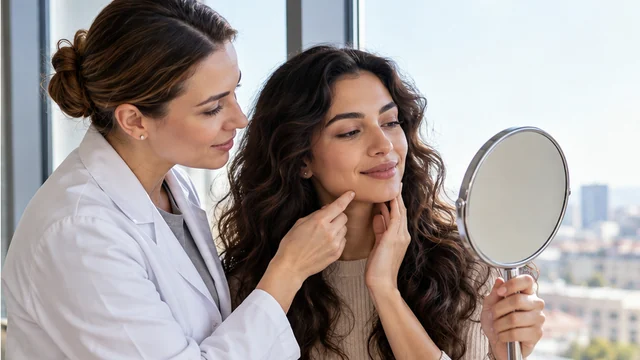
You are looking at Attiva before-and-after photographs and wondering whether your jawline could become more defined without surgery. Subdermal radiofrequency treatment might produce moderate tissue tightening, but these images cannot justify a promise of a surgical-facelift result. What happens depends on skin laxity, the amount of fat beneath the skin, the area treated and the technique. Promotional photographs cannot tell you how much of the change came from Attiva rather than swelling, lighting, head position or another intervention.
An important distinction is often omitted from galleries: Attiva is not a cream or a superficial facial treatment. In aesthetic practice, it is described as delivering radiofrequency energy through an instrument inserted beneath the skin. This is a minimally invasive heat-based intervention. Ask how well the particular desired outcome is supported, which risks are involved, what recovery looks like and who will manage complications.
Which changes in an “after” image are plausible—and which are doubtful?
Heating deeper tissues can produce contraction and later remodelling, or changes in tissue structure. Reviews of radiofrequency treatment describe changes in some measures of firmness and contour, but devices, delivery techniques and study designs differ markedly. Evidence for RF treatments as a category is not direct proof of Attiva's outcomes, much less a guarantee of the size or duration of a benefit.
| Your concern | What might reasonably change | What a photo cannot establish |
|---|---|---|
| A slightly blurred jawline | A possible moderate change in soft-tissue appearance with suitable anatomy | That a lasting change occurred without swelling or additional treatments |
| Pronounced jowls and excess skin | Benefits may be limited; discuss surgical and nonsurgical options | That the device can replace a facelift |
| Local fullness below the chin | Clarify whether fat, muscle position, skin or a combination is responsible | That less fullness comes from skin tightening alone |
| Fine neck creases | Possible changes in texture and firmness that may vary across the area | That all creases will disappear without irregularities |
“Firmer skin” is not the same as “a lifted face.” Firmness may be perceptible to touch or in side lighting without much change in silhouette. Lifting often involves repositioning deeper tissues and is not equivalent to heating them. If you want to preserve familiar facial features, ask for the likely degree of change, not just a technology name.
How to read photos without buying a promise
A meaningful pair shows the same area, expression and posture with no filters. Chin position, neck tension, camera angle and distance matter particularly in the lower face. A slight tilt upwards or forwards changes the contour beneath the chin. Even lighting conceals texture while side lighting emphasises folds, especially on the neck.
Check the date and interval after the procedure. A very early photo may capture tissue response and swelling; one taken months later records another stage. If fillers, weight loss, threads, liposuction or surgery occurred between photos, you cannot isolate Attiva's contribution. Ask how the examples were selected: galleries often show successful cases rather than the full spread of results.
- Are matching front, side and three-quarter views available with a consistent head position?
- Are the interval after treatment, treated area and other procedures disclosed?
- Are natural skin texture, moving folds and any asymmetry visible?
- Are there several cases with anatomy resembling yours, not only the most striking one?
Without these answers, a photo may prompt questions but cannot predict your outcome. Take your own baseline pictures in consistent light to explain your priorities at consultation and compare later results without daily mirror checks.
When to assess the result rather than an early tissue reaction
As of October 2026, the reviewed sources do not establish one universally reliable timetable for Attiva of an instant result and a final result at a fixed number of months. Heating and healing are distinct processes. Early changes can reflect swelling and tissue response; later ones may reflect remodelling. The time involved depends on treatment extent and individual healing. Do not compare yourself with a stranger's one-week photo if your clinician has arranged a later assessment.
Request a plan for photographs and follow-up: when is the first safety check, when is healing reviewed and when is the aesthetic outcome judged? Timing should be individual; minimal early change should be discussed as a possibility. One early photo cannot demonstrate durability, and available heterogeneous research does not establish a universal length of effect for Attiva.
Is Attiva non-invasive, and what has been cleared by regulators?
“Without surgery” does not mean “without entering the skin” or “without risk.” Subdermal techniques may require local anaesthesia, a skin puncture and an instrument passing through tissue. Ask which model, technique and handpiece will be used; one mode cannot stand in for another. Pain, swelling, bruising, numbness or firmness can occur, to varying degrees. Serious risks reported with related subdermal RF methods include burns, contour irregularities, persistent lumps and nerve injury. Their reported rates cannot be assigned to Attiva.
The US FDA issued a 510(k) clearance K220505 for ATTIVA for electrocoagulation and haemostasis in adults—using energy to coagulate tissue and control bleeding. That clearance is not a separate FDA finding that cosmetic lifting with ATTIVA is effective. The manufacturer distinguishes US labelling from the CE-marked product presentation. This US document by itself establishes nothing about registration, availability or authorised indications in Armenia.
If lifting is proposed, ask for the exact model and settings, the legal and clinical basis for this use in your country and the limitations of available research. “FDA approved for lifting” without a document containing that indication should prompt questions, not automatic consent.
When to postpone, and what recovery might involve
Substantial excess skin, pronounced sagging, earlier surgery, fillers and threads in the area all warrant discussing other options because they change anatomy and treatment planning. The manufacturer lists pregnancy, fever and infection in the treated area as situations in which it should not be used. Other illnesses, medications, impaired healing, a tendency to marked scars and implanted devices need individual assessment against the instructions for the specific model. Never stop medication on your own.
Before a wedding, flight or presentation, do not confuse walking out of the clinic with appearing unchanged the next morning. Puncture marks, redness, swelling or bruises may remain. There is no well-supported universal “zero social downtime” for Attiva. Leave an individually justified margin of time or postpone.
Worsening pain, rapidly increasing swelling, spreading hot redness, discharge at puncture sites, altered facial movement or unusual numbness warrant urgent contact with the treating clinician. Trouble breathing, sudden facial weakness or another severe acute symptom needs emergency medical attention, not a wait until a scheduled photo appointment.
Attiva, another RF approach, or no treatment?
With modest contour concerns, observation, sun protection, skin care or adjusting expectations may be enough; treatment is optional. Surface RF does not involve a subdermal instrument, but its effects and durability are also limited and not interchangeable with Attiva. RF microneedling works differently and carries different risks. For considerable excess skin, talking with a plastic surgeon can help more than comparing dramatic galleries. Read our Endolift article for differences from another technology.
At consultation, ask to see a modest possible result as well as a successful one in someone with similar anatomy. Check the clinician's qualifications and experience with this exact device, anaesthesia, aftercare responsibility, warning signs and the plan if you are dissatisfied. Confirm whether follow-up appointments are included. Pressure to “decide today” is not a medical argument.
Attiva photographs can help define the range of possible changes and useful questions. They do not promise you will become the person in the “after” image. If no one can responsibly answer “how much will my own face change?”, choosing to wait remains entirely reasonable.
Further questions
Can symmetry be judged from one photograph?
No. Matching views at rest and, where appropriate, an assessment of facial movements are needed. Some asymmetry may be present naturally before treatment.
Why might two clinicians interpret the same gallery differently?
They may give different weight to skin firmness, head angle or contour, and to the uncertainty of photographic evidence. Ask what observable detail supports each interpretation.
Sources
- FDA: ATTIVA 510(k) K220505, indications for use.
- ATTIVA: technology and regional labelling.
- Rezapour et al.: endodermal RF systematic review.
- Swanson: subsurface RF review and evidence limitations.
- Austin et al.: RF face and neck rejuvenation review.