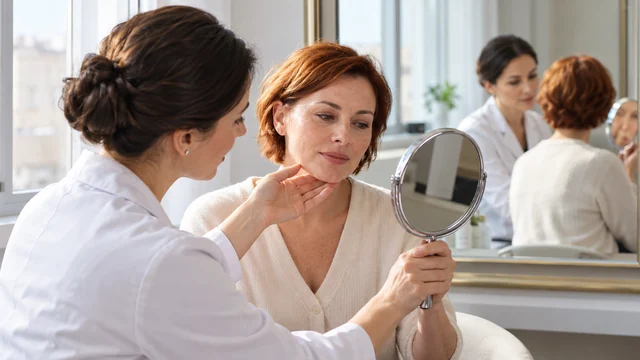
BioRePeel Benefits: Possible Gains and Limits of the Evidence
You may have heard that BioRePeel renews skin, shrinks pores, lightens marks and requires almost no recovery—all at once. The realistic possible benefit is an improvement in selected superficial texture and tone irregularities of the kind suitable chemical peels can provide, but these effects cannot be guaranteed for BioRePeel itself. Research on peels as a whole is much broader than independent evidence on this branded formulation. The more complex the concern—melasma, inflamed acne, prominent scars or deep folds—the more important it is to distinguish cosmetic improvement from treatment of a condition.
CMed Aesthetics describes BioRePeelCl₃ FND as a professional biphasic product for face, neck and décolletage containing 35% trichloroacetic acid (TCA) and other ingredients. A BODY formulation containing 50% TCA is intended for specified body areas. These are different products for different sites and should not be interchanged. The company describes exfoliating, hydrating and “biostimulating” effects. Biostimulation suggests activating processes in skin, but a marketing description of a mechanism does not establish clinically meaningful rejuvenation in an individual.
Which benefits are reasonable to discuss?
Separate three levels of evidence. First are composition and intended use according to the manufacturer. Second is research on acid peels as a broad treatment group. Third would be strong studies specifically of BioRePeelCl₃ FND, ideally including controls, standardised photographs, measured outcomes and recorded adverse effects. In the independent regulatory, professional and clinical material reviewed through October 2026, the third level does not justify promising a definite degree of improvement. Results from traditional TCA peels must not be presented as proven results of this particular two-phase formula.
| Potential benefit | What research on peels generally suggests | What BioRePeel should not be promised to do |
|---|---|---|
| More even texture | Superficial exfoliation can lessen roughness | Produce flawless skin or eliminate every pore |
| More even tone | Carefully selected peels can help some pigment disorders | Cure melasma or prevent all new dark marks |
| Less visible fine lines | Some peels soften the appearance of superficial lines | Act like a surgical lift or correct deep creases |
| Effects on acne | Certain acid peels can complement treatment for selected acne presentations | Treat every severity and type of acne with one branded product |
| Acne scars | Outcome varies with scar type and depth; combined methods may be necessary | Remove deep indented scars without other therapy |
| “Without visible peeling” | External reactions can be subtle after some procedures | Guarantee no redness, burn or social downtime |
This helps you discuss benefits without absolutes. For one woman, a slight reduction in roughness is worthwhile; for another who hopes to remove visible scars, the same effect is not enough. Neither preference is wrong. What matters is whether the goal, plausible benefit and risk align.
What does “biphasic” mean—and where does evidence stop?
Biphasic means that the preparation has water-based and lipid-based components. The manufacturer links this design to stability, moisturising and a particular skin effect. Yet a chemical peel still produces controlled chemical injury: response depth depends on acid concentration and acidity, application technique, number of passes, skin preparation and individual factors. Two phases do not prove that concentrated TCA has automatically become painless or exclusively superficial.
Instead of asking “Is the acid strong?”, ask “What depth of action do you expect on my skin, and how will you judge it?” A percentage alone cannot answer fully, but a proprietary-technology claim does not remove risk either. Studies of traditional TCA peels can provide background on the chemical category, not direct proof of this product's benefits or safety.
Be equally careful with “collagen”. Some peels lead to skin remodelling processes, providing a plausible biological explanation for surface changes. That does not prove that this branded procedure measurably boosts your collagen, removes pores or produces an effect for a predetermined length of time. Such claims require studies of the actual formulation using meaningful outcomes.
Whose expectations might reasonably match the potential benefits?
If you want a subtle refresh, not a different face
A peel may be worth discussing if your skin is generally healthy and you are concerned about mild roughness, scattered superficial marks or an uneven-looking surface. A natural result means your face still looks like yours; only some visible surface qualities may change. Even a small goal does not eliminate risk. Reactive skin, a damaged barrier and a history of dark marks after inflammation make results less predictable.
If you have breakouts and the marks they leave
A peel does not replace diagnosing and managing acne. Comedones (blocked pores) and inflamed lesions can require different treatment. Painful, active, scarring or suddenly adult-onset breakouts deserve dermatological assessment first. Some peels can supplement acne therapy, but BioRePeel is not thereby proven effective for every acne type. Brown post-inflammatory marks should not be confused with scars: pigmentation and structural indentations need different strategies.
If melasma or a darker phototype is your main concern
Melasma often relates to sunlight and internal factors, tends to recur and may worsen after irritation. If spots darken readily after acne or injury, discuss post-inflammatory hyperpigmentation before any peel. Relevant issues are your actual phototype, reaction history and inflammation, not nationality or stereotypes about appearance. A dermatologist may recommend sun protection, targeted topical pigmentation treatment or a gentler route.
If you want deep lines and depressed scars smoothed out
Change the question from “How many BioRePeel sessions?” to “What is causing what I see?” Muscle movement, volume changes, lower elasticity, structural scars and surface irregularities are different problems. Mild surface renewal will not necessarily address them. Dermatologists choose acne-scar procedures by scar type, not by starting with the name of a peel. A promise to erase deep defects with one acid without examination deserves a second opinion.
When might the risk outweigh the possible benefit?
Postpone peeling if there is an active skin infection, herpes lesions, open wounds, major sunburn or substantial irritation. A new or changing suspicious lesion needs diagnosis, not cosmetic lightening: peeling could delay assessment. Tell the clinician about previous keloids, unusual peel reactions, pigment disorders and other skin disease. This is not the product's definitive contraindication list: the current instructions for the precise formulation and an examination are essential.
Disclose retinoids, including oral isotretinoin, prescribed creams, acid serums, antibiotics and recent procedures. Do not adopt a one-size-fits-all medication break from social media: timing depends on the drug, condition being treated, skin state and product instructions. Stopping prescribed treatment on your own can worsen the underlying condition. Professional guidance does not support a blanket months-long delay after isotretinoin before superficial peels for every patient; this does not establish the safety of a particular BioRePeel protocol on every skin type. Agree on medication and aftercare changes with the prescribing clinician before consent.
For an elective TCA peel during pregnancy, the conservative course is to defer: direct safety evidence for this formula is insufficient. Breastfeeding needs a separate assessment rather than being automatically treated as pregnancy; the application site, skin condition and relevant medicines matter. Professional reviews emphasise gaps in evidence, not unconditional universal safety.
Buying a professional peel and repeating it at home to save money is not a safe substitute for care. The US Food and Drug Administration has warned about chemical burns and serious injuries from certain strong acid peel products used without professional supervision. That notice concerns certain marketed products and unsupervised use; it is not an independent finding about BioRePeel's registration in Armenia.
How should you compare potential benefits with alternatives?
For dryness, begin with tolerable cleansing, moisturising and consistent UV protection. Sometimes skin looks more even once its barrier recovers. For dark marks, a dermatologist may select topical therapies with better-established properties; for acne, treatment that prevents new lesions. An acid peel need not be the first step.
If you specifically want an in-clinic procedure, compare concrete factors rather than words like “biostimulating” and “revolutionary”: the target concern, supporting evidence for that protocol, expected depth, visible recovery and experience in people with your skin characteristics. A better-studied formula might suit your condition, or avoiding procedures might make more sense. Microneedling, lasers and other alternatives are not automatically safer: each has distinct indications, recovery demands and risks.
| Your main priority | A sensible first step | What to clarify before any peel |
|---|---|---|
| Dryness and tightness | Review skincare and the skin barrier | Could the acid make existing irritation worse? |
| Acne and fresh inflamed spots | Develop an acne treatment plan with a dermatologist | Is a peel needed at all, and at what point? |
| Post-acne dark marks | Identify pigmentation type and depth | How will the risk of new dark marks be reduced? |
| Deep folds or scars | Identify the underlying anatomical issue | Why should this method help it? |
| Even-looking skin for an event | Avoid unfamiliar irritating procedures just before the date | Is there enough time if recovery is unexpectedly visible? |
What happens on treatment day and afterward?
A chemical peel can sting or burn to varying degrees. A professional TCA formulation should not be described as guaranteed painless. Some people can resume normal activities, but skin healing and being socially unnoticeable are different. Redness, dryness or peeling may develop later. The American Academy of Dermatology describes about 1–7 days' healing after superficial peels and 7–14 days after medium-depth peels. These are class-level estimates, not personal BioRePeel predictions: without knowing depth and your reaction, the branded treatment cannot simply be assigned to either category.
For day-by-day considerations and makeup, exercise and sunlight, see the BioRePeel downtime guide . At home, follow the clinician's written plan: cleanse gently, moisturise as directed, protect from sun and never pick off flakes. Reintroduce acids, scrubs and retinoids only as agreed. Worsening pain, blisters, pus, fever, rapidly increasing swelling or eye symptoms require urgent medical assessment. If acid gets into an eye, flush immediately with clean running water for at least 20 minutes and seek emergency care; do not rub the eye.
How do you decide whether this formula is worth the cost?
Ask for a one-sentence goal, such as “make superficial roughness on my cheeks less noticeable,” not “total facial rejuvenation”. Ask what would count as a small, good or unlikely response, when it will be checked, and what happens without improvement. Confirm the exact product, provenance and current instructions; the provider's experience with your phototype; and an action plan for complications.
Compare the whole commitment, not only a single-session price. Consultation and diagnosis, a proposed course, protective skincare, follow-up visits and potential treatment of a reaction can change the overall cost. Local prices or availability in Yerevan cannot be asserted without verification; what matters is a clear individual quotation. You are not obliged to accept a course offered in advance.
To judge other people's outcomes, use the separate guide to BioRePeel before-and-after photos . If you cannot yet describe what you hope to change, pause and discuss it with a dermatologist. A good decision does not depend on extravagant promises or pressure in the treatment room.
Additional questions
Can BioRePeel be used in summer if the manufacturer says it is suitable year-round?
The manufacturer markets the product for use in any season, including summer. This is not a guarantee of safety during intensive sun exposure. Sun protection after a chemical peel remains important, particularly with melasma or a history of post-inflammatory dark marks. If you have a beach holiday or extended outdoor exposure planned, ask the clinician whether postponing is wiser.
If my skin temporarily looks better, does the result last forever?
No. Initial smoothness may change as skin heals, while ageing, UV exposure, acne and pigmentation tendencies continue. A specific duration for BioRePeel cannot responsibly be promised without applicable studies.
Is there evidence that BioRePeel works better than a conventional chemical peel?
Our October 2026 review of accessible manufacturer information, clinical reviews and major dermatology sources did not identify a robust independent, direct comparative study of this precise formula sufficient to claim superiority. This is a statement about that search scope, not proof that no study exists. Ask to see the exact product, study design and outcomes.
Sources
- CMed Aesthetics: BioRePeelCl₃ FND and BODY — manufacturer information .
- American Academy of Dermatology: Chemical peels — overview .
- American Academy of Dermatology: FAQs and healing categories .
- Chemical peels in the treatment of acne: patient selection and perspectives, 2018 .
- DermNet: Postinflammatory hyperpigmentation .
- Cosmetic Dermatology in Pregnancy and Lactation: A Risk–Benefit Framework, 2026 .
- U.S. FDA: warning on unsupervised chemical peels .
- American Society for Dermatologic Surgery: chemical peels and isotretinoin consensus, 2017 .
- Mayo Clinic: first aid for chemicals splashed into an eye .