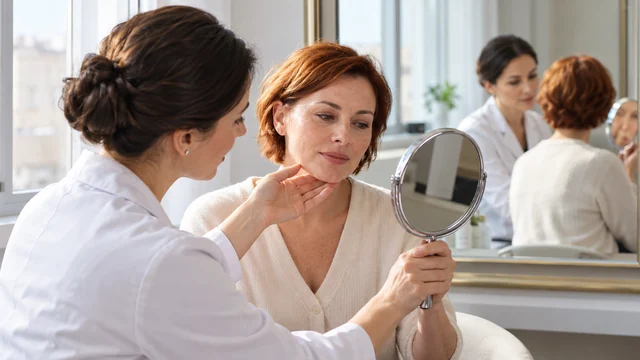
BioRePeel Downtime: Recovery, Peeling and Redness
If you are considering BioRePeel between work meetings or days before a celebration, “zero downtime” is less useful than knowing what you might see in the mirror. Redness, sensitivity, dryness and visible peeling are possible. Nobody can guarantee exactly when you will look as usual. Some people have very little visible reaction, but a two-phase formulation does not exclude complications. For a first session before an event, leave a time buffer rather than counting on a guaranteed lunchtime treatment.
The manufacturer describes BioRePeelCl₃ FND as a professional peel containing 35% TCA for face, neck and décolletage. The two-phase design does not establish the same penetration or recovery as an ordinary superficial peel. The American Academy of Dermatology gives approximately 1–7 days for superficial-peel healing and 7–14 days for medium-depth peels. These are class-level ranges, not a published personalised timetable for BioRePeel. The suggestions below are for monitoring and planning, not promises.
Medical healing and social downtime are not the same
You may feel fit to work while someone nearby notices red patches or dry flakes around your nose. Or your skin may look calm but sting when you wash it or apply cosmetics. “I can leave the house,” “I can wear my usual makeup,” and “my skin has fully healed” are three different claims. Before deciding, ask about each one.
| Observation period | What might happen | What this means for your plans |
|---|---|---|
| Treatment day | Stinging during application, redness, warmth or tightness; responses vary | Avoid an immediate photoshoot and do not assume makeup will be permitted |
| The next 1–2 days | Redness may fade or persist; dryness and sensitivity are possible | Computer-based work may be possible, but looking entirely normal is not guaranteed |
| Approximately days 3–7 | Some superficial-peel patients develop flaking, often near nose and mouth; others have very little | Foundation can emphasise flakes instead of hiding them |
| After the first week | Mild recovery may look calmer, but persistent irritation needs assessment | Do not automatically dismiss a complication as “normal prolonged peeling” |
Important: these are discussion intervals based on general chemical-peel evidence, not an established day-by-day BioRePeel response. Deeper injury can mean longer redness, swelling and restrictions than this table suggests. You cannot judge treatment depth yourself from the acid percentage or absence of flakes.
When can you return to makeup, exercise and skincare?
Makeup and an important meeting
Timing depends on skin integrity, treatment depth and the actual protocol. The American Academy of Dermatology says that makeup may be worn immediately or the next day after some superficial peels; medium peels require greater caution. This is not permission to apply makeup immediately after BioRePeel. Ask your clinician to name a specific point for resuming cosmetics and what to do if skin still burns, cracks or weeps. Concealer over damaged skin is not a good solution for an event.
If you are speaking publicly on Tuesday and attending a wedding Friday, trying your first peel earlier in that week is a gamble, especially if you previously reacted to acids. When your calendar is full, choose conservative skincare, postpone, or discuss a different approach with more predictable visible effects. Social downtime is a legitimate factor even if someone calls medical downtime “minimal”.
Exercise, heat, sauna and hot showers
Heat, heavy sweat and rubbing can aggravate irritated skin. Do not make “gym that same evening” your default. Ask when each level of activity can resume, taking redness and sensitivity into account. A short walk in the shade is unlike a workout in heat. While skin is inflamed, hot saunas, abrasive towels and vigorous facial rubbing are not helpful. The independent sources reviewed through October 2026 do not establish precise BioRePeel-specific exercise restriction hours.
Sun exposure, walks and seaside travel
Recently treated, sensitive skin requires particular UV protection. Avoid tanning and sunbeds, use clinician-agreed sunscreen, seek shade and wear a hat. For people prone to dark marks, this matters more than an attractive “back to normal tomorrow” slogan. If upcoming plans include beaches, sunny tours or long unshaded walks, postponing a first peel may be sensible.
Acids, retinoids, cleansing and moisturising
Use gentle, agreed aftercare. Do not force exfoliation with brushes, scrubs, acid masks or another DIY peel; never rub or pick off flakes. Resuming retinol, adapalene, tretinoin and other active products depends on the individual medicine, its instructions and skin condition. If a clinician prescribed a retinoid for acne, do not stop it for an arbitrary number of weeks based on influencer advice: agree changes with the prescriber.
What affects recovery more than an advertising promise?
- Starting condition: sensitivity, active inflammation, barrier damage, a recent tan or irritation from skincare can change tolerance.
- Exact formula: FND for the face and BODY for specified body areas have different TCA concentrations; aftercare and recovery assumptions are not interchangeable.
- Technique: preparation, skin contact, passes, treated surface and combination procedures can change the reaction.
- Pigmentation tendency: a history of dark marks after acne or irritation calls for discussion of post-inflammatory hyperpigmentation risk.
- Other treatments and medicines: laser or microneedling combinations and retinoid therapy should not be treated as ordinary stand-alone BioRePeel recovery.
A friend's “I had absolutely nothing” cannot predict your response. Variation does not automatically imply clinician error, but a guarantee of identical recovery for everyone merits questions about qualifications and protocol. Ask what routine effects and uncommon serious problems might look like, rather than accepting only a next-day photograph of calm skin.
A routine reaction or a reason to seek help?
Mild dryness, brief redness, moderate sensitivity and slight flaking may occur after a peel; context and depth matter. Increasing or severe pain, large blisters, weeping wounds, pus, rapidly spreading redness, marked swelling or fever should not be endured for a promised result. Contact a clinician promptly. Severe symptoms, breathing difficulty with facial swelling or eye injury call for emergency care.
If acid accidentally enters an eye, immediately flush with clean running water for at least 20 minutes and seek emergency medical care; do not wait for symptoms to pass. Do not rub the eye or delay flushing to call a clinician. Herpes blisters also matter, especially with a history of cold sores. Prolonged redness, new dark or pale patches or unusual scars deserve assessment even without severe pain. Peeling risks include infection, changes in pigmentation and scarring; testimonials cannot establish rates for this formulation.
Who should postpone even before the treatment date?
Active herpes, infection, open wounds, significant sunburn, a flare of inflammatory skin disease or an unresolved reaction after another procedure all call for assessment first. Disclose previous keloids, unusual pigment changes and isotretinoin use. Isotretinoin is not an evidence-based blanket prohibition on every superficial peel: professional guidance does not require the same months-long delay for everyone, but a clinician must assess its relevance to the specific BioRePeel protocol. A new or changing pigmented lesion should be medically evaluated, not covered up through acid treatment.
Deferring an elective TCA peel during pregnancy is generally the prudent option because direct safety evidence is lacking. Breastfeeding is a separate, individual decision, not automatically identical to pregnancy. If someone proposes adding another skin-injuring treatment to accelerate results, ask whether it could extend recovery and what evidence supports the combination. Scheduling the peel after the important event may be entirely rational.
Your short plan before you consent
List camera-facing work, travel, exercise, social events and occasions requiring full makeup. At the consultation ask for three separate milestones: return to ordinary tasks, permission for makeup and sufficiently complete healing for other treatments. Ask for written skincare guidance, a phone contact for unexpected symptoms, and a plan if pigment changes occur. Mention prior reactions, medicines and any planned sun exposure.
If instead of answers you hear “nothing will show; no recovery needed,” you do not have to consent. You can choose another date or stay with usual skincare. To decide whether the changes justify a peel, read the BioRePeel benefits guide ; to evaluate actual images, use the before-and-after photo guide . This page is about whether a possible reaction fits your calendar, not what the peel promises.
Additional questions
If there is no flaking, can I immediately repeat a treatment?
No. Lack of visible peeling does not measure barrier healing or determine a safe interval. The clinician must decide using the protocol, your reaction and your skin's current condition.
Can peeling begin after the skin initially looked fine?
Yes. With superficial peels, dryness and flaking can develop later. A calm first day is not a promise that all later photographs or meetings will be unaffected.
Can foundation simply cover any redness?
Not always. Makeup can worsen discomfort on irritated, cracked or weeping skin, while flakes can become more visible. Get specific instructions before applying cosmetics.
Sources
- CMed Aesthetics: BioRePeelCl₃ FND — manufacturer information .
- American Academy of Dermatology: Chemical peels — healing ranges and care .
- American Academy of Dermatology: Preparation — questions to ask a clinician .
- DermNet: Chemical peels — reactions, recovery and complications .
- ASDSA: Protecting patients from harm — chemical peels, 2024 .
- Mayo Clinic: first aid for chemical eye exposure .
- International Journal of Dermatology: Pregnancy and Lactation Risk–Benefit Framework, 2026 .
- American Society for Dermatologic Surgery: chemical peels and isotretinoin consensus, 2017 .