
Botox: which wrinkles it softens, onset and how long it lasts
Are you curious about Botox but worried about losing your familiar facial expression? Or considering injections before an important event and wondering what others might notice? Botulinum toxin type A can temporarily soften lines caused by muscle movement, but it does not remove every crease or produce the same outcome on every face. Start not with a number of “units”, but with which muscles create the lines that concern you and how much movement you wish to keep.
People often call any botulinum toxin injection “Botox”. Yet BOTOX Cosmetic is a specific product containing onabotulinumtoxinA. Other botulinum toxin products have their own prescribing information and potency units; doses must not be converted automatically between them. This article concerns cosmetic use of type A botulinum toxin generally; check the actual product label and local rules separately.
Which wrinkles can really soften?
Smiling creates fine lines at the outer corners of the eyes; frowning creates lines between the eyebrows; raising the brows creates horizontal forehead lines. These dynamic or expression lines are linked to contracting muscles. The drug temporarily blocks nerve signals to selected muscles so they contract less strongly. A face does not have to become frozen: the degree of relaxation depends on the muscle, injection sites, product, dose and your anatomy.
Lines already visible when your face is relaxed may only soften partly. Botulinum toxin does not replace lost volume, remove pigmentation, directly improve skin texture or surgically lift excess skin. If brows or lids already droop, relaxing certain muscles can sometimes make heaviness more apparent. These distinctions are worth discussing before treatment, rather than discovering them afterward.
| What you want to change | When toxin may help | Where its limits lie |
|---|---|---|
| Frown lines between the brows | Reducing muscle action can soften expression lines | A deep crease visible at rest may remain |
| Crow's feet when smiling | Their appearance may be reduced | Completely immobilising the area is neither necessary nor necessarily desirable |
| Horizontal forehead lines | The expression-related component may soften | Brow position and the action of the forehead muscle need special assessment |
| Dry skin, discolouration or lost volume | Not this medicine's primary purpose | Another approach, or no procedure, may be more appropriate |
The US prescribing information for BOTOX Cosmetic lists particular adult aesthetic indications, including glabellar, outer-eye and forehead lines and neck platysma bands. This is US regulatory information, not evidence that the service is available in Armenia, that another product is authorised, or that Armenian indications match US ones. Other treatment sites require separate medical discussion and may be outside the particular product's approved label.
How much expression can a “natural” result preserve?
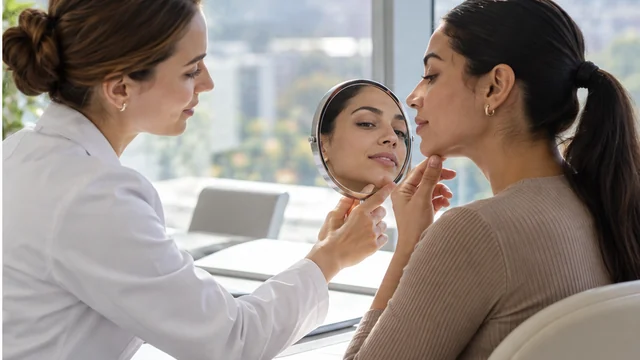
During a calm consultation, ask which muscles work as you raise your brows, squint and smile. If keeping an expressive forehead and familiar smile matters, say so before the dose is planned. Lighter relaxation may preserve movement but leave more lines; stronger relaxation can increase the chance of a heavy or unfamiliar expression. A single photograph cannot predict that balance.
Pay particular attention if you habitually lift your brows to compensate for heavy upper lids. Weakening the forehead muscle in that situation may change brow position and the look of your eyes. The clinician should assess your face at rest and in motion, asymmetry, dry eyes, previous procedures and existing tissue descent. “The same as my friend had” is not a sound plan: anatomy and patterns of expression differ.
Botulinum toxin is not a filler: it adds no volume and does not fill a crease with material. Its cosmetic effect is temporary but cannot be reversed at the push of a button. If muscles relax more than you wanted, there is no dissolving injection that instantly cancels its action; normally you must wait for the effect to wear off gradually and seek medical assessment if problems arise.
What happens during an appointment, and does it hurt?
First, the clinician discusses your concerns and examines your facial movements. Tell them the exact name and date of any previous toxin treatment, all medicines and supplements, neuromuscular illness, swallowing or breathing difficulties, allergies, eye conditions and prior facial surgery. Before starting, you should understand the proposed sites, intended degree of relaxation, risks and how to obtain help if an unwanted effect occurs.
After cleansing the skin, the clinician uses a fine needle to place several small injections at the chosen sites. They may feel like quick pricks or stings; sensitivity varies. Treatment is often brief, although neither the exact injection count nor appointment time can be promised without assessing the area and plan. Anaesthetic is often unnecessary, but discuss comfort options beforehand if you are concerned.
Immediately afterward you may see tiny needle marks, redness, local swelling or a small bruise. That does not mean the toxin has already started working. Do not judge the final symmetry in the clinic mirror or demand an immediate extra dose. If the practitioner will not identify the product, explain its source or let you ask questions, pause the procedure until things are clear.
When will it work, and how long will it last?
Changes can begin after several days, while a final assessment generally takes longer; early differences in sensation or movement are not necessarily the final result. The American Academy of Dermatology describes visible effects often appearing within 3–7 days and lasting around 3–4 months, sometimes longer. These are broad guides, not a promised day or duration for an individual.
Nerve-to-muscle signalling gradually recovers, and movement and lines return. Results vary with muscle activity, the treated area, dose, individual response and product properties. Repeating treatment is a choice, not an obligation. If you stop, the relaxation gradually fades; the skin's ordinary ageing process, however, does not stop.
According to the US BOTOX Cosmetic label, the safety and effectiveness of treating more often than every three months have not been specifically evaluated. That is not a universal timetable for every formulation or location. Another treatment should be considered only after reassessing actual movement and consulting the label for the product used, not because a package deal prescribes a date.
What will people see afterward: work, photographs, exercise?
| When | What may be visible | How to plan around it |
|---|---|---|
| Immediately afterward | Needle marks, mild redness or slight swelling | Work is usually feasible, though the face may not look its best in a close-up photograph |
| First days | Occasional bruising and gradual changes in expression | Do not schedule an important shoot assuming the finished result is instant |
| Following weeks | The effect settles; unwanted asymmetry may become apparent | Discuss any adjustment at an arranged review rather than reacting immediately |
| Following months | Movement gradually returns | Repeat visits are optional and individually planned |
“No recovery time” does not mean “nothing visible”. You may return to work immediately and still have a bruise near the eye that matters for a photo shoot or special occasion. If the date is fixed, allow time for the effect to emerge, possible bruising and clinical review; do not have a first treatment on the eve of an important event.
Do not rub or massage the injection sites; apply makeup without pressing firmly. Advice on exercise varies: for example, the AAD suggests waiting two hours before strenuous activity. Blanket week-long restrictions without a clear reason are not automatically necessary; ask which instructions apply to your treatment. Specific questions are covered separately under Botox aftercare, exercise after Botox and alcohol after Botox.
Who should postpone treatment or seek further assessment?
A known allergy to a botulinum toxin product or any of its ingredients, or infection at the planned injection site, are contraindications in the BOTOX Cosmetic label. Neuromuscular disorders such as myasthenia gravis increase the potential for clinically significant weakness and call for careful medical assessment; being symptom-free today is not a green light. Canadian BOTOX Cosmetic patient information expressly lists certain neuromuscular disorders as reasons not to use that product; restrictions vary by country and formulation.
Disclose medicines affecting nerve-to-muscle transmission, including aminoglycoside antibiotics, muscle relaxants and other recently used botulinum toxins. This is not a list of medicines you should stop yourself: your treating doctor must assess the interactions, indications and risks. Existing swallowing or breathing disorders, and certain eye conditions, make a careful discussion particularly important.
There are insufficient adequate data on cosmetic use during pregnancy; adverse effects were found in animal studies at some doses. During breastfeeding, evidence about transfer into human milk and effects on infants is insufficient. For an elective aesthetic treatment, postponing and discussing the decision with a clinician is sensible. Lack of evidence does not prove either safety or harm in every exposure.
The safety and effectiveness of BOTOX Cosmetic for aesthetic use have not been established in people under 18; these injections should not be presented as a routine cosmetic option for minors. Active inflammation at the intended site or substantial excess skin calls for medical assessment and possibly a different approach. Discuss also how you would feel about small asymmetries: no injection can promise mathematically identical movement on both sides.
Which reactions are expected, and when is help urgent?
The more common concerns are injection-site pain, minor bruising and temporary swelling. Headache, drooping of a brow or eyelid, dry eyes, changes to the smile and unintended weakening of nearby muscles can occur; likelihood and severity differ by site and product. Some complications cannot be rubbed away or rapidly corrected at home. Seek prompt medical advice for new double vision, difficulty closing the eyelid, eye pain or changes in sight; pronounced eye symptoms need urgent assessment.
Seek emergency medical help immediately if you experience trouble breathing, swallowing or speaking, or increasing widespread muscle weakness after treatment. The label warns that the toxin's effect can rarely spread beyond the injection site with potentially severe consequences; symptoms may occur hours, days or weeks later, not just immediately. Do not wait for the next cosmetic appointment. A rash with facial or throat swelling, wheezing or signs of a severe allergic reaction also requires emergency care.
To reduce preventable risks, check the clinician's qualifications, the product's authenticity and name, batch traceability, storage arrangements and an emergency plan. Licensing, registration and indications differ by country; a US label does not establish Armenian registration or that any specific service is offered in Yerevan.
Botulinum toxin, skin care or something else?
If your main concern is lines produced by movement, toxin treatment may be worth considering. Dryness, uneven texture, pigmentation and volume loss involve other mechanisms. Sunscreen and well-chosen skin care address the skin but do not switch off muscle contraction. Fillers add volume and have their own potentially serious risks; energy-based treatments act differently and do not produce interchangeable outcomes.
Compare the actual concern and the trade-off, rather than a promise to look “ten years younger”: stronger relaxation can soften lines but alter familiar expression. Doing nothing is a valid alternative. A longer comparison appears under Botox alternatives; combinations should be discussed only after the risks of each component are understood separately.
What should you ask before consenting, without pressure?
- Which expression-related muscle is responsible for my concern, and what will this treatment not change?
- What are the generic and brand names of the product, which indications are authorised in our country, and is any proposed use off-label?
- How might brow and smile movement change given my anatomy and preference for a natural expression?
- What happens if an eyelid droops, my eyes become uncomfortably dry or there is asymmetry, and who can I contact?
- Which of my medicines, illnesses and previous injections change the plan or make not treating safer?
- What do consultation, medicine, follow-up and any complication care cost; is a bargain price obscuring product details?
When looking at before-and-after photographs, check that expression, lighting, head position and the time since injection match. A relaxed “after” face cannot honestly be compared with a frowning “before” face. Reviews can help you ask about communication and follow-up, but they cannot replace product documentation or personal risk assessment. You have every right to take time or decline; not having injections is perfectly reasonable.
Other questions
Can I have blood tests or dental treatment after Botox?
There is no blanket prohibition on all blood tests or dental procedures. If dental work with anaesthesia, prolonged mouth opening or another intervention is planned, tell your dentist and toxin clinician the date, product and treatment area. Any necessary interval depends on the particular procedures and your health.
Why might repeat injections seem less effective?
Possible explanations include a changed dose or injection pattern, switching products, altered baseline muscle activity or unrealistic expectations. Neutralising antibodies may occasionally be considered, but a single disappointing result cannot establish that cause. Do not increase injection frequency yourself; review the full treatment history with your clinician first.
Sources and medical references
- BOTOX Cosmetic: official US prescribing information, revised October 2024.
- American Academy of Dermatology: botulinum toxin FAQs.
- American Academy of Dermatology: overview of botulinum toxin treatment.
- AbbVie Canada: BOTOX Cosmetic product information.
- DailyMed: current US BOTOX Cosmetic label listing, January 2026.
- US FDA: warning on illegally marketed botulinum toxin products, November 2025.