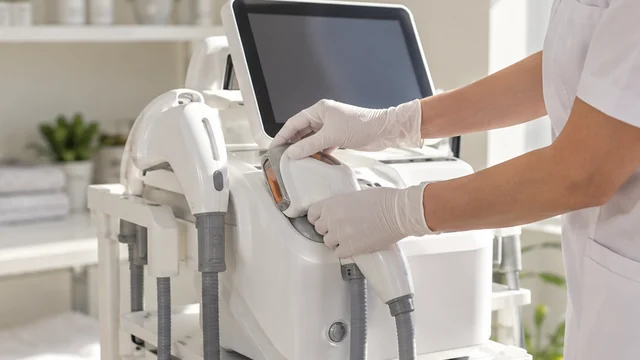

Lutronic Clarity II: 755 nm and 1064 nm laser, key facts
Clarity II: are you paying for a device name or a thoughtful treatment plan?
You see “Lutronic Clarity II” in a hair-removal description and want to know whether the platform actually suits your skin. Clarity II is a professional Lutronic laser system combining a 755 nm alexandrite laser and a 1064 nm Nd:YAG laser. It is used for more than hair reduction: the US regulatory documentation also lists certain vascular and pigmented conditions and wrinkles. But the name alone does not determine what will be done or whether the procedure is safe for you today.
For hair removal, colour and thickness of the hair, skin tone, recent tanning, body area, growth patterns and operator expertise are more useful than brand prestige. Even an excellent machine cannot remove every hair permanently in one visit; very fair, grey, white or red hair contains too little suitable pigment for reliable laser targeting. The realistic goal is long-term hair reduction, not guaranteed lifelong absolute smoothness.
This page is about the particular Clarity II platform: what 755/1064 means, what its additional features can and cannot do, the country-specific authorisations and the questions to ask about the machine on site. For hair-removal methods and the hair-growth cycle more generally, read the separate laser hair removal guide.
What is inside the device, and what is documented?
US FDA submission K183566 identifies CLARITY II Laser System by Lutronic Corporation. In 2019 the agency cleared it for marketing under the 510(k) substantial-equivalence route, comparing it with legally marketed predecessor devices. This is not the approval process for a medicine, and it proves nothing about the equipment in any particular Yerevan clinic.
The 510(k) submission did not include new clinical testing of Clarity II itself: the regulatory determination relied on substantial equivalence to previously cleared lasers. This does not negate the benefits of laser hair reduction, but it is not direct evidence that this model produces better patient outcomes than alternatives.
The FDA documentation describes two separate laser resonators. At 755 nm, energy targets melanin, the pigment in hair, efficiently; that also makes careful settings important where the skin contains pigment. The 1064 nm beam penetrates deeper and is often considered for more strongly pigmented skin, but can still burn skin when applied incorrectly. Wavelength choice follows an actual assessment of hair and skin phototype, not a slogan about the best-sounding technology.
Clarity II has interchangeable handpiece parts and cooling options as well as functions such as IntelliTrak, designed to help the operator cover an area consistently. Lutronic also describes skin-temperature feedback. Crucially, the FDA filing calls temperature monitoring an informational feature: it is not an automatic guarantee against a burn. Claims of faster coverage and operator convenience come from the manufacturer and do not guarantee superior results for every person.
Important update: a 2026 recall affecting certain Clarity II systems
The FDA recall database lists a Class II recall for the CLARITY II Laser System, model 1110200210 (Z-1558-2026). The manufacturer initiated it on 27 January 2026, and the FDA posted the record on 12 March. The reason given is reports of devices sparking or making popping sounds, with the potential to burn patients. As of 21 October 2026, the record was marked open. This does not mean every Clarity II unit is faulty, but the earlier 510(k) clearance alone does not establish that an individual unit is safe.
Before agreeing to treatment, ask for the exact model and serial number, whether that unit falls within the affected serial numbers, whether the provider received the manufacturer’s notification and whether any required recall or corrective action has been completed. Ask for documentary confirmation through the supplier or manufacturer. If this cannot be established, postponing is reasonable. Armenia is not named in the FDA record’s published distribution list for the affected equipment; that neither confirms nor rules out the presence of a particular unit in Yerevan.
755 or 1064 nm: which difference matters to you?
| Your situation | What the clinician may consider | What needs caution |
|---|---|---|
| Fair skin with adequately dark, coarse hair | 755 nm is frequently considered for targeting hair melanin | Recent tanning, medicines, sensitivity and the skin’s response still matter |
| Darker skin or higher risk of pigment changes | 1064 nm may be preferable with appropriate settings | Neither this wavelength nor cooling eliminates burns or post-inflammatory hyperpigmentation |
| Grey, white, very fair or red hair | Limited melanin reduces the effectiveness of both modes | Discuss electrolysis rather than promises that every hair can be removed |
| Fine facial or neck vellus hair | Potential benefit may be small because the laser target is weak | There is a risk of paradoxical increased hair growth after light-based treatment |
| Recent sun, tanning bed or self-tanner | First assess tanning and when it will be safe to postpone until | Switching device or wavelength alone is not an adequate risk-control plan |
Fitzpatrick phototypes describe how skin tends to respond to sunlight, but they are not a complete risk assessment. Two people with similarly coloured skin may differ in pigmentation tendency, hair thickness or cooling response. The US Clarity II clearance includes various skin phototypes for specified indications, but does not say identical settings are safe for everyone. A systematic review of hair removal in darker skin supports tailoring wavelength and settings; it does not establish that this branded machine beats all alternatives.
Beyond hair: why the list of uses is not a treatment menu
The US documentation also lists benign pigmented and vascular lesions and wrinkles for 755 nm. For 1064 nm it lists a variety of vascular and pigment-related conditions, wrinkles and pseudofolliculitis barbae, meaning inflammatory bumps related to beard-hair growth. These are the documented US indications for that model; each requires separate diagnosis and treatment planning rather than a different button press.
A brown spot might reflect sun exposure, melasma or a skin lesion needing a dermatologist’s assessment. Never agree to laser removal of an unidentified mole or changing pigmented lesion without diagnosis. Evolving size, asymmetry, colour change or bleeding call for in-person assessment, not cosmetic camouflage. Vascular redness also has several possible causes; an advertising photo cannot diagnose yours.
Results of hair reduction cannot be taken as evidence for pigment or vessel treatments on Clarity II, or vice versa. The intended wavelength, condition, local authorisation and clinician’s competence all need checking. If your priority is leg hair, a long list of other possible indications does not make the hair-removal outcome better.
What will the appointment feel like?
Before the first session the clinician should ask how your skin reacts to sun, about past burns or pigment changes, medicines, skin disorders and a tendency to scar. They should examine the actual hair and treatment area, not simply hand you a questionnaire. A test area may be appropriate when phototype, tanning or previous reactions create uncertainty; even a reassuring test cannot guarantee the absence of reactions across a larger area.
The area is cleaned, and hair is generally shaved short beforehand according to the operator’s instructions so energy is not wasted on exposed hair shafts. You and everyone in the room require protective eyewear suitable for the wavelengths in use. Pulses can feel like intense warmth or a snapping elastic band. Cooling may ease discomfort and protect the outer skin layer, but the upper lip or armpits can feel different from the lower legs. Tell the operator immediately if it becomes unbearably hot.
The appointment length depends on area and technique: a small patch takes less time than full legs. The manufacturer’s faster-coverage claims for IntelliTrak refer to device and operator capability, not a licence to rush through unsafe skin reactions. The goal is controlled treatment, not a race.
The first days: exercise, beach plans and what other people may notice
| When | What can happen | What to allow for |
|---|---|---|
| Immediately afterward | Warmth, redness and moderate swelling around follicles; sometimes it resembles mild sunburn | Loose clothing, clinician-approved cooling and no expectation of camera-ready skin |
| Over the next 1–3 days | Local symptoms often improve, though some people react more strongly or for longer | Avoid irritation and excessive heat; ask when to resume strenuous sport or hot baths |
| Later after the session | Treated hairs may shed gradually and look as though they are growing again | Do not pluck or wax without agreement; do not judge success by the first day |
| Between visits | Some hairs regrow because follicles are in different growth phases | Agree intervals and maintenance according to site and reaction, not someone else’s schedule |
The AAD notes that redness, swelling and discomfort are usually short-lived and many people resume routine activity without formal downtime. Yet “no sick leave” does not mean your skin will look invisible in photographs. If facial redness would bother you at work or on camera, give yourself flexibility and consider treating a small area well before an important occasion.
Sun protection matters throughout the course: avoid direct sun and tanning beds and use recommended broad-spectrum protection on exposed skin. Avoid scheduling treatments too close to a beach holiday if you cannot prevent tanning or protect treated skin. “The machine is safe on tanned skin, so I can swim in the sea tomorrow” is not a safe general rule. With blisters, crusts or broken skin, exercise, pools and cosmetics need reassessment by a clinician.
How many visits—and when can you fairly assess progress?
A single laser session targets only a proportion of hair follicles accessible in a susceptible growth phase. Repeated visits are therefore usually needed, with spacing depending on the site, hair cycle and personal response. According to AAD general guidance, several sessions with intervals of weeks are common. There is no universally correct number specifically for Clarity II. Some sites and hormonal changes may require maintenance despite substantial reduction in growth.
Judge progress using comparable photographs and how often you need to shave, not just an advertised percentage. Compare the same area with similar lighting and a similar stage of hair growth. Thinner remaining hair may feel smoother without every follicle having been destroyed. Expectations for legs and underarms can differ considerably from those for the upper lip, chin or neck.
If facial hair rapidly becomes thicker while menstrual cycles become irregular or prominent acne or other hormonal symptoms appear, see a clinician to assess possible causes rather than treating hair removal as the whole answer. A laser cannot normalise hormones. With fine facial fuzz, it may be wiser not to rush: a review describes paradoxical hypertrichosis, increased hair growth following laser or light treatments, particularly on the face and neck. Clarity II’s name does not make that risk zero.
Who should postpone treatment, and which reactions need help?
Fresh tanning, sunburn, open wounds, active infection and inflamed skin at the site are reasons to postpone elective treatment until the area has been assessed and recovered. Disclose photosensitising drugs, recent isotretinoin, a tendency to keloids, herpes, pigment changes and previous burns. Different conditions require different precautions: never stop prescription medicines yourself. Pregnancy and breastfeeding merit discussion; postponing elective laser treatment is reasonable where reassuring evidence is limited.
Mild redness and perifollicular swelling may be expected. Increasing pain, marked blisters, burns, significant pigmentation changes, infection signs or eye injury need prompt medical assessment. Sudden eye pain or altered vision requires emergency care. Do not treat a blister with strong acids or attempt to “polish away” a dark mark with another laser pass.
Possible complications include post-inflammatory darkening, loss of pigment, scars and herpes flares. Risks differ with phototype and technique. Research on darker skin does not identify a single universally best machine, but does underline the need to tailor treatment to pigment risks. Ask about the operator’s experience with skin like yours rather than trusting a famous model alone.
What should Clarity II be compared with before you buy a course?
Lumenis Splendor X, Cynosure Elite iQ and Clarity II have their own hardware designs, settings and operation. The shared numbers 755/1064 do not make treatments clinically identical. Data, speeds and warnings from a different model cannot simply be transferred, and “newer” does not automatically mean “safer”.
When comparing offers, confirm the precise machine on site, its maintenance, cooling method and eye protection. Ask which wavelength will be used and why it suits your skin, who assesses your response at the first session, and how they will change the plan if irritation is marked. Do not ask the operator to copy settings from the internet: energy and pulse duration are professional decisions based on an examination, not do-it-yourself instructions.
Alternatives include a diode laser, another professional platform, electrolysis for hair without enough melanin, or straightforward shaving. Choosing less dramatic results with more control is valid. Pressure to prepay a large package before assessment is not a medical argument. Area, number of visits, preparation, clinician training and follow-up can affect cost, but local prices and the presence of Clarity II at particular Armenian clinics have not been independently verified here.
Questions to ask before the first pulse
- Is this really Lutronic Clarity II rather than the older Clarity or another dual-wavelength device? Can I see its model identification?
- Why is 755 or 1064 nm chosen for my hair and skin, and how have tanning, past burns and medications been considered?
- Who will assess and treat me, and what is their experience with my phototype and this facial or body area?
- What is expected in the first days, and which symptom calls for urgent contact with a doctor?
- How will progress be judged if growth barely reduces or fine hair starts growing more densely?
- Does the plan include treatment of adverse effects, what is charged separately, and can I decline a package after consultation?
Ask for written aftercare instructions and a contact route if complications arise. If answers are unavailable, or someone promises safe removal of every hair on every skin without exceptions, seek another opinion. Choose an understandable, adjustable plan—not simply the loudest brand name.
Frequently asked questions
Can laser hair removal be performed over a tattoo?
Do not treat tattooed skin with an ordinary hair-removal pulse: tattoo pigment can absorb energy and increase tissue damage risk. Disclose tattoos and permanent makeup in advance so the clinician can mark safe boundaries.
Are protective goggles needed when the area is nowhere near the face?
Yes. Laser radiation and reflections can harm eyes irrespective of the treatment area. Eyewear must be suitable for the wavelength or wavelengths actually used.
Can Clarity II be combined with self-tanner?
Self-tanner changes how skin looks and may affect how its surface absorbs light. Tell the clinician when it was applied and let them decide on removal, preparation and waiting time. Do not rely on advertising that says the system is safe for all phototypes.
Sources
- FDA — 510(k) clearance K183566 for CLARITY II
- FDA — K183566 model indications and description
- Lutronic — device and IntelliTrak/temperature-sensing features
- AAD — laser hair removal preparation
- AAD — side effects, intervals and recovery
- Systematic review: laser hair removal in darker skin
- Systematic review: paradoxical hypertrichosis
- FDA — recall of certain CLARITY II systems, Z-1558-2026 (status and affected devices)