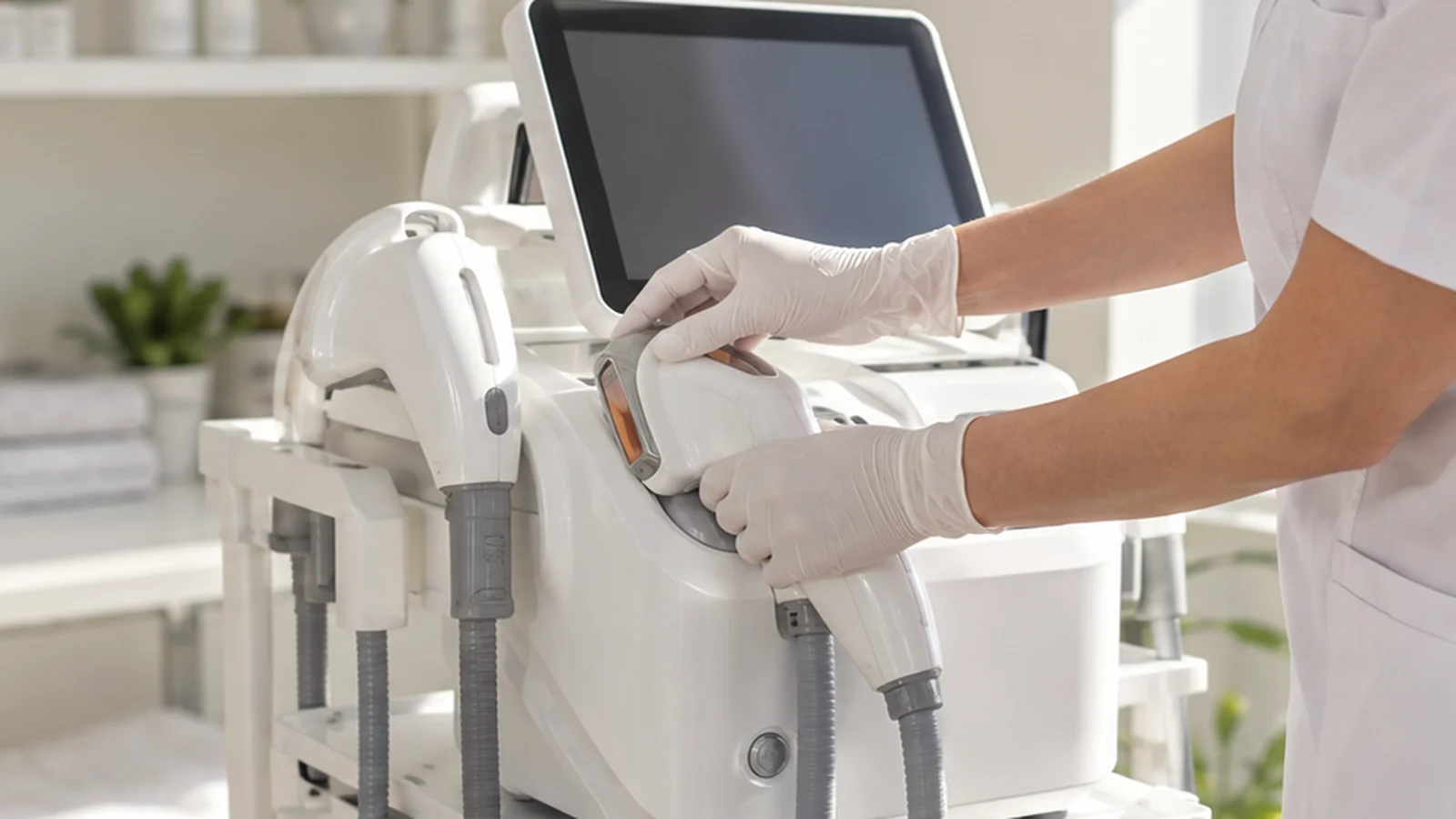

Lumenis Splendor X: hair removal safety and questions to ask
If you are offered hair removal with Lumenis Splendor X—especially before a holiday or after tanning—the important question is not just how smooth your skin might become. Splendor X is a professional laser platform for reducing hair growth; safety depends on the precise device configuration, skin and hair colour, tanning, treatment parameters, eye protection and the operator's training. Two wavelengths and cooling broaden the options for tailoring treatment, but do not make burns impossible. No machine can remove every kind of hair from every kind of skin equally effectively and without risk.
What is Splendor X, and why does the device version matter?
Lumenis describes Splendor X as a system using a 755 nm alexandrite laser and a 1064 nm Nd:YAG laser, with BLEND X technology for controlling these sources. The first wavelength interacts strongly with melanin pigment; the second may be useful for darker skin phototypes when suitable settings are selected by a trained operator. Both heat hair-related structures to reduce regrowth. But skin also contains melanin, so the difference between heating the target hair and harming surrounding skin depends on actual settings, not a marketing slogan.
There is an important technical distinction. The FDA 510(k) document K241407 describes Splendor X variants (Alex, Alex2, Nd:YAG and Alex+Nd:YAG). For the Alex+Nd:YAG configuration, BlendX is described as successive pulses that do not overlap in time, although some marketing language refers more broadly to synchronised emission. So it is wrong to assume every Splendor X mixes two lasers simultaneously in an identical single flash. Ask for the exact model, configuration, year and device instructions used in your session.
The US FDA database lists 510(k) decisions for particular Splendor X configurations, including K241407 and K243445. These are US clearances based on substantial equivalence for stated indications, not worldwide certification of every installation or a promise that complications cannot occur. Legal status in Armenia, the exact model and the practitioner's qualifications must be checked separately; a foreign catalogue is not evidence that a local clinic owns the device.
Who might benefit, and when should the skin be assessed first?
| Your situation | What it means in practice | Next step |
|---|---|---|
| Coarse, dark hair; skin without a recent tan | There is a pigmented target for the laser; meaningful reduction may be possible over several sessions | Agree on the settings for your skin phototype and treatment area |
| Olive or darker skin | Treatment may be possible, but choosing the wrong mode increases the risk of burns and pigment changes | Ask about experience with your phototype and whether an appropriate Nd:YAG mode is used |
| Recent sun exposure, a tan or self-tanner | Changes in skin pigmentation complicate safe selection of settings | Disclose it and discuss postponement; never hide a tan |
| White, grey, very fair or red hair | There may be too little pigment for reliably targeting the hair | Discuss electrolysis or another approach rather than promises of complete laser removal |
| Inflammation, an open wound or a suspicious mole in the area | The site must not be treated as ordinary hair-removal skin | Postpone treatment there until it has been medically assessed |
The American Academy of Dermatology particularly recommends disclosing tanning, a tendency to scar, herpes outbreaks, medicines and skincare products. Do not try to remove an unexplained pigmented lesion “at the same time” using a hair-removal setting: seek a diagnosis first. If hair suddenly becomes significantly coarser or more abundant, especially with menstrual changes or other hormonal symptoms, hair removal is no substitute for investigating the cause.
How to reduce the risk of burns and marks before the first pulse
Before starting, a qualified professional should ask about your skin phototype, recent sun exposure or new pigmentation, medications and active skincare, and how your skin healed after previous laser sessions. Some patients may need a test area and a later assessment of its reaction; a successful test is not a 100% guarantee for every treated patch. If you hear that “this model never needs testing or a medical history,” it is reasonable to seek another opinion.
- Eyes. Everyone in the room needs suitable protection for the wavelengths being used. Closed eyelids and ordinary glasses do not replace laser-specific eye protection. If suitable protection is in doubt, do not start. Do not have laser hair removal on the eyelids, eyebrows or surrounding areas: serious eye injury is possible. Tattooed skin should not be treated with the hair-removal laser either.
- Skin. Cooling helps manage discomfort and protect the surface, but does not replace checks on energy, pulse overlap and the tissue response. Intense burning, visible blanching or unusual pain means treatment should stop immediately while the area is assessed.
- Device. Ask for the actual configuration, not just the brand. The name “BLEND X” alone does not tell you which mode will be used or why it suits your skin.
- Medicines and tanning. List all medicines, topical retinoids, recent isotretinoin use, self-tanner and sun exposure. Do not independently discontinue prescriptions; discuss whether to postpone or adjust skincare with a clinician.
The American Academy of Dermatology warns that hair removal in inexperienced hands can cause burns, blisters, lasting changes in skin colour and scars. For darker skin it is especially important to find a clinician experienced with similar skin phototypes. A larger spot size, faster operation or built-in cooling does not replace such experience.
Will it hurt, and how long might your skin look different?
Pulses are often described as short rubber-band snaps with warmth; sensitive areas may feel more intense. Cooling can ease discomfort, but “completely painless” is not a defensible promise. Area size determines appointment length: underarms are not both legs. Hair grows in cycles, so a single session cannot affect every follicle equally. Expect discussion of multiple treatments and possible maintenance, not a guarantee that every hair will disappear for good.
After an appropriately delivered treatment, moderate redness and small bumps around follicles can occur, resembling irritation after a close shave. In many people these settle fairly quickly, but the exact timing varies. You might be medically well enough to work while the skin is still visibly red or sensitive. Before a beach day, photo session or event where your legs will be on show, plan for this social recovery time too.
When planning a trip, account not only for the appointment date but also for protecting treated skin from sunlight. Avoid tanning beds and self-tanner during preparation and agree with your clinician how long to wait after tanning. After treatment, follow your advice on cooling, gentle cleansing, avoiding irritants and sun protection; on exposed areas use clothing and broad-spectrum SPF 30+. Do not open blisters or exfoliate skin following an unexpected reaction.
What is normal afterward, and when should you seek medical care?
| What you notice | What to do |
|---|---|
| Mild redness and moderate sensitivity that are not increasing | Follow your individual instructions and monitor whether symptoms diminish |
| Severe or worsening pain, blisters or extensive colour changes | Stop additional treatments and get urgent medical assessment |
| Pus, increasing warmth, redness and tenderness | See a doctor to rule out infection; do not apply random home “healing” mixtures |
| Eye pain or changes in vision after laser exposure | Seek emergency ophthalmological care immediately |
| Dark or light pigment patches that persist or worsen | See a dermatologist; do not attempt aggressive home bleaching |
A blister or sharp pain is not “the hair root coming out.” Symptoms, not the device name, determine how possible skin injury should be assessed. Immediate help is particularly important for an eye injury. The treatment centre should have a clear burn-response plan and a clinician to contact—not just an offer of a free follow-up session.
How does Splendor X compare with other lasers, and what affects cost?
A useful comparison with Clarity II or GentleMax Pro Plus considers the particular configurations available, the operator's experience, cooling method and treatment area. Two wavelengths are a technical capability, not an independent effectiveness ranking or a guarantee that your skin will tolerate one brand better. A separate page explains laser hair removal generally; this page is about using Splendor X safely.
Ask how the treatment area is defined for pricing, what counts as one appointment, whether consultation and test-area assessment are included, how repeat visits are planned and who manages complications. Never infer Yerevan prices or actual service availability from a manufacturer's foreign website. You can review before-and-after photos, but fair comparison needs similar lighting, comparable stages of hair growth and a known interval after the course. Someone else's impressive results do not establish that your skin is ready for laser treatment after a holiday.
If you tanned recently, have an unexplained skin lesion or are uneasy about missing eye protection, postponement is a sensible choice. Smooth skin is not worth unnecessary risk. Shaving, carefully chosen temporary methods and electrolysis for hair lacking pigment remain alternatives. Your next step can be a conversation with a dermatologist, not a laser appointment.
Frequently asked questions
Can I shave between sessions?
Shaving is usually acceptable, although precise timing depends on your skin's response and professional advice. Pulling hair out at the root before the next visit may remove the target needed for laser treatment.
What if some hair seems to keep growing after treatment?
Treated hair shafts sometimes emerge gradually and look like fresh growth. You cannot reliably judge the course from one area immediately afterward; show it at your agreed follow-up.
Could facial hair removal unexpectedly increase growth?
Paradoxical hair growth after laser treatments has been reported, particularly in some facial regions. If there is fine downy facial hair, discuss this risk and alternatives before treating it.
Sources and verification
- FDA 510(k) K241407: Splendor X configurations — a US regulatory document.
- FDA K241407: technical description of modes and indications — must be read for the stated configuration.
- FDA 510(k) K243445: separate Splendor X decision .
- Lumenis: manufacturer-described BLEND X technology — manufacturer information, including regional qualifications.
- American Academy of Dermatology: laser hair removal procedure and risks .
- American Academy of Dermatology: preparation, tanning and medicines .
- Systematic review and meta-analysis of paradoxical hair growth after light-based hair removal — a class risk, not a Splendor X-specific rate.
- Review of eye injuries associated with dermatologic laser procedures — evidence supporting appropriate eye protection, not a Splendor X-specific risk rate.
- Mayo Clinic: why hair-removal lasers should not be used on eyebrows, eyelids or tattooed skin.