GentleMax Pro Plus: Laser Hair Removal at 755 and 1064 nm
You are considering laser hair removal and a clinic advertises GentleMax Pro Plus. The name is sometimes presented as a guarantee of perfect results on every skin tone. In reality, this is a specific professional Candela laser system with two wavelengths: 755 nm alexandrite and 1064 nm Nd:YAG. Its advantage is the option to select a wavelength and settings according to hair, skin and body site. It cannot remove every hair forever, without sensation or without risk. Careful assessment and operator experience matter more than promotional claims about the model.
What exactly is GentleMax Pro Plus?
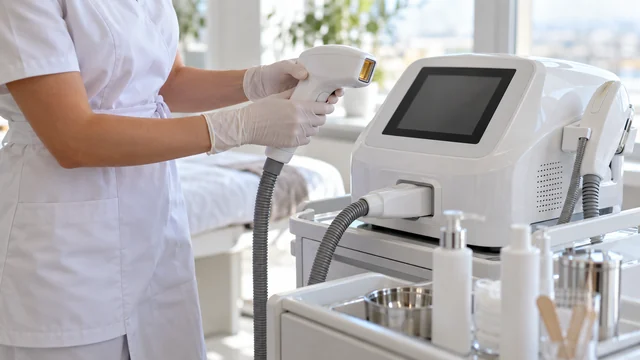
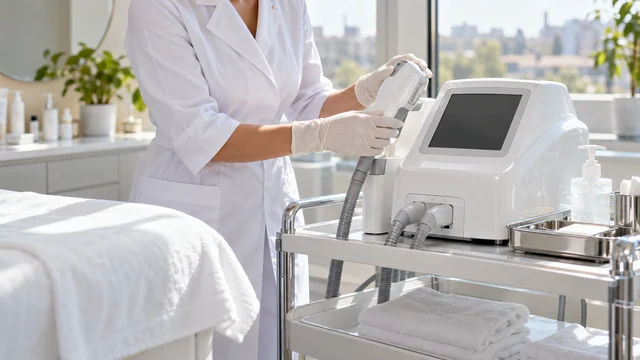
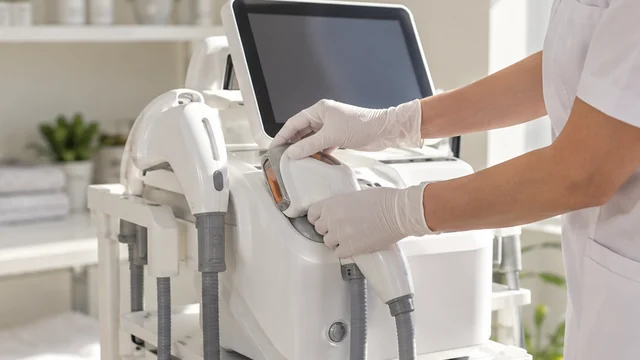
Candela places the device in the Gentle Pro series. GentleMax Pro Plus should not be confused with GentleMax Pro, GentleLase Pro (alexandrite) or GentleYAG Pro (Nd:YAG). Plus combines 755 and 1064 nm wavelengths with interchangeable applicators and Dynamic Cooling Device (DCD) skin cooling; compatible air cooling is possible with certain configurations. These are technical features, not a personalised prescription. Wavelength, spot size, pulse and cooling must be chosen after examining you.
Marketing also mentions the GLX delivery system, larger spot sizes and faster treatment modes. According to Candela, GLX may be included with newer systems or added as an upgrade to an existing Plus. A label on the console therefore does not prove that every advertised accessory is fitted. Claims of being faster, more powerful or the newest model describe equipment capabilities and workflow, not how many of your hairs will stop growing.
How does it reduce hair growth, without promising absolute smoothness?
Laser light is absorbed by melanin, the pigment in the hair, and heats structures in the follicle. Hairs do not all grow in the same phase at once; some follicles are more accessible during one appointment than another. Several visits are therefore commonly needed, with maintenance possible later. In US FDA documents, “permanent hair reduction” means a stable reduction in the number of regrowing hairs after a course, assessed at 6, 9 and 12 months. It does not mean that no hair can ever grow there again.
The American Academy of Dermatology (AAD) notes that hair which returns often becomes finer and less noticeable. Results depend on the area, hair pigmentation, skin tone and hormonal influences. On a woman's face, hormones can sustain growth. Sudden new coarse chin hairs, changes in menstrual cycles or other possible endocrine symptoms deserve medical assessment before committing to a package. Blonde, grey, white and red hairs respond poorly to conventional laser hair removal because the target pigment is inadequate. For isolated such hairs, electrolysis performed by a trained practitioner may be a more predictable option.
755 or 1064 nm: which should you discuss?
| Consideration | Alexandrite 755 nm | Nd:YAG 1064 nm |
|---|---|---|
| Melanin absorption | Higher; useful with contrasting dark hairs, but epidermal pigmentation competes for the light. | Less absorption by superficial melanin and greater tissue penetration; often preferable on darker skin. |
| People often assessed for it | Lighter, untanned skin with dark hairs, still based on individual risk. | Darker skin phototypes, coarse dark hair, or situations requiring particular epidermal protection. |
| What remains essential | Correct parameters, cooling, eye protection and more than one session. | It is not automatically safe with any tan, nor can it target hair without melanin. |
| The important question | Why is this wavelength safer for my phototype and recent sun exposure than the alternative? | How will you check skin response and whether the hair receives adequate treatment? |
The US clearance documentation lists use across skin phototypes, but an indicated device use is not a guarantee of equal safety for every setting. Greater epidermal melanin can increase the risk of burns and pigment alteration, as experts in lasers for darker skin emphasise. Choosing Nd:YAG for higher phototypes is a reasoned clinical strategy, not proof that any laser is suitable for everybody.
What is documented by regulators, and what is brand marketing?
The US FDA records a 510(k) substantial-equivalence decision for GentleMax Pro Plus, K201111, dated 26 May 2020. This concerns US market access; it does not endorse every promotional claim or grant permission to practise in Armenia. The document includes indications other than hair reduction for the relevant wavelengths, including specified pigmented and vascular lesions, wrinkles and certain other uses. This does not authorise treating an unusual mole, rosacea or vascular complaint during a routine hair-removal session without assessment and diagnosis. Separate conditions need separate expertise and settings.
Candela advertises increased speed and energy, cooling improvements and capabilities concerning residual finer hairs. Distinguish these statements from large, independent head-to-head trials that could predict your own percentage hair reduction against every competing model. Confirmation of the exact configuration, its service records and local operating requirements is a separate issue. This page cannot verify that a particular Yerevan clinic owns GentleMax Pro Plus or that any named operator is qualified to use it.
Who is a good candidate—and when is another approach wiser?
A possible candidate has visible pigmented hairs, with no recent tan, injury or active infection on the treatment area, and can follow the timing and aftercare instructions. Complete hairlessness need not be your aim: reducing shaving, underarm irritation or coarse stubble may be sufficient. Define what success means for your own area, such as less irritation after shaving, rather than an abstract ideal of perfect smoothness.
Recent tanning, sunburn, self-tanner, broken skin, a bacterial infection, active herpes or a suspicious lesion all change the plan. Disclose keloid scarring, unusual post-inflammatory marks, past burns, photosensitivity, epilepsy triggered by light flashes, medicines and skin products that make you more irritable. Do not stop prescribed medicines independently: a clinician should assess the particular drug and risk. After recent isotretinoin, another laser procedure or an aggressive peel, any interval or postponement must be assessed individually rather than copied from a universal promotional prohibition.
During pregnancy it is reasonable to defer elective cosmetic laser hair removal because good safety studies are lacking; this is precaution, not demonstrated harm to a fetus. During breastfeeding the assessment is more individual, but work near the breasts, current medication and skin condition need clinical discussion; a laser's name provides no blanket assurance. Do not apply an ordinary hair-removal protocol over a tattoo or permanent makeup: the pigment can absorb laser energy and damage skin. For fine downy facial hair, discuss both a limited response and rare reports of paradoxical stimulation of nearby hair growth in some patients.
What does treatment feel like and what happens before the first pulse?
The operator should ask about tanning and skincare, assess skin and hair, explain realistic results and obtain informed consent. You will usually be advised to stop plucking or waxing beforehand because the follicle needs the hair as its target, and to shave the area as instructed before your visit. Do not guess at hair length or experiment with numbing creams yourself: applying a thick anaesthetic layer over a large area can have risks of its own.
Treatment may feel like repeated brief hot snaps or a rubber band flick. DCD supplies a cooling burst intended to protect surface skin and ease heat sensation, but it does not rule out burns from unsuitable settings. Sensitive areas can hurt more; tell the operator during the procedure rather than enduring it silently. Everyone in the room needs suitable laser-specific protective eyewear; ordinary sunglasses do not substitute. Special caution is needed near the eye, and a laser must never be aimed at the eyeball.
Treatment time depends on the area, hair density, spot size and selected mode. A faster applicator can reduce device time, but it does not justify skipping assessment of phototype, a test exposure when indicated or aftercare instructions. If no one asks about sunlight, medication or previous skin reactions, deciding not to begin is sensible.
Recovery: work, exercise, holidays and photographs
Redness and mild swelling around follicles often occur after laser hair removal, sometimes looking like a mild sun reaction. The AAD describes common minor effects that frequently settle in 1–3 days, though individuals differ. Most people can return to everyday activities. “Able to work” does not necessarily mean “perfect skin for a close-up photograph”. Allow a margin before your first treatment on a visible area, especially before photography or a beach holiday.
A cool compress may ease discomfort after treatment. Keep the treated area out of direct sunlight, avoid tanning beds, and follow the written aftercare instructions you receive. If skin remains hot, red or swollen, postpone strenuous exercise, saunas and friction until it settles. These are general laser-hair-removal aftercare principles, not a promise that recovery ends after a fixed number of hours. Allow for possible irritation and sun protection when planning a beach holiday.
| Time | What may happen | Practical response |
|---|---|---|
| First hours | Warmth, red dots around hairs and mild swelling. | Use a cool compress as advised; do not rub or test the skin in a hot shower. |
| Following 1–3 days | Usual reactions gradually subside; sensitive skin may take longer. | Protect from sun; temporarily avoid extra heat and friction, and ask when to resume sport or sauna. |
| Days and weeks afterwards | Treated hairs may gradually shed; that is not necessarily fresh active growth. | Avoid removing hairs by the root between sessions; do not expect a final result from the first appointment. |
Severe pain, blisters, white or dark patches, weeping, worsening redness, pus or fever are not routine signs that the laser is “working”. Stop irritating products and seek medical advice, particularly for a significant burn; do not wait for the next scheduled visit. Hyperpigmentation or light patches may appear later and sometimes last. Initial calm-looking skin is not a reason to disregard proper risk assessment.
How many visits, and how should models be compared?
The AAD gives a broad illustration of multiple visits, often 2–6 or more. This is information about laser hair removal generally, not a fixed GentleMax Pro Plus schedule. Hair cycle, body area, phototype, hormonal influences and safely deliverable energy all affect the outcome. The legs, face and abdomen cannot be promised identical results. Continued growth in a hormonal condition does not automatically mean the device malfunctioned.
Relevant alternatives include Clarity II, Elite iQ and Splendor X, with their own approaches to dual wavelengths and cooling. DEKA Motus Pro uses a different energy-delivery concept. None is necessarily “best for everyone”. Discuss the wavelength suited to you, experience with your skin tone, response to complications and the verified device model, rather than comparing brochure wattage.
For before-and-after pictures, seek the same area in similar lighting, ask how long after course completion the picture was taken and whether hairs were shaved. A photograph the day after a session does not establish permanent reduction. For budgeting, ask about the price per area, actual recommended visits, test spots, repeat or maintenance fees and postponement after tanning. You are not obliged to buy a large package before learning how your skin reacts.
Questions that protect your choice
- Is the installed device specifically GentleMax Pro Plus, with which applicator and accessories? Who handles servicing and safety checks?
- Why is 755 nm or 1064 nm preferred for my phototype, hair and recent sun exposure? How have pigmentation risks been considered?
- Who will treat me, and what training do they have on this model and on skin tones like mine?
- How are eyes and skin protected, when do you use a test spot, and who can treat a burn if it occurs?
- What result is plausible on my particular area, which hairs may remain, and when should hormones be investigated?
- What is restricted afterwards, what could maintenance cost, and may I start without purchasing a package?
You can choose laser treatment, a different hair-removal method or no change for now. Promises of entirely painless, guaranteed permanent removal of every hair are a reason to look for a professional who can discuss limitations as clearly as technology.
Additional questions
Can I use a normal razor after completing a course?
Yes, once the skin has fully settled and unless your clinician advises otherwise. Shaving does not remove the follicle and by itself does not make regrown hair thicker; it differs from plucking out the root between treatments.
What does “GLX” mean in an offer?
It names a compatible beam-delivery system and applicator arrangement in the Plus range, not a separate promise of effective hair removal. Ask whether it is actually fitted and whether your area needs it.
Why might a dermatologist's assessment be recommended if I only want hair removal?
A changing pigmented lesion, unexplained rash, inflammation or higher complication risk may need diagnosis first. Laser hair removal does not establish a diagnosis for any of these findings.
Sources
- FDA: GentleMax Pro Plus 510(k) K201111, decision of 26 May 2020 (US)
- FDA: K201111 intended uses and permanent-hair-reduction definition
- Candela: Gentle Pro Series, models and manufacturer features
- American Academy of Dermatology: laser hair removal FAQ and complications
- DermNet: laser treatment of pigmented skin and wavelength selection