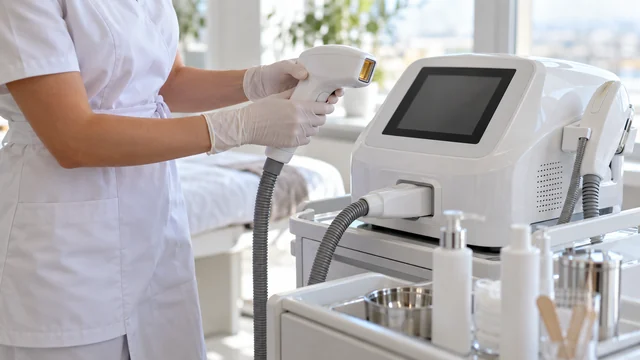
DEKA Motus PRO: What Stands Behind the Name of This Hair Laser
You are considering laser hair removal and see the name DEKA Motus PRO on an offer. It sounds reassuring, but a device name alone cannot tell you how smooth your skin will become, how it will feel, or whether a session will be safe for your skin tone. The important questions are the actual equipment configuration, the hair and skin being treated, and the practitioner's competence. Motus PRO is a professional laser platform made by the Italian company DEKA, not a cosmetic product or a promise that hair will never return.
The Motus PRO family includes alexandrite light at 755 nm and Nd:YAG light at 1064 nm, although some configurations contain only the alexandrite source. Different handpieces and energy-delivery methods may be available. Instead of merely asking whether a clinic has “Motus PRO”, ask which specific model, wavelength and handpiece will treat your area. This matters especially for darker or recently tanned skin, pigmentation-prone skin and sensitive locations.
What does the name Motus PRO actually identify?
DEKA describes the platform for hair reduction and certain benign pigmented and vascular skin concerns. However, a family of applications does not mean every handpiece offers every application, or that each is right for everyone. This page is mainly about hair removal; any pigmented or vascular lesion needs its own dermatological assessment rather than a cosmetic assumption.
US FDA 510(k) document K241459, issued in 2024, describes the MOTUS PRO family and specifically identifies MOTUS PRO AX as an alexandrite-only configuration. It lists indications involving reduction of unwanted hair, including long-term stable hair reduction. A 510(k) substantial-equivalence clearance authorises US marketing within its scope; it does not establish that a particular Armenian clinic owns the device or that the outcome will be identical for every patient.
Motus AY is another member of the range: do not apply photographs of its controls, output specifications, handpieces or instructions to PRO. If you want to compare the systems, see the separate DEKA Motus AY article. Even two PRO advertisements may conceal significant differences, so the provider should confirm the configuration of the physical unit they intend to use.
Why do the two wavelengths and Moveo matter?
Laser light is absorbed mainly by melanin, the pigment in the hair. It turns into heat that damages follicular structures and reduces their ability to generate hair. Dark hair generally provides more of this target. Blonde, red, grey and very fine vellus hair responds much less predictably. Switching brand names does not create pigment that the hair lacks.
Alexandrite 755 nm is commonly used for more strongly pigmented hairs. Nd:YAG 1064 nm has different light absorption and may be preferable for some darker skin types. It does not eliminate the risk of a burn, nor make every recent tan safe to treat. A clinician needs to consider skin phototype, sun exposure, hair thickness and treatment site rather than simply selecting the most powerful setting.
Moveo is DEKA's name for a contact, multipass technique: the operator moves over a defined area repeatedly, building heat gradually. DEKA promotes it as more comfortable; conventional handpieces can use individual pulses and cooling. Comfort is not proof of superior effectiveness. A session that feels easier does not necessarily deliver longer-lasting hair reduction, and the marketing phrase “painless” is not a clinical guarantee.
| Offer | Meaning for you | Check before treatment |
|---|---|---|
| Motus PRO with 755 nm alexandrite | One laser approach; results depend on the contrast between skin and hair | Exact model, skin type, tan, predicted hair response |
| Motus PRO with 1064 nm Nd:YAG | Different energy profile that may suit darker phototypes | Whether this source is actually installed and selected for your area |
| Contact Moveo mode | Gradual heating over multiple passes; sensations may differ from single pulses | Planned handpiece, cooling and technique |
| “Complete permanent removal” | Overstates the meaning of long-term hair reduction | How the outcome will be measured and whether maintenance may be needed |
When can the result disappoint even with a genuine device?
Laser treatment reduces hair growth; it does not guarantee that not a single hair will ever return. Hairs grow in different phases, so one session cannot effectively reach every follicle. Treated hairs may shed over days or weeks, initially looking as though they are still growing. A photograph the next morning is not a meaningful measure of the final response.
Thick dark hair on large body areas may respond more visibly than fine facial fuzz. If new coarse chin hairs appear together with changes to your menstrual cycle, acne or other symptoms, consider a medical assessment for hormonal causes. The laser acts on existing hairs, not on the hormonal stimulus for new ones. Facial areas also carry an uncommon risk of paradoxical hair growth around the treated site.
The number of appointments and the gaps between them should reflect the site, growth rate and your skin's and hair's response. Patient guidance commonly describes a series of laser visits, but it is not a Motus PRO-specific schedule. If the same package promises the same result for legs, face and bikini area, ask what supports that prediction.
Recent sun exposure, tanning beds or self-tanner complicate the decision: the contrast between skin and hair may be reduced and unwanted pigment changes more likely. Even if a US device indication covers a range of skin types, your safety depends on preparation and settings. Mention sunburn, recent tanning and colouring products before the session.
What will it feel like, and how will you look afterwards?
Before the first treatment, the professional should ask about skin conditions, medications, previous reactions to light-based treatments, scarring and tanning. They should assess hair thickness and colour, inspect your skin and explain the plan. During treatment, appropriate protective eyewear is essential and the area is prepared. Depending on the handpiece and approved protocol, cooling, contact gel or another technique may be used. You might feel a cool tip, warmth, tingling or brief snapping sensations. Pain thresholds differ, and underarms or bikini skin cannot be compared with the shins.
Redness and mild swelling around the follicles can occur after a session. These often settle as the skin calms, but nobody can promise there will be no visible trace within an hour. For a photo shoot, beach holiday or event showing your legs, leave some time and, if appropriate, learn how a small area of your skin reacts. You may feel medically well yet still notice dots, redness or discomfort where clothing rubs.
| When | What may be visible | What to do |
|---|---|---|
| Immediately afterwards | Warmth, pink skin, swelling around hair roots | Gentle cooling if advised; avoid friction and harsh products |
| Over the following days | Irritation gradually subsides; some hairs are still visible | Careful skin care, sun protection; do not pluck hairs |
| Over days or weeks | Treated hairs can shed gradually; density can remain uneven | Compare like-for-like photos rather than judging day one |
| If the reaction worsens | Blisters, severe pain, oozing, marked change of skin colour | Contact a medical professional rather than awaiting the next visit |
Sun protection matters after laser hair removal, especially on exposed skin: follow your clinician's advice and use broad-spectrum SPF 30 or higher. While the skin remains irritated, sauna, hot baths, intense exercise and coarse scrubs may be unwise. The appropriate interval depends on healing and the protocol, not a universal promotional figure. Do not cover a visibly inflamed area with heavy makeup simply to attend a social event.
Which risks does the word “modern” not remove?
Laser treatment can cause burns, blisters, crusting, temporary or persistent darker or lighter pigment, and rarely scars or infection. Risk varies with phototype, tan, settings, medical circumstances and operator skill. Ordinary laser hair removal is not suitable around the eyelids or eyebrows because of possible eye injury; protective eyewear for patient and staff is indispensable. A changing mole or suspicious pigmented lesion should be examined by a dermatologist before anyone attempts cosmetic laser treatment.
Elective cosmetic hair removal is generally postponed during pregnancy because reliable procedure-specific safety data are lacking and treatment is not urgent. During breastfeeding, discuss the site and individual situation with a clinician. This does not mean Motus PRO has been shown to harm a pregnancy. Do not stop prescribed medication on your own; disclose it first, particularly drugs that affect photosensitivity or healing.
Unusually severe pain, blisters, worsening swelling, signs of infection or problems with vision after a session call for urgent medical help. With ordinary mild redness, follow personalised care instructions and report the reaction before the next appointment. Do not accept additional laser passes over already damaged skin in an attempt to “even out” the result.
Motus PRO, another laser, electrolysis—or nothing yet?
For dense dark hair over a larger area, laser reduction may reasonably reduce the need to shave. For grey or nearly pigment-free hair, consider electrolysis, which works on individual follicles using electrical energy and does not depend on hair melanin in the same way. It does require hair-by-hair work and a different time commitment. With only a few unwanted hairs, your usual non-device removal method may be enough.
Without comparable studies of specific handpieces, skin types and long-term outcomes, nobody can credibly declare Motus PRO universally better than a platform such as GentleMax Pro Plus. Differences in delivery and cooling may alter comfort; suitability is not decided by the logo. Broader options and limitations belong in the general laser hair removal guide.
A natural result here can mean choosing how much hair reduction you want. Maximum reduction is not everyone's goal, particularly on the face. Discuss which places you want treated or left alone and the possibility of uneven density as some hair regrows. It is reasonable to stop a course after assessing the response if it no longer meets your preferences.
What should you ask to see before consenting?
- The exact model shown on the actual device, its configuration and whether 755/1064 nm sources are installed—not merely a photo of an advertising display.
- Evidence of operator training, a skin assessment, and an explanation of the chosen site, handpiece and method. You need a comprehensible rationale even if technical settings are not disclosed in detail.
- The plan if you have a tan, active dermatitis, relevant medication or an unexpected reaction, and what would lead to postponement.
- Realistic outcome criteria, the chance of maintenance visits and a full explanation of costs without speculative promises.
- Written first-days advice on sunshine, clothing, exercise and care, plus a contact in case of blisters or burns.
If a provider asks nothing about your health, promises zero risk for every skin tone, or cannot identify the device, stopping is sensible. In Armenia, lawful import and use of the actual machine and the practitioner's qualifications must be checked separately; an American FDA record or a DEKA website does not prove an installation exists in Yerevan. You can take time to compare responsible options without buying a package at the first consultation.
Further questions
Can the laser pass over a tattoo?
Hair-removal laser light should not be directed at tattooed skin. Tattoo pigment can also absorb energy, increasing the risk of skin injury and changes to the design. Ask how the tattoo and a suitable margin will be avoided.
Can I attend during menstruation?
The day of your cycle does not usually determine the device's suitability, but tenderness and discomfort may vary. If the area feels especially sensitive, arrange another date; medical contraindications are assessed independently.
Can it help with ingrown hairs?
Reducing hair numbers may reduce ingrowing for some people. Painful pustules, active inflammation or suspected infection should be assessed before any laser passes over the area.
Can I try a small test area?
A test spot can sometimes show immediate skin response and sensation, but cannot rule out delayed pigmentation or guarantee the safety of a full course. The practitioner decides whether and when to test and reassess it.