How Botox Works: Nerve, Muscle and Skin
You notice the crease between your eyebrows as you concentrate, and wonder whether Botox fills wrinkles, freezes the face or does something else. Botulinum toxin type A temporarily reduces the signals sent from a motor nerve to a targeted muscle. The muscle contracts less and pulls the overlying skin into a crease less strongly during expression. It does not fill a wrinkle, stretch the skin or normally eliminate sensation to touch.
In ordinary speech, “Botox” is often used for different botulinum toxin medicines, although Botox Cosmetic specifically refers to onabotulinumtoxinA. Brands, formulations and their potency units are not interchangeable. This affects both effectiveness and safety: the exact product, dose, anatomy and injection technique matter. Here is what happens from the nerve signal to the change you may see in the mirror, without promises to “stop ageing.”
What happens between the nerve, the muscle and the skin?
When you frown or raise your eyebrows, a motor nerve normally releases the messenger acetylcholine, telling muscle fibres to contract. The muscle then pulls the attached skin, creating dynamic, movement-related lines. Eyebrow position, forehead strength, habitual squinting and existing creases all shape an individual's pattern.
Injected into an appropriately selected muscle, botulinum toxin type A is taken up by motor nerve endings and interferes with proteins needed to release acetylcholine. The established mechanism of onabotulinumtoxinA includes cleavage of SNAP-25. Fewer activation signals reach the affected muscle fibres, weakening local contraction. This is not the same as switching off awareness, eyesight or skin sensory receptors; the mechanism can reduce expression lines without a numb-face feeling.
It is not instant: the cellular processes take time. Transmission gradually recovers as nerve terminals regain function and compensatory nerve signalling develops, allowing movement to return. No muscle is removed, no collagen is replaced and no permanent expression change is guaranteed. You can generally stop repeating injections, although an unwanted effect that has already appeared cannot be turned off immediately on request.
Why do some wrinkles respond better than others?
Think of one crease that disappears when you stop frowning and another that remains visible even at rest. The first is driven largely by facial movement and is more directly suited to muscle relaxation. The second also involves skin quality, accumulated sun damage and established tissue changes. Weaker contraction may soften it, but may not erase it. Increasing the dose does not make this a universal solution for every deep line.
| What bothers you | How the mechanism may help | Where it reaches its limits |
|---|---|---|
| Frown line between the eyebrows | Weakens the muscles responsible for that expression line. | Deep lines visible at rest may not disappear fully. |
| Horizontal forehead lines when raising the eyebrows | Reduces forehead-muscle contraction. | That muscle also elevates the brows; too much weakening can cause heaviness or drooping. |
| Lines beside the outer corners of the eyes when smiling | Decreases activity in part of the orbicularis oculi muscle. | It does not treat every cause of fine dry skin and requires careful eyelid assessment. |
| Dryness-related lines, texture or dark spots | Little or no direct effect on those causes. | Skin care, sun protection or texture-targeted treatment may be more appropriate. |
| Facial volume loss or significant sagging | Selective muscle weakening can sometimes shift the balance of tissue pull. | It cannot restore lost volume or replace treatment of structural changes. |
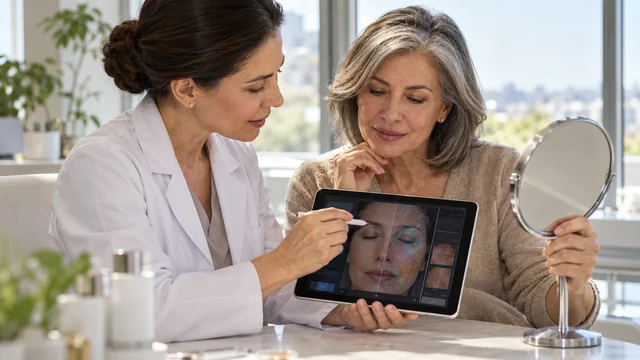
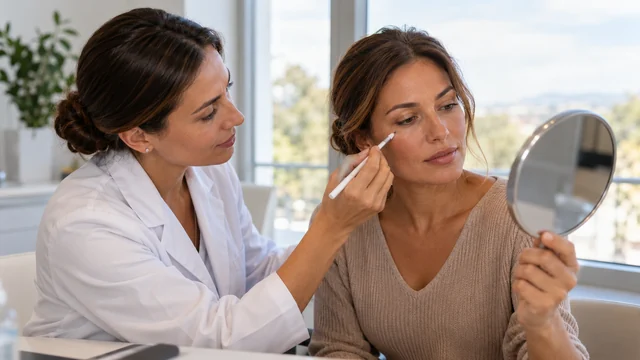
That is why a clinician checks the face not only at rest but while you frown, smile and raise your brows. Muscles work together: weakening one can reveal the pull of another and alter a brow or mouth corner. Treatment is an anatomical decision, not simply a price per unit. Existing asymmetry must also be recognised; perfectly identical movement on both sides is not normal for everyone.
Will my face still move naturally?
Natural movement can remain when the zones and degree of weakening are selected carefully. But this is not automatic or guaranteed with any pattern of injection. Stronger weakening of muscles central to expression makes unfamiliar movement more likely. A restrained approach may leave more wrinkles yet better preserve your ability to raise the brows. There is no single best compromise for everyone.
Tell the clinician explicitly which expressions you want to retain: for example, “I want to look surprised naturally without a heavy forehead.” They can explain whether that suits your anatomy and how much softening to expect. A promise to erase every crease, create perfect symmetry and preserve every movement unchanged contradicts how the medicine works.
When does it begin working, and why does it wear off?
The first changes often appear over several days. The American Academy of Dermatology says many people notice effects within 3–7 days. A full judgement should not be made on leaving the treatment room; timing varies by product, area and response, and your clinician should set a follow-up point. The effect on expression lines commonly lasts around 3–4 months, sometimes longer, without guaranteeing that duration for you.
The differences reflect muscle size and strength, dosage, injection sites, product, restoration of nerve-muscle signalling and the clinical aim. Question proposed injections at unusually short intervals or promises of permanence. Repeated use may sometimes alter response, including rare neutralising antibodies, but this does not mean everyone develops “addiction” or resistance. Duration is explored separately on the page about how long Botox lasts. The US Botox Cosmetic label specifies that safety and effectiveness of treatment more often than once every 3 months have not been clinically evaluated. This is a product-specific evidence limit, not a universal schedule for every toxin brand.
How does the procedure feel, and what might other people notice?
A fine needle causes brief pricks; possible effects include tenderness, redness, slight swelling or a bruise. Many people can resume ordinary activities relatively soon, although pinpoint marks may still show. Minimal medical downtime does not mean you will necessarily feel camera-ready for a video call or photo shoot. Plan for both possible needle marks and the time needed to judge the final expression change.
Do not rub or massage the injection sites. The advice on strenuous exercise, makeup and aftercare must match the specific product and clinician's instructions; the AAD, for example, recommends avoiding rubbing and postponing vigorous exercise for a period. Do not try to redistribute the medicine yourself. Eyelid heaviness or facial asymmetry should be reviewed by the treating clinician, not handled with advice from social media.
Why can Botox affect a muscle that was not the target?
The result depends on the muscle selected, injection depth and spread into nearby tissues. Even weakening a nearby muscle can alter eyelid position, brow height or the smile. Recognised adverse effects include drooping eyelid or eyebrow, local weakness, headache and eye discomfort. Dry eye or difficulty closing an eyelid can also occur; persistent irritation, light sensitivity or visual change calls for medical assessment.
Trials of Botox Cosmetic support effectiveness for particular facial expression lines, not every brand or off-label area. Uses outside an approved indication may be considered by qualified clinicians but require a separate explanation of evidence limitations and consent. A US product label does not establish that any medicine is registered or available in Armenia. Ask for the exact offered product, its origin and documentation rather than relying on the general word “Botox.”
When is this treatment unsuitable or in need of extra caution?
The US Botox Cosmetic label lists known hypersensitivity to any botulinum toxin preparation or an ingredient of Botox Cosmetic, and infection at the planned injection site as contraindications. Neuromuscular disorders—including myasthenia gravis, Lambert–Eaton syndrome and motor neuron diseases—need particular caution because weakness may be more serious. The clinician must know about past toxin treatments and medicines that interfere with nerve-muscle transmission, including aminoglycoside antibiotics and muscle relaxants. Tell the clinician before treatment if you already have difficulty swallowing or breathing: the label warns that these pre-existing problems can increase susceptibility to serious complications. Lung or cardiovascular disease also warrants individual assessment rather than a one-size-fits-all plan.
Evidence is insufficient to establish safety for elective cosmetic injections in pregnancy, so postponement is sensible. During breastfeeding, the decision needs individual discussion: the Botox Cosmetic label says data are lacking about its presence in human milk or effects on the breastfed child. This does not establish either proven safety or certain harm. Inform your doctor about pregnancy, breastfeeding or pregnancy plans before an injection. Dedicated pages discuss pregnancy and breastfeeding in further detail.
A rare but important warning is that botulinum toxin effects may spread beyond the injection area and cause widespread weakness or problems speaking, swallowing or breathing. These require urgent medical attention even if they develop later. A serious allergic reaction with breathing difficulty also needs emergency care. These are not routine outcomes of cosmetic injections, but must not be dismissed.
What if you do not want to reduce facial movement?
Start by identifying what causes the feature that bothers you. Gentle skin care may be more useful for dryness-related fine lines; consistent sun protection and dermatologist-guided therapy address photodamage. Volume loss and deeper tissue changes require different approaches, which have their own risks. Sometimes a line bothers you mostly in enlarged selfies rather than daily life. Doing nothing is a valid, often reasonable choice.
You may hear that Botox “prevents every future wrinkle.” Reducing repeated muscle contractions can reduce some dynamic creases while the product is active, but it cannot stop skin ageing, UV damage or other tissue changes. Available evidence is not enough to promise a preventive benefit for every young adult. Base the decision on your current concerns, not anxiety about hypothetical future wrinkles.
What should you ask before a first injection?
- Which muscles create my specific line, and how would weakening each change it?
- What is the exact product, can its origin and local authorisation be checked, and why are its units not interchangeable with other brands?
- Which movements or asymmetry may remain, and where are the risks of a heavy forehead, drooping eyelid or altered smile?
- When should the result be assessed, how can I contact the clinician after an adverse effect, and what happens if I dislike the result?
- Which conditions, medicines, prior injections or pregnancy plans affect my safety?
- Would skin care, observation or skipping the treatment be a sensible starting point?
The clinician should explain both the expected softening and the reduced movement responsible for it. With good information you can choose a subtle change, a more marked effect or no injection at all. The mechanism is a temporary weakening of nerve signalling; its visible effect on a living face is individual and depends on anatomy, preferences and careful medical judgement.
Additional questions
Why is botulinum toxin also used for excessive sweating?
It can also inhibit acetylcholine signalling to sweat glands, which reduces sweating. That is a different indication and involves different injection sites, dosing and safety considerations; an aesthetic wrinkle consultation does not establish suitability for this treatment.
Sources
- DailyMed — BOTOX Cosmetic US prescribing information
- American Academy of Dermatology — Botulinum toxin therapy: Overview
- American Academy of Dermatology — Botulinum toxin therapy: FAQs
- DailyMed — Botox Cosmetic Medication Guide
- Health Canada — BOTOX Cosmetic Product Monograph
- DailyMed — BOTOX Therapeutic Prescribing Information