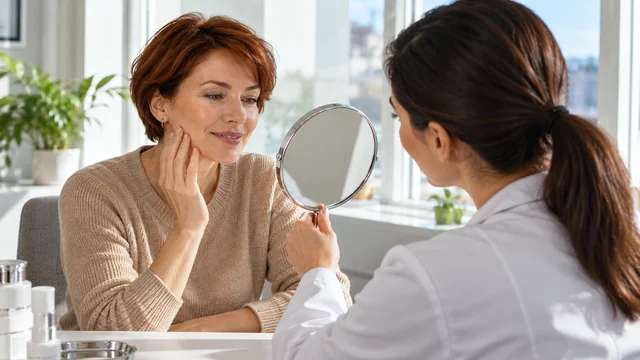
How Mesotherapy Works: What Is Injected and What to Expect
When someone says “Let's do mesotherapy, your skin will improve,” the useful first question is what exactly will be injected, and why? Mesotherapy is not one drug with one effect. It describes a technique of multiple small injections, usually into superficial tissue. What happens to skin or hair depends on the product, dose, depth, indication and individual response. Needle punctures do not turn any vitamin mix into a proven treatment, and an attractive umbrella name is no substitute for a studied formulation.
Confusion often starts when advertisements interchange “cocktail”, “biorevitalisation”, “skin booster”, “microneedling” and “mesotherapy”. The treatment areas may overlap, but the ingredients, delivery routes and legal product status do not necessarily match. Understanding your proposed procedure requires the full names of injected products, their intended administration route, clinical goal and potential risks.
Which elements of the procedure might actually have an effect?
First comes delivery of a substance. The needle crosses the skin barrier and places a product into a particular tissue layer. This is different from applying a cream: local concentration and exposure change, as do potential side effects. If a specific intradermal hyaluronic-acid product is used, the aim may be changes in hydration or skin properties. Another active ingredient requires a different rationale. “Meso cocktail” alone tells you nothing about whether a formulation has been studied for this route of injection.
Second is the tiny injury made by each needle. Punctures prompt the skin's normal repair response and can cause temporary redness and swelling. It is not sound to attribute every change to “new collagen production”, especially if a study did not compare the active product with needle punctures alone. Sometimes an early plumper appearance comes from swelling, not lasting improvement.
Third is the condition of the tissue being treated. Dehydrated or irritated skin, advanced sun damage, loss of deeper facial volume, pigmentation and active hair loss are not the same problem. Even carefully chosen intradermal injections cannot necessarily treat a cause situated deeper in the body. That is why examination matters more than the number of injection points or a promise of “universal rejuvenation”.
Why can't two treatments called mesotherapy be compared directly?
| What is offered | Usually proposed mechanism | What should not be expected automatically |
|---|---|---|
| Injection of a specified hyaluronic-acid formulation | The local action of that particular injectable product; possibly improved hydration or skin quality. | Lifting substantially sagging tissues, the same effects from any other hyaluronic-acid product, or established multi-year durability. |
| Mix of “vitamins, amino acids and trace elements” | The proposed action of each ingredient after injection into the skin. | Guaranteed efficacy or safety without evidence of sterility, compatibility and an authorised injection route. |
| Scalp injections | An attempt to influence follicles or scalp condition. | Replacement of diagnosis for androgenetic, alopecia areata or scarring hair loss, or proven benefit from an arbitrary cocktail. |
| Microneedling with a topical serum | Controlled micro-punctures, with the serum applied on the surface. | Equivalence to a sterile injectable medicine, or permission to inject a cosmetic serum through a needle. |
This distinction matters for product authorisation. A product cleared for topical use does not become approved for injection because it is described as “natural”. Conversely, a favourable trial of one manufactured injectable formulation proves nothing about a mixture prepared ad hoc. Regulatory decisions apply to specific products and jurisdictions, not to the word “mesotherapy” itself.
What does research say about skin quality?
In the international 2025 consensus, authors recognised considerable variation in mesotherapy practice and no single internationally accepted standard across all applications. Some intradermal products used to address hydration or fine lines have encouraging evidence, but long-term effectiveness and tolerability cannot be assumed for the whole category. A 2021 review specifically assessed facial rejuvenation mesotherapy critically and considered the clinical evidence insufficient to recommend broad routine use. That document covers several medical and dermatological applications; it does not validate every cosmetic mixture for facial rejuvenation.
There are newer product-specific trials. A 2026 randomised study of one sodium-hyaluronate composite reported improvements in measured skin hydration and elasticity compared with no intervention during its follow-up period. This is a reason to ask which formulation was tested and against what, not evidence that all mesotherapy cocktails work. With an untreated control group, the design does not fully separate the product's contribution from the act of injection; a component manufacturer also funded the research.
Ask about limitations as well as the publication: was there a comparison group, how long was follow-up, was it exactly the same formulation, and were results judged using consistent photos or objective measurements? Finding a study of a different product does not oblige you to buy an expensive course. Limited evidence is a legitimate reason to decline or choose a more predictable option.
When is it worth discussing mesotherapy, and when does the goal not match?
If you have mild dryness or texture concerns and would accept a moderate, possibly temporary change, a conversation about one well-studied product makes more sense than a promise to look “ten years younger”. Superficial injectable formulations cannot replace structural correction of deep static folds, substantial tissue descent or excess skin: the site and depth of the problems differ.
Active acne, rosacea, eczema, infectious inflammation or a changing pigmented lesion should be medically assessed first. Injecting into inflamed or damaged skin can complicate matters and delay appropriate treatment. With hair loss, diagnosing the type and checking possible deficiencies or hormonal factors matter more than choosing a fashionable cocktail. Scarring alopecia may need timely medical treatment rather than a cosmetic injection series.
If you bruise easily, take medicines affecting clotting, have an autoimmune condition or have had a severe allergy, the risk discussion should be more detailed. These are not automatic absolute bans on every potential product; contraindications depend on the specific formulation and your medical circumstances. Do not stop prescribed medication for a cosmetic procedure without speaking to your treating doctor.
What happens during a session and what will the next day look like?
An examination and discussion should happen before product preparation. The practitioner clarifies the goal and medical history, checks the ingredients, expiry date and intended administration route, cleanses the skin and performs injections with sterile single-use equipment. Pain relief and its limitations can be discussed. Duration and number of punctures vary with the area and technique; promising everyone the same multi-session course makes little medical sense without naming a product and indication.
You may feel small pricks, burning, tingling or pressure. Immediately afterwards, small raised bumps at injection sites, pinpoint marks and redness may appear. Bruises and swelling can develop later. How quickly these settle depends on the formula, technique, body area, individual sensitivity and current skin condition. Even meticulous injections cannot guarantee an absence of visible marks.
| Practical situation | What to consider | Sensible approach |
|---|---|---|
| Work video call tomorrow | A grid of punctures, bumps or local redness may still be visible. | Do not count on your face looking entirely unchanged after a first treatment. |
| Important photos in a few days | Bruises or uneven swelling may last longer than expected. | Postpone injections if your appearance in the pictures needs to be predictable. |
| You want to know if the treatment “worked” | Early fullness may be post-injection swelling. | Agree on a review appointment after reactions have settled. |
| You regularly swim, use a sauna or work out | Punctures bring restrictions that depend on skin and product. | Get personalised return-to-activity instructions before treatment. |
Not needing medical sick leave is different from looking ready for close-up photography. Ask in advance when you may wash with your usual products, apply makeup, restart acids or retinoids, exercise and use a sauna. Do not massage or puncture raised injection bumps yourself. Aftercare must match the actual formulation and skin response, not be copied from another kind of mesotherapy.
What risks come from the method itself?
Every injection carries risks of pain, bleeding or bruising, inflammation and infection. Additional risks depend on the ingredients: allergy, local tissue reactions, persistent nodules and granulomas (long-term inflammatory lumps), pigment changes and scarring. Published reports link some serious and difficult-to-treat infections with poor sterility or inappropriate products. Never inject home-made mixtures or cosmetics intended only for application to the surface.
Pregnancy and breastfeeding call for particular caution: elective cosmetic cocktails are diverse and safety data are inadequate. It is sensible to postpone injections pending individual discussion with a clinician. Fever, active skin infection or an unexplained rash also call for assessment first. “They're just vitamins” is not a safety guarantee; the injection route matters as much as the contents.
Contact a medical professional promptly if pain worsens, redness spreads with heat, pus appears, swelling is unusually severe or you develop fever. Signs of a severe allergic reaction—difficulty breathing, tongue or throat swelling, fainting—require emergency care. Do not dismiss deterioration several days later as “natural detoxification”: that is not an accepted phase of mesotherapy.
Mesotherapy, biorevitalisation or microneedling: how do you choose?
“Biorevitalisation” is commonly used for hyaluronic-acid injections, but the marketing term does not establish which formula was studied or whether it is made for intradermal delivery. Mesotherapy encompasses more ingredients and indications. Microneedling produces controlled micro-injuries; applying serum afterwards does not make that serum safe to inject as medicine. Botulinum toxin alters nerve signalling to specific muscles, helping some expression lines—not “feeding the skin”.
Often the most useful starting point is consistent gentle skincare, sun protection and treatment of a diagnosed skin condition. If your concern is expression wrinkles, medically caused hair loss or structural sagging of the lower face, the right consultation route will differ. Your options need not be limited to four injections on a price list: declining any procedure is a valid decision.
Your checklist before consenting
- Full name and contents: Which manufactured formula will be used, who makes it, and how are authenticity, expiry and sterility checked? Is it mixed on site or supplied ready-made?
- Route and regulatory status: Does this product's own documentation allow the proposed injections in the country where treatment occurs? Is an authorisation from another country being misleadingly relied on?
- Expected change: What will remain once injection-related swelling has gone, how will it be measured and in which circumstances might treatment fail?
- Alternatives: What if you continue skincare alone, treat the underlying skin condition or choose another researched technique?
- Safety and response plan: Who injects, which sterile precautions are used, and what happens with allergy, inflammation or a lump? Is an emergency contact available?
If someone refuses to show packaging, cannot name the active substances, offers to inject an ordinary cosmetic serum, or promises “no complications”, do not consent. Mesotherapy can be discussed meaningfully only when the product, indication and quality of evidence for that particular combination are known.
Frequently asked questions
Can an allergic reaction be delayed?
Yes. Not every reaction appears immediately. Unusual rash, itching, lumps or increasing inflammation should prompt contact with the clinician; severe allergy symptoms require emergency help.
Should the dose be doubled if injections made no difference?
No. Increasing dose or frequency is not a proven solution for an absent result. Revisit the diagnosis, formula, expected outcome and benefit–risk balance.
Is the word “hyaluronic” on the label enough to judge a product?
No. Formulations, concentrations, sterility, intended tissue layer and permitted administration route differ; products are not interchangeable just because an ingredient has the same name.
Sources
- International Consensus Guidelines on the Safe and Evidence-Based Practice of Mesotherapy, 2025.
- Consensus statement on mesotherapy for clinical and regulatory practice, 2026.
- Review of evidence for facial skin rejuvenation mesotherapy, 2021.
- Randomized study of one sodium-hyaluronate composite for facial skin, 2026.