
How to Treat Dimpling After Thread Lift: Safe First Steps
After a thread lift, you notice a dent in your cheek; when you smile, the skin seems caught at a single point. Wanting to smooth it out quickly is understandable. The safest first step is to contact the clinician who placed the threads and show them the dimple, rather than kneading it yourself. Some small irregularities in the first days ease as swelling settles and tissues adapt. A persistent dimple, however, may reflect an overly superficial thread, too much tension or skin caught on a thread's barbs; it needs assessment and sometimes professional correction. There is no universal safe home trick to “remove every dent”.
First decide: is the dimple stable, or are warning signs appearing?
A skin dimple, sometimes called dimpling or puckering, is a visible point or crease where the skin appears tethered deeper than normal. It may appear only with facial movement or also at rest. It is different from a simple bruise or widespread swelling. Record where and when it first appeared, whether it changes with smiling, speaking or opening your mouth, whether pain is strong and whether a thread tip is visible.
Contact the treating clinician soon, especially if the depression is pronounced, painful, worsening or limits your facial expression. Photos taken at rest and under consistent lighting can help, but they do not replace examination if a complication is suspected. A review of thread-lift complications notes that early assessment may distinguish a temporary tissue reaction from mechanical traction; later tissue fixation may make correction harder. A 2025 clinical review proposes a follow-up visit within 1–2 days of thread placement; this is an example of early monitoring, not a universal deadline or a reason to wait if warning signs appear. Do not postpone assessment for months merely because someone says “the thread will dissolve”.
| What you notice | Possible explanation, not a diagnosis | What to do |
|---|---|---|
| A small dimple immediately after treatment that is fading, without worsening pain | Early tissue tension and swelling | Tell the clinician, follow the restrictions and monitor to an agreed schedule |
| A deep fold or pulling with a smile that barely changes | Barbs catching tissue or a thread placed too superficially | Attend an in-person assessment and discuss professional release or adjustment |
| A thread you can feel or see, or a protruding tip | Superficial placement, movement or extrusion | Do not pull or trim it at home; seek medical review |
| Increasing redness, warmth, discharge, worsening pain or fever | Possible inflammation or infection | Urgent same-day medical assessment; emergency care if severely unwell |
| Sudden facial weakness, visual disturbance, abrupt unusual swelling or difficulty breathing | A potentially serious complication, not routine cosmetic unevenness | Emergency medical assistance |
Can massage, cooling or cream remove the dimple?
Do not start vigorous massage, stretch the crease, use facial massagers, gua sha, taping or “roll the thread” with your fingers after watching a video. If a thread is physically tethering the skin, pressure may increase pain, injure tissue, move the thread or obscure a complication. Published clinical reports do describe gentle manual release for some early dimples, but this is not a home-massage instruction. The professional needs to know the thread's direction, type, depth and the condition of the skin.
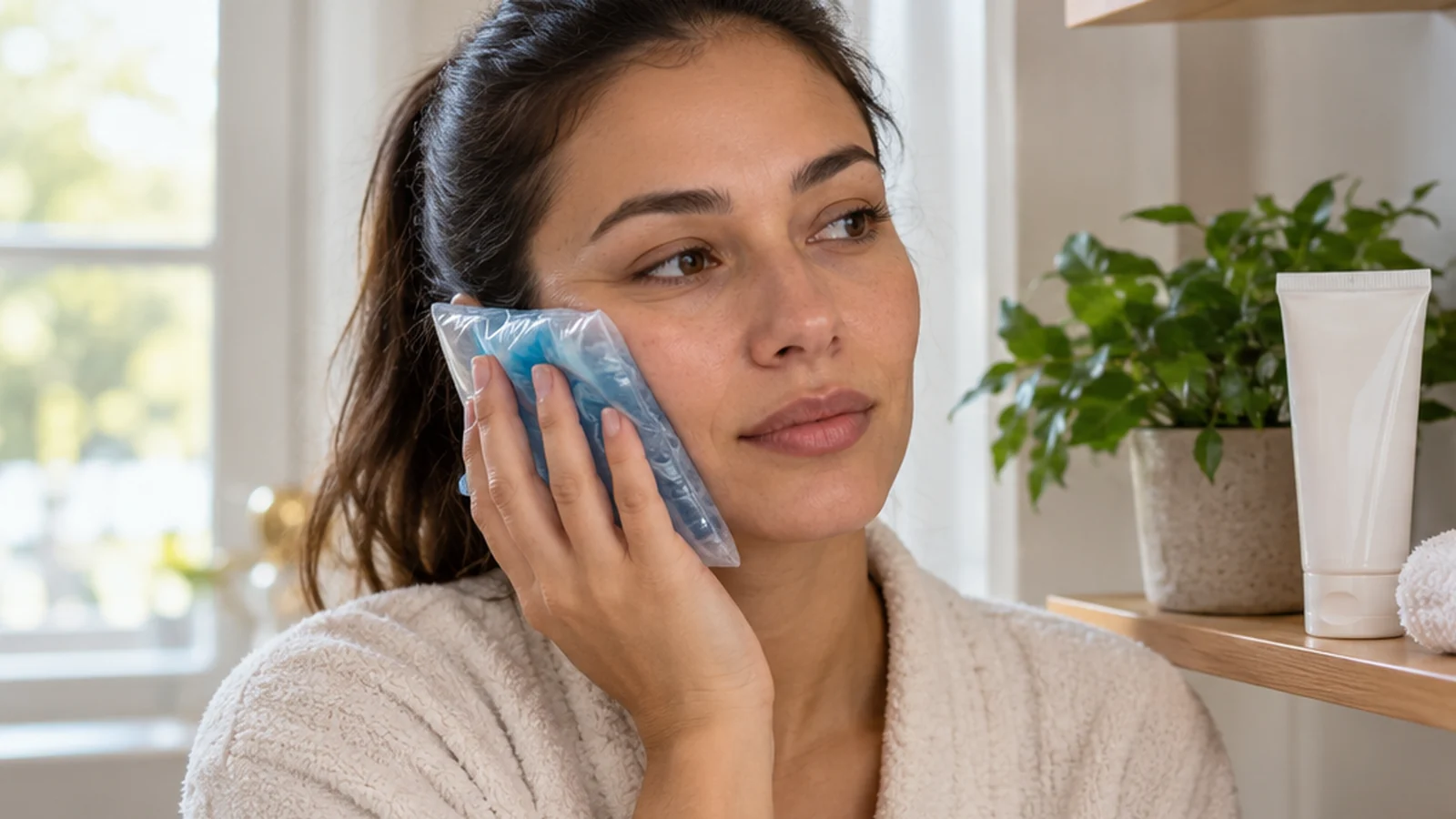
A cool compress is sometimes advised soon after thread lifting for swelling, but it does not unhook a tethered thread. Use one only as instructed by your clinician, through clean fabric and without pressing on a protruding thread or damaged area. Cooling must not delay an assessment of suspicious redness. Facial cream may be suitable for ordinary skincare once your clinician allows it, but no cream can mechanically release a thread-fixed crease.
While awaiting assessment, avoid vigorous rubbing, improvised heat, device-based treatments, intensive facial exercises and attempts to squeeze or lift out a thread. Do not seek filler injections from another practitioner to camouflage a dimple before its cause is known. Do not take antibiotics or steroids “just in case”; a clinician should decide the treatment if infection is suspected.
What kinds of correction might a clinician discuss?
Management depends on the cause, whether the thread is absorbable or permanent, barbed or smooth, its depth, time since placement, severity and whether inflammation is present. A suitably experienced clinician examines the skin at rest and during movement, compares findings with the insertion record and may consider ultrasound imaging when it could help locate a structure. Ultrasound is not necessary for every case, and availability should not be assumed.
| Option | When it may be considered | Important limitation |
|---|---|---|
| Review and observation | A small early dimple is fading, with no infection signs | Requires contact with the clinician and a scheduled review, not indefinite waiting |
| Precise manual adjustment or releasing a tether | A clinician has identified a mechanical cause amenable to early correction | Do not attempt the manoeuvre yourself; another approach may be needed |
| Repositioning or removing the problem thread | Persistent traction, a superficial or extruding thread, or another confirmed issue | A repeat procedure brings its own risks and removal may not be simple |
| Other specialist methods | Selected difficult cases after tissue assessment | Saline or filler injections and tissue release have been described but are not universal and can cause further complications |
If someone promises to remove every dimple with one movement — or insists that no dimple can be touched before the thread has completely dissolved — ask what supports that choice in your situation. Published studies include diverse materials and techniques, making a single guaranteed date for resolution unreliable. Even an absorbable thread does not guarantee that the visible crease will disappear quickly and completely without treatment; tissue changes can outlast the pulling force.
When might it fade, and what about appearing in public?
In the first days, swelling may either highlight or hide surface irregularities. Clinical publications distinguish early reactions from persistent problems lasting weeks, and use varying follow-up periods. A 2026 meta-analysis notes that dimples resolved on their own within 3–6 months in some studies; that is not a personal prediction and does not justify postponing medical assessment. A photo cannot supply a fixed date for resolution. If the crease continues to improve and the clinician finds no warning signs, monitored observation may make sense. If it stays marked or worsens, repeat assessment is more sensible than waiting for an arbitrary calendar date.
Social recovery is a separate matter. You may be able to work at a computer while still seeing a fold in side lighting or when you smile. Heavy make-up cannot flatten a mechanically tethered dimple, and cosmetics must not be applied to fresh thread-entry sites until the clinician approves. For filming, interviews or a family event, do not assume there will be an “even skin” date; discuss whether the crease may still show and when it will be reviewed.
General thread-lift aftercare often involves gentle cleansing, avoiding strong friction and temporarily limiting exertion and sleeping with pressure on the treated side. Your own restrictions depend on the technique and instructions given. Permission to return to normal activities is not permission to massage the dimple. Any sudden change in symptoms overrides the observation plan.
What should you bring to make the assessment more useful?
- Bring the procedure date, treated areas, exact thread name if documented and the name of the person who performed it.
- Explain when the dimple first appeared: immediately, once swelling fell or weeks later; describe how its depth has changed.
- Show photographs in matching light at rest and smiling, without deliberately stretching the skin for the camera.
- Report pain, changed sensation, fever, discharge, skin-colour change, medicines and previous facial procedures.
- Ask what points toward temporary tension, when you need another visit, what happens without improvement and what risks correction carries.
If the original clinician cannot be reached, consult a qualified plastic surgeon or another physician experienced in thread-procedure complications. Do not delay when facial movement is affected, pain develops or a thread seems to be extruding. Before any revision, ask how it differs from the initial lift and whether it could leave a scar, asymmetry or additional swelling.
When is watching reasonable — and when is waiting unsafe?
Observation is reasonable not because an online comment says “let the threads settle”, but because a professional has checked a mild stable dimple, excluded warning signs and agreed a follow-up plan. Nor must a barely visible point be corrected at any cost: revision can add tissue injury and the cosmetic concern must be balanced against that risk. A persistent painful fold, exposed thread or evidence of infection, however, is not only an aesthetic issue.
You may request a clear explanation, your thread records and a second opinion. Do not agree to an immediate repeat injection or forceful massage just because leaving with a visible dimple feels awkward. What matters now is identifying the cause safely and agreeing a review plan, not making the skin smooth at home at any price.
Additional questions
What if I no longer have the card naming the threads?
Ask the clinic for a copy of the record showing the product name, material, number of threads and insertion areas. If that is unavailable, tell the new clinician everything you know so assessment takes account of missing information rather than proceeding blindly.
Can hyaluronidase “dissolve” a lifting thread?
Hyaluronidase is used for certain hyaluronic-acid products, not as a universal solvent for lifting threads. Do not inject it yourself or accept an injection without establishing the material and the cause of the dimple.