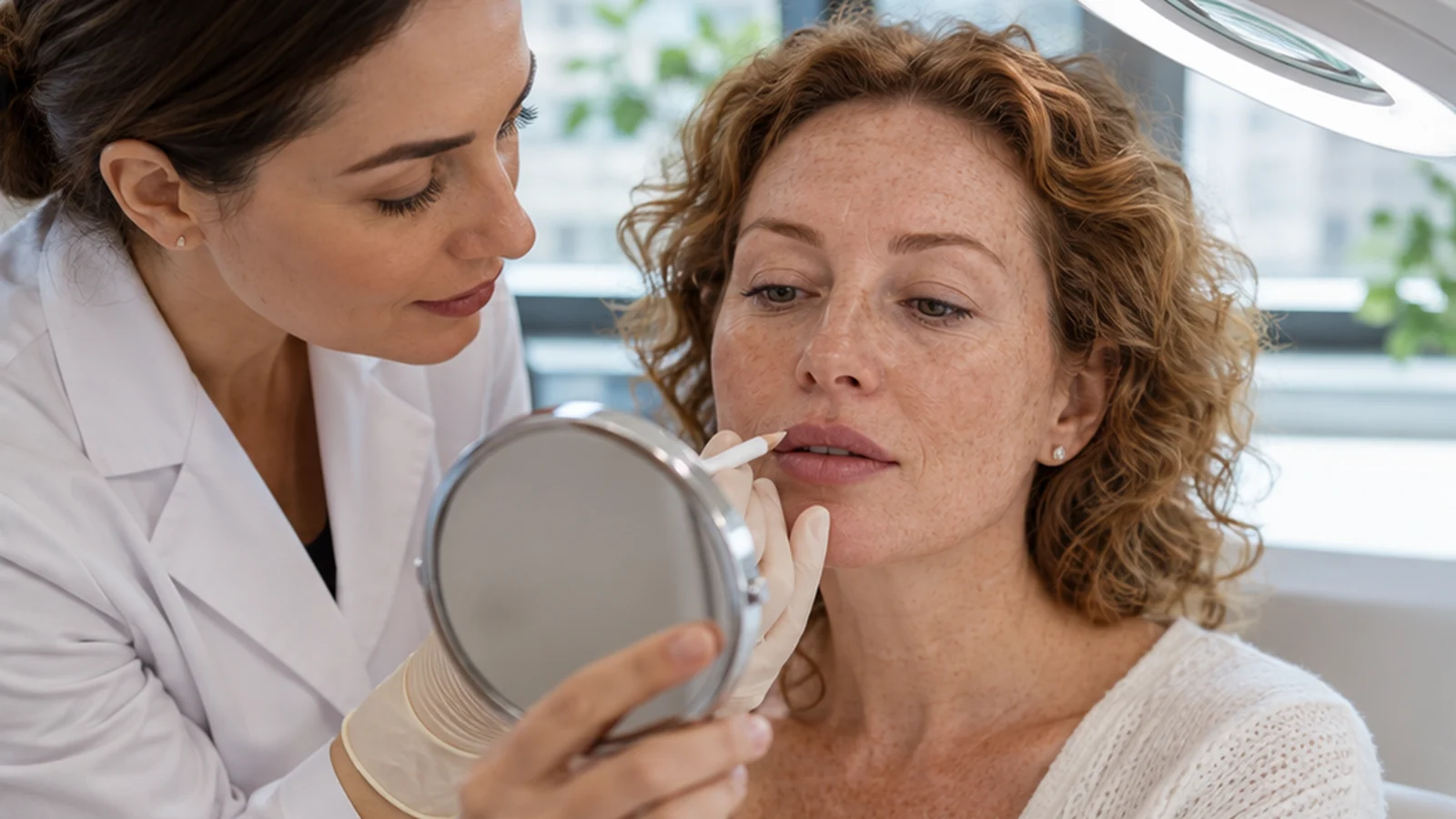

Lip fillers: what to expect, the first days and the risks
If you want a clearer lip border or a little more fullness, filler can seem straightforward: one visit and the change is visible. But lips move constantly, have a rich blood supply and swell easily. Start not with millilitres but with your actual aim: volume, shape, asymmetry, dryness, lines around the mouth or how the upper lip sits when you smile. Injection does not solve all these concerns. A natural-looking result is possible, but cannot be guaranteed without sound anatomical assessment and informed consent.
Temporary augmentation often uses hyaluronic acid (HA) fillers, gels made with a water-binding substance. “Hyaluronic acid,” however, does not mean risk-free. The most important uncommon danger is material entering a blood vessel and interrupting blood flow. Ask about recognition and an emergency response plan before numbing begins, not after a complication occurs.
Why the same volume looks different in different lips
Lips comprise the red lip tissue, the border with surrounding skin, the central curve of the upper lip, the corners and muscles involved in speech and smiling. Teeth, bite, the skin length between nose and upper lip, relative upper and lower lip size, habitual movement and tissue firmness all affect appearance. A moving area calls for particular care in product and placement choice. Filler adds volume; it cannot reposition teeth or solve every issue around the mouth.
A small increase can be striking on naturally thin lips, while copying a stranger's large-volume look may blur the natural lip-skin transition and feel overfilled. Check whether asymmetry appears at rest or only when smiling: adding gel may not correct differences in muscle action. Dryness and peeling call for barrier care and investigation of irritation, not automatic injectable “hydration.”
| Your main concern | What filler may do | What also needs assessment |
|---|---|---|
| Thin red lip tissue | Temporarily add fullness and alter proportions | Tissue suitability and natural facial movement |
| Uneven border without substantial volume loss | Sometimes define a small area of the edge | Whether gel would cause visible protrusion |
| Asymmetry chiefly when smiling | Help only if there is a volume-related component | Muscle movement, teeth and bite, earlier injections |
| Dryness, fissures and peeling | Does not treat the cause | Gentle barrier care, allergies, inflammation and possible medical review |
| Vertical lines above the upper lip | Some specifically indicated fillers may soften certain lines | Skin quality, muscle movement and alternative methods |
| Long upper-lip skin or lip-to-teeth position | Does not shorten skin or alter the bite | Appropriate specialist evaluation; possibly no injection |
Which product is appropriate for lips?
Regulatory status belongs to a specific product, formulation, age group and country—not to the generic word “filler.” For example, the US Restylane Kysse patient label describes temporary lip augmentation and treatment of lines around the upper lip for people older than 21. That is a US statement about that product, not identical indications for all gels and not proof that Kysse is registered or available in Armenia. Check the authentic pack, batch number, expiry, labeling and instructions rather than trusting a familiar advertising name.
HA gels vary in viscosity, elasticity, how they spread and other ingredients. Some include lidocaine, a local anaesthetic. No one brand or formulation is automatically best for every lip: baseline tissues and medical history matter. Unverified permanent substances and liquid silicone are not equivalents to purpose-authorized fillers; the FDA warns of serious, sometimes irreversible harm from silicone injections.
A separate red flag is an offer to inject filler using a needle-free pressure “pen,” or a gel bought for self-injection. The US FDA warns that such needle-free devices are not approved for dermal-filler injection in the United States and have been linked to serious injuries; self-injection and buying unverified filler are unsafe, too. This is a US safety warning, not a statement about Armenian registration rules. Choose a proper medical setting and a qualified professional able to respond to complications.
Instead of only asking “How many millilitres?”, ask “Why that amount for me?” Starting conservatively and reassessing after swelling resolves may prevent overfilling. Even a tiny amount, however, does not eliminate vascular risk. Your clinician should explain the intended area and rationale; you need not choose needle depth yourself or dictate technique from a video.
What happens during an appointment, and will it hurt?
Discuss how you wish to look relaxed and smiling, earlier fillers, medicines, allergies, cold sores, inflammatory conditions and upcoming dental procedures. The clinician should establish what was injected before. If records are unavailable or lumps persist, further evaluation may matter more than another injection; it may be wise to return with documents later.
After cleansing, the doctor may use cooling, numbing cream or another appropriate anaesthetic. Lidocaine inside some products can reduce discomfort but does not make treatment painless. You may feel a prick, pressure, burning or brief soreness; sensitivity varies. Intense unusual pain is not something you should accept as the price of a good shape. Marked pain, blanching or unexpected colour change demands stopping injection and immediate clinical assessment.
Immediately afterward, uneven swelling and injection marks make symmetry hard to judge. Arrange follow-up rather than treating the mirror as the final result. Do not accept extra gel merely because your swollen lips do not match a photograph. Obtain a written record of product name, volume, date and batch number, plus a reliable contact for complications.
What will lips look like on day 1, day 3 and after a week?
On injection day, tissue swelling can make lips appear fuller than intended. Red puncture marks, tenderness, swelling, bruising and temporary differences between sides are possible. Swelling commonly eases over the following days, but no one can predict your social comfort at work, on a date or on camera: bruising and puffiness may remain longer. AAD notes that ordinary localized reactions with some fillers often settle within 7–14 days, sometimes sooner. This is not a personal guarantee or a reason to ignore worsening signs.
| Time after injection | What others might notice | How to respond |
|---|---|---|
| Treatment day | Swelling, punctures, redness, unfamiliar shape | Do not judge final volume or massage gel yourself |
| Days 2–3 | Swelling and bruises may persist; one side may look larger | Follow tailored instructions and monitor changes; seek assessment for worsening |
| Around the first week | Some look more familiar while others still have visible marks | Avoid first-time filler immediately before important photos |
| After the initial reaction settles | Contour and smiling movement can be assessed more reliably | Discuss any adjustment at review; extra product may not be needed |
Your clinician may advise avoiding strenuous exercise for the first day or two to limit swelling and bruises. ASPS cites 24–48 hours as a general guide, but follow your treating clinician's instructions. Ask separately about heat, sauna, sunshine and skin care. Do not squeeze or massage lips unless specifically instructed: not all fillers require massage, and home intervention during a complication can waste critical time. Use lipstick and other contact products when the clinician advises, considering puncture sites.
Which symptoms are more serious than normal swelling?
Common concerns include bruises, pain, swelling and transient asymmetry. Lumps, infection, allergy, recurrent inflammation and migration can occur. A particularly serious complication is vascular occlusion: a vessel is blocked if filler enters it accidentally or impairs blood flow, potentially causing tissue ischaemia and necrosis (tissue death). The FDA also warns of uncommon severe visual problems, including blindness, and stroke from filler-associated vascular complications. These outcomes do not have equal probability for lip injections; listing them is not an estimate of your own risk.
Seek immediate medical attention for unexpected severe or increasing pain, white, grey or blue skin, sudden changes in vision, abrupt facial or limb weakness or trouble speaking during or soon after treatment. Call emergency services immediately for visual or neurological symptoms. Suspected impaired skin blood supply requires urgent care from a professional competent in filler complications; do not wait overnight, for messaging replies or for swelling to pass. Spreading redness with fever or pus also requires urgent examination. Breathing trouble or tongue swelling is an emergency.
For an HA filler, clinicians may use hyaluronidase, an enzyme that breaks down hyaluronic acid. If occlusion is suspected it can form part of immediate specialist management; neurological or visual emergencies require their own emergency pathways. Hyaluronidase does not make every complication fully reversible: timing, distribution, tissue injury and further injection risks all matter. Fillers made from other materials do not dissolve through this same mechanism.
When is postponement safer?
Active cold sores, inflammation, painful eruptions or injured skin warrant assessment and healing before injection. Tell the doctor if cold sores recur: treatment near the lips can trigger a flare, and the doctor can consider prevention. Severe allergy or a previous reaction to HA filler makes certain products, including Restylane Kysse, contraindicated; allergy to lidocaine also matters when it is in the product. Clotting disorders, anticoagulants and immune status need individual consideration. Never stop medicines yourself for filler treatment.
Safety of Restylane Kysse during pregnancy and breastfeeding has not been established; deferring elective injections is prudent. Coordinate the timing of dental work, laser or other treatment near the mouth because inflammatory reactions can also occur later. An unexplained ulcer, persistently cracked area or lump requires clinical assessment instead of concealment with added volume. Neither attractive photos nor promises of “natural lips” override a product's contraindications.
When the goal is different, filler may not be the answer
For dryness, begin with gentle lip care and removal of irritants. If your concern is the position of the upper lip when smiling, muscle movement and anatomy should be assessed before thinking about added volume. For vertical lines above the lip, a clinician may consider skin quality and facial expression as well as purpose-indicated fillers. Major structural or bite concerns may warrant a relevant specialist. Surgical ways to change lip position exist but have different indications, scars and risks; they are not a simple substitute for injections.
Doing nothing is another valid option. If you like your expressions and mainly dislike one selfie angle, filler may not fix the problem. Look critically at advertising: compare relaxed faces, equal camera distance and lighting, images taken after swelling has resolved and clearly stated follow-up times. Videos taken “immediately after” may show temporary puffiness rather than lasting volume. Another person's beauty standard need not be yours.
Questions for your clinician and the cost of choosing
Ask for the product's exact identity and documentation, indications in the country of treatment, reasons for that formulation, proposed volume and injection area. What changes at rest and when smiling, and what will stay as it is? Clarify red flags, the emergency referral route, the injector's ability to recognize occlusion and what treatments are available. Ask how older filler, asymmetry after swelling and a wish to return to your previous appearance would be managed.
The total cost is not just the gel: consultation, anaesthesia, check-ups, corrective treatments and complication care may be charged separately. High cost does not prove quality; buying more volume is not necessarily good value. Decline an offer that skips medical history, hides product identity, takes place in a nonmedical setting or dismisses vascular safety questions. Consent means understanding limits and having time to choose, not an obligation to inject that day.
Further questions
Can filler be completely removed if I dislike the shape?
Hyaluronidase may reduce an HA filler partially or substantially, but complete, predictable return to the original appearance is not guaranteed. Other fillers cannot all be dissolved this way; establish which material was used first.
Why can I feel lumps after swelling has gone?
Possibilities include gel distribution, a local tissue reaction, delayed inflammation or another condition. Do not knead a lump yourself; show it to a doctor, especially if it hurts, reddens or grows.
Can I kiss someone or wear lipstick right away?
Advice about pressure, contact and cosmetics depends on punctures and your doctor's guidance. Ask for personalized written instructions; there is no universal rule that everything is immediately safe.
Sources
- FDA: dermal filler indications and serious vascular risks.
- FDA: patient do's and don'ts for fillers.
- Restylane Kysse: US patient information.
- AAD: filler procedures and recovery.
- ASPS: dermal-filler recovery.
- AAD: lip cold sores and skin care.
- Proposed expert-informed vascular occlusion algorithm (accepted manuscript, October 2026).