
Skin Tags and Lasers: Can They Be Removed Without a Trace?
Can skin tags be removed by laser, and is it worth it?
There is a soft growth on your neck or beneath a breast that catches on jewellery or underwear. You have heard that a laser removes everything without a trace and want to know whether that is true. Some confirmed acrochordons, or skin tags, can indeed be removed with laser techniques. But laser treatment is not essential and has not been proven best for every size, location or skin tone. Dermatologists also routinely use careful snip or blade excision, electrodesiccation (destroying tissue using electrical energy) and cryotherapy (freezing).
The first decision concerns diagnosis, not a device. A mole, wart, seborrhoeic keratosis or another growth can resemble a soft fibroma; some require tissue analysis. When a diagnosis is uncertain, laser destruction may eliminate the sample a pathologist needs to identify the lesion. “Removal without examining it” is no benefit. This is general information, not a claim that any particular clinic offers laser skin-tag removal.
What does a laser actually do to a skin tag?
Laser technologies differ. Ablative devices, including certain CO₂ and erbium lasers, deliver energy to tissue and can remove small areas layer by layer. Another approach targets tiny blood vessels feeding the growth; the tissue then dies and detaches later rather than immediately. “Laser treatment of skin tags” is therefore not a single standardised procedure. Results with one laser must not be transferred to every other type or every kind of skin lesion.
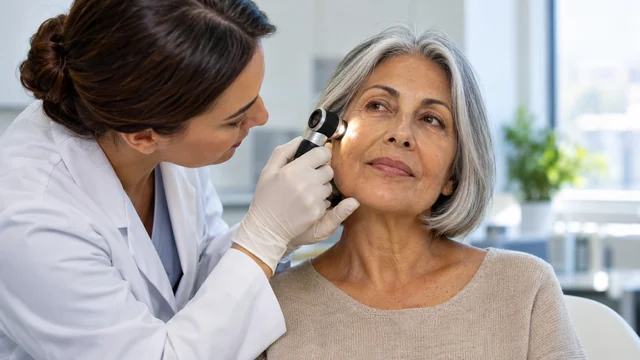
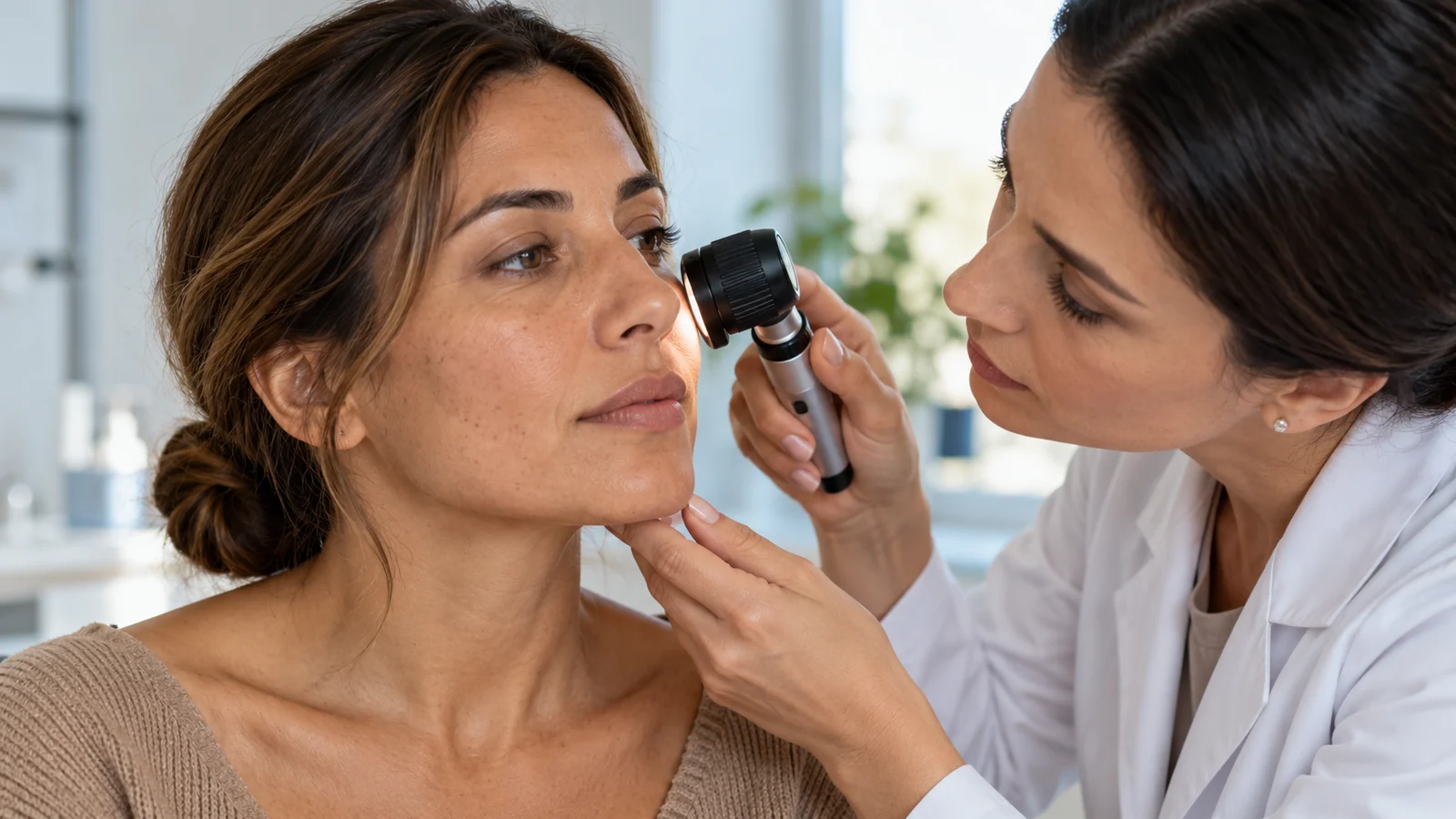
A dermatologist usually begins by examining the lesion, asking how it changed and assessing its size, colour, stalk thickness and surrounding skin. They then discuss whether anaesthesia is needed and what follows treatment: immediate removal with a small superficial wound, or gradual drying and detachment. This depends on the technique. A short procedure does not mean instantaneous cosmetic healing.
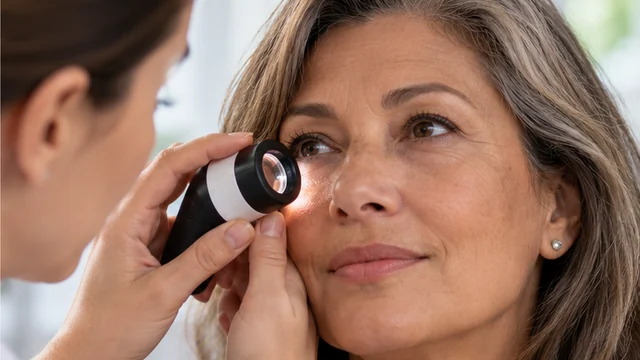
Ask for the exact technique and type of laser, not just the marketing word “laser.” Experience in diagnosing skin growths, eye protection, skin preparation and a plan for bleeding or adverse reactions all matter. Eyelids deserve particular caution: laser light can damage the eye if protection is inadequate, and using a device near the eye is not an ordinary at-home beauty treatment. If treatment near the eye is followed by severe eye pain, blurred vision, sensitivity to light or sudden vision changes, seek immediate medical care and an ophthalmic assessment rather than waiting for the symptoms to pass.
Is laser better than scissors? What research shows
A direct comparative study does not support the advertising claim that laser is always gentler. In a 2025 randomised trial, scissors were compared with a non-ablative 532 nm LBO laser for neck and underarm skin tags. Sixty-eight participants had 1,257 growths treated in total; each person received both methods on different lesions allocated at random. Healing, experience and preferences were assessed after 4 and 12 weeks. At 12 weeks, complete healing was more frequent after scissor removal: 85% versus 71% after this particular laser. Participants rated pain lower with scissors, while redness and pigment changes were more frequent with laser. In the study setting the laser was faster when dressing time was included and avoided bleeding, but treated tags sometimes remained attached for up to three weeks before detaching.
These findings have limits: the trial studied one non-ablative 532 nm LBO laser on the neck and armpits in one study setting, not all CO₂, erbium or other platforms. It proves neither that every laser is inferior nor that all lasers outperform scissors. Another small randomised trial in 2024 compared cryotherapy with electrodesiccation across several benign growth types, including skin tags, and found greater satisfaction with electrodesiccation in the relevant subgroup. Its size and design also prevent a universal ranking.
Professional reviews and the American Academy of Dermatology (AAD) commonly describe simple excision, electrodesiccation and cryotherapy for ordinary skin tags. A short list of standard options that omits laser does not mean it is never used. It does, however, make promises of absolutely no pain, no scars or a guaranteed one-session result worth questioning.
| Approach | What happens | Practical trade-off |
|---|---|---|
| Snip or blade excision | The confirmed growth is separated from the skin; any bleeding is controlled | Often an immediate removal result, but possible bleeding, a small wound and a scar |
| Electrodesiccation | Electrical energy destroys tissue | A scab may form; pigment changes or a scar remain possible |
| Cryotherapy | Tissue is frozen and detaches later | Blistering, swelling or a scab may be visible; pigment loss is possible |
| Ablative laser | The clinician removes tissue layer by layer using focused energy | Accurate diagnosis, depth control and eye protection are essential; burns, pigment changes and scars remain possible |
| Non-ablative vascular laser | May cause the treated growth to die gradually | The growth may not disappear that day; results from one laser cannot be generalised to others |
| Monitoring without removal | No skin injury is created | Often best for a confirmed benign growth that causes no trouble |
When might laser be unsuitable?
The first limitation is uncertainty about the diagnosis. Rapid growth, spontaneous bleeding, an ulcer, irregular shape, unusual pigmentation or new tenderness needs investigation before cosmetic destruction. For a suspicious lesion, a technique that preserves tissue for histology (microscopic examination) may be preferable. Neither a photograph nor someone's confident statement that it is “definitely a papilloma” can replace that assessment.
The second concern is location and skin condition. Eyelids require expertise around the eye and suitable eye protection. Genital growths must first be identified; they may not be skin tags. In sweaty, constantly rubbing folds, comfortable wound care can be harder. A history of marked scarring or persistent dark marks after inflammation, or a darker skin phototype, makes discussion of hyperpigmentation and hypopigmentation—darkening or lightening—particularly important.
Tell the clinician about impaired wound healing, diabetes, immune deficiency, an active local infection, tendency to keloid scars, anticoagulants (medicines that reduce blood clotting) and allergies to local anaesthetics. These are not automatic bans in every case: the clinician decides on technique, whether to postpone and how to manage bleeding. Never stop prescribed medication yourself for cosmetic removal.
During pregnancy it is generally sensible to defer elective cosmetic removal. During breastfeeding, the decision should be made separately, considering the method, treatment site (especially near the breast or nipple), skin condition and whether the baby may touch the treated area. Direct evidence on laser removal of skin tags in these groups is limited: that neither guarantees complete safety nor creates a blanket ban on every laser technique. A clinician may recommend another approach now for severe irritation, injury or an uncertain diagnosis.
Will it hurt, and what will your skin look like afterwards?
Sensations vary: brief stinging, burning or warmth are possible. A numbing cream may be enough for some methods, while others require an injection; for a very small tag, the clinician may choose not to inject. “No injection” alone is no quality measure. If you are sensitive to pain, ask in advance how it will be managed and what sensations to expect.
After removal, the skin often looks more like a small wound, pink mark or scab than a finished “after” photograph. Freezing may cause a blister; electrical or laser methods may leave a dry surface; excision may leave a tiny bleeding point or dressing. Even if you can work almost immediately, the marks may be socially visible. On an exposed neck, the décolletage or near the face they can show in daylight and photographs.
| Stage | What you may notice | What to do |
|---|---|---|
| Treatment day | Redness, stinging, a small wound or dressing; some methods leave the growth visible at first | Clarify cleansing, friction protection and dressing instructions |
| Following days | Scab, colour change, local tenderness; a blister after cryotherapy is possible | Do not pick a scab; follow your clinician's instructions and do not cover an open wound with makeup without permission |
| One to three weeks and beyond | Many small superficial wounds are healing over this period; pinkness or pigment changes may last longer | Arrange review if needed; protect healed exposed skin from sun as advised |
| Outside the expected course | Worsening pain, spreading redness, pus, fever or continuing bleeding | Contact a clinician promptly; seek emergency care for severe uncontrollable bleeding |
Timing varies with injury depth, lesion size and number, location, skin characteristics and the exact device. An important event or photoshoot only a few days away is a reason to discuss how visible the marks may be, not only how many minutes treatment takes. Nobody should guarantee an exact date when the scab disappears or pigmentation evens out.
How should you care for the area, and what should you avoid?
Follow the treating clinician's individual instructions. They depend on whether there is an open wound, a dressing and which technique was used. Care usually involves gentle cleansing, protection from dirt and rubbing, dressing changes if prescribed and monitoring healing. Do not try to speed recovery with alcohol, acids, scrubs or scab picking. Apply sunscreen to the area at the stage your clinician allows, particularly after the wound has closed.
Ask when you can return to swimming pools, saunas, vigorous exercise, shaving and heavy makeup on the site. There is no universal rule across techniques; sweat, friction, water and cosmetics can irritate unhealed skin. If clothes cover it, make sure fabric does not catch or soak a dressing. With unusual burning or expanding redness, do not attempt to treat a possible infection with a random home ointment.
Possible complications include infection, bleeding, burns to nearby skin, persistent dark or light marks, a scar and incomplete removal. The latter deserves specific discussion when the base is broad. No procedure prevents future skin tags appearing nearby: the treatment removes one growth, not all the underlying predispositions.
What to ask before consenting
- Is it definitely a skin tag? What findings support the diagnosis, and is dermoscopy or tissue analysis necessary?
- Why laser in my case? How does it compare with simple excision, electrodesiccation or doing nothing?
- Which technology will be used? Ablative or non-ablative, what happens to the tag and when might it disappear visibly?
- Who performs the procedure and how are eyes protected? Especially for a growth near an eyelid.
- What will my skin look like tomorrow and next week? When might there be a wound, scab or mark, and can I conceal it with makeup?
- What if there is a complication? Where can I seek help for pain, infection or bleeding, and who decides on reassessment?
- What makes up the price? Does it cover examination, anaesthesia, number of lesions, histology if needed and follow-up? Without clear written details total costs are hard to compare.
Be wary of before-and-after photos taken with different lighting or immediately after treatment. Comparable images after complete healing are more useful, but cannot predict your individual result. Reviews promising painless laser treatment without a mark do not erase the possibility of pigment changes or scars. You may take time to decide or choose monitoring if the benign growth causes no trouble.
Why a home “laser pen” is a different matter
Calling a product a laser pen does not make it a professional laser system. Some advertised devices actually use electrical discharge or heat. Unknown injury depth, lack of diagnosis and inadequate eye protection can cause burns, scars, infection or a missed condition mistaken for a “papilloma.” The US Food and Drug Administration (FDA) warns about products marketed for at-home mole and skin-tag removal; its position concerns US regulation. It neither establishes that a particular “pen” is a laser nor determines any device's regulatory status in Armenia.
Do not replace medical diagnosis with wart removers, acids, threads or cutting at home. Leaving a barely noticeable, uninjured tag alone is a valid choice. If it bothers you, start with an examination, then choose a technique with realistic expectations about healing.
Other questions
Can a laser-removed skin tag be sent for histology?
If tissue has been completely vaporised, a usable specimen may not remain. If the diagnosis is uncertain, discuss a technique that preserves tissue for microscopic examination beforehand.
Can dozens of tags be treated in one visit?
Sometimes, but that depends on the diagnosis of each growth, total injured area, location and tolerance. Large numbers are not a reason to skip examination or promise that all sites will heal alike.
Does a remaining dark dot mean the laser failed?
Not necessarily. It may be a scab, temporary pigment change or remaining tissue. Do not remove it yourself; the clinician can reassess after an appropriate period of healing.
Sources
- American Academy of Dermatology: Skin tags.
- American Family Physician: Diagnosing Common Benign Skin Tumors, 2024.
- Haase O. et al., Archives of Dermatological Research, 2025: scissor excision vs 532 nm LBO laser.
- Sadeghzadeh-Bazargan A. et al., Health Science Reports, 2024: cryotherapy vs electrosurgery.
- American Academy of Dermatology: 5 reasons to see a dermatologist for mole, skin tag removal.
- DermNet: Skin tag.
- Kovacs et al., International Journal of Dermatology, 2026: Cosmetic Dermatology in Pregnancy and Lactation.
- Ocular Injury in Cosmetic Laser Treatments of the Face, review.