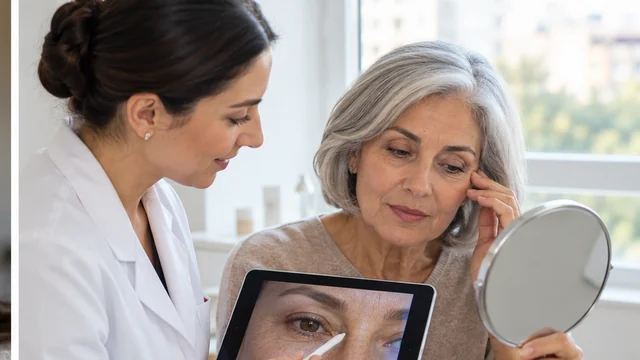
Temple Filler Before and After: What Photos Can Show
You are looking at temple filler before-and-after photos and wondering whether your face might look softer, whether it will still look like you, and whether other people will notice. A realistic change is a reduction in hollowing between the outer corner of the eye and the hairline and a smoother transition from forehead to cheekbone. For some, the face looks less angular overall. But filler does not lift skin like surgery, eliminate wrinkles across the face or give two different people the same result.
Someone else’s “after” photograph cannot predict your result. The original depth of the hollow, soft-tissue volume, bone structure, chosen product, swelling and how carefully the image was taken all influence what you see. Here is how to examine such photos without treating advertising as evidence, and how to recognise when it is better to defer a decision.
What changes can a before-and-after photo realistically show?
The temple is the side of the upper third of the face. When it lacks volume, bone outlines and the transition to the cheekbone can become more noticeable in certain lighting. Hyaluronic acid filler can replace some volume, making the side contour less concave. That does not mean every temple should become perfectly convex: adding too much may look unfamiliar and disturb the individual balance of the face.
If your temples are barely hollow, a dramatic “after” may require volume for which there is no clear aesthetic reason. With marked asymmetry, first establish its cause: differences between sides cannot always be treated in the same way. Look at the face straight on, at an angle and in profile, not just in flattering light.
| What you compare | A plausible, fair “after” | What the picture cannot establish |
|---|---|---|
| Depth of the hollow | A flatter contour at the temple | That you need the same volume of filler |
| Temple-to-cheek transition | A softer-looking line at the side | That filler lifted the lower-face tissues |
| Symmetry | Less difference from certain angles | That the two sides became anatomically identical |
| Overall impression | The face may look less hollow | That age-related changes outside the temples disappeared |
Five conditions for a fair before-and-after comparison
First, use the same lighting. Side light accentuates a depression, while soft frontal light can conceal it without any treatment. A useful series has neutral lighting and similar head position. Second, match the camera angle: even a small turn alters the visible border between temple and cheek. Ideally see the front and both three-quarter views.
Third, compare relaxed facial expressions. Raised eyebrows, tense temples, smiling or tilting the chin can create false differences. Fourth, ask for the date: a shot taken immediately after an injection can show swelling as well as filler, not the settled result. Fifth, compare image processing. Filters, retouching, contouring makeup, hairstyles and even distance from the camera make conclusions unreliable.
Ask to see more than a selected pair of excellent photos: request examples of several people with different starting anatomy and, where possible, similar follow-up intervals. Lack of these photographs does not by itself mean poor work, but a refusal to explain the timing or product is a reason not to rush.
When reviewing other patients’ before-and-after images, ask whether they consented to their use. Permission to publish matters for privacy, but is not proof of effectiveness. Separately, ask how your own photographs will be stored and whether you can decline their use in advertising.
When is it too early to judge the “after”?
Hyaluronic acid filler adds volume at the time of injection, but the first days are not suitable for a final verdict. Puffiness, tenderness, redness, small bruises and a temporary uneven feeling are possible. Professional filler guidance describes local reactions lasting several days and sometimes up to one or two weeks. This is a guide, not a promise that your face will look completely familiar on a particular day.
| When you look | What you may notice | What to do |
|---|---|---|
| Day of injection | Added volume together with the tissue response; sometimes puncture marks | Do not assess symmetry from one glance in the mirror |
| First days | Swelling or bruising may obscure the contour | Follow personalised instructions; do not massage the area yourself |
| After one to two weeks | Short-lived reactions have settled in many people | Compare baseline photos and discuss review if needed |
| Later | The effect may change as filler is gradually absorbed | Do not schedule top-ups automatically to follow somebody else’s calendar |
If a wedding, photoshoot or important meeting is approaching and you would rather not explain a bruise, do not book by an advertisement promising “no downtime”. You may return to daily activities quickly, but being socially unnoticeable is a different matter. Allow a time buffer and leave yourself room to change your mind.
Will it look natural?
Here, natural does not mean “nobody will ever notice”. It means proportions that still feel familiar in different expressions and camera angles. Discuss which specific depression the clinician intends to reduce and where some natural concavity should remain. Bring an unfiltered photograph and say: “I want to preserve the features of my face, even if the change is small.”
Volume is not the only consideration. The temple has complex vascular anatomy, so injection method and plane must be chosen by a qualified clinician after examining you; online photographs cannot determine a safe technique, entry points or amount. Sometimes staged treatment with another assessment is proposed. Sometimes the likely benefit is too small in relation to the risk.
What does the research establish—and what does it not?
A controlled multicentre trial of a specific hyaluronic acid filler, VYC-20L (Juvéderm Voluma XC), found improvement in the severity of temple hollowing as rated by clinicians and participants; some participants retained improvement during follow-up extending to 13 months. This supports the possibility of treating this hollow but neither guarantees individual longevity nor shows that every brand, method or practitioner is equivalent. Participants were selected by defined criteria, and the trial was funded by the manufacturer.
In the US, the FDA approved one specific product, Juvéderm Voluma XC, for a specified approach to temple augmentation in adults over 21 years of age. The manufacturer states that safety of this particular formulation for the temple region has not been studied in people younger than 32 or older than 82; this is an evidence gap, not an additional absolute prohibition. This is not approval of all fillers, proof that complications cannot occur, or evidence of registration or availability in Armenia. When interpreting other people’s photos, ask for the exact product name and documentation; different types of injectable material should not be treated as interchangeable.
Normal reaction or warning sign?
Minor bruising, sensitivity and local swelling can follow injections. Unusually severe or escalating pain, blanching or mottled skin colour, sudden changes in vision, and signs of a stroke are not a normal adjustment period. Seek emergency medical help immediately and tell the team about the recent filler injection. Material inadvertently entering a blood vessel can impair circulation, resulting in tissue death, loss of sight including blindness, or stroke. These events are uncommon but important to discuss before consent.
Delayed reactions are possible too. If new or worsening redness, warmth, a painful lump, swelling or fever appears days, weeks or months later, seek prompt medical assessment. Infection and inflammatory reactions are among the possibilities; a photograph cannot establish the cause. Do not try to massage, treat or “dissolve” the filler yourself.
Hyaluronidase is an enzyme that clinicians can use to break down hyaluronic acid filler in certain complications or where too much volume was added. It is not a simple “undo” button or a guarantee that vision can be restored after a vascular event. Ask beforehand whether the clinician has an emergency protocol, access to the necessary supplies and a clear pathway to urgent care.
When should the cause of temple hollowing be assessed first?
If the temple changes suddenly, on one side, following an injury or with other unusual symptoms, seek a medical assessment of the cause rather than a cosmetic photo comparison. Active infection or inflamed skin near the intended injection site is a reason to postpone. Disclose previous fillers, allergies, bleeding tendency, medicines and medical conditions even if they seem unrelated to appearance.
Filler safety has not been adequately studied during pregnancy and breastfeeding, so it is sensible to defer an elective aesthetic procedure. Previous severe allergic reactions warrant particular care, while the contraindications depend on the exact product formulation. Do not stop prescribed medication yourself just to reduce bruising.
Questions to ask before agreeing to correction
- Which change in my photos is actually about the temples, rather than lighting, cheekbones or the overall volume of my face?
- Which brand and formulation will be used, and what does the official labelling say about temple use and the jurisdiction where it applies?
- How do the clinician’s expertise and my vascular anatomy affect the plan, symmetry and risks?
- What might I look like the next day, and when is it appropriate to judge the outcome?
- Whom should I contact at night or on weekends if I experience unusual pain, skin blanching or a change in vision?
- What is included in the quoted cost, such as follow-up and management of complications, without being pressured into repeat treatment?
If your question is less about photo comparisons and more about whether filling the temples is worthwhile at all, see the page on potential benefits of temple filler. Practical treatment details are discussed separately under temple hollow correction. Choosing no injections, observing changes over time, or adjusting lighting or makeup are also reasonable options when you have no significant concern.
Additional questions
Can you tell from a photo how many millilitres will be needed?
No. The volume depends on tissue depth, asymmetry, the specific product and the clinician’s plan. It is unsafe to copy the amount mentioned beneath someone else’s image.
Should I tell the clinician about filler previously injected in my cheeks?
Yes. Previous injections, including in neighbouring areas, may affect the assessment of proportions and safety planning. Bring the product name and date if possible.
Does a photo without bruising mean the injections did not hurt?
No. A photo cannot convey the sensation during treatment or rule out reactions on other days.
Sources
- FDA: Dermal fillers — risks and safety.
- FDA: US temple indication for Juvéderm Voluma XC, 2023.
- Montes et al.: controlled trial of VYC-20L in the temple region, 2025.
- American Academy of Dermatology: filler and recovery FAQs.
- UK multidisciplinary consensus on filler-related vision loss, 2026.
- Juvéderm official safety information: studied age ranges.
- Consensus review of delayed reactions to hyaluronic acid fillers, 2024.