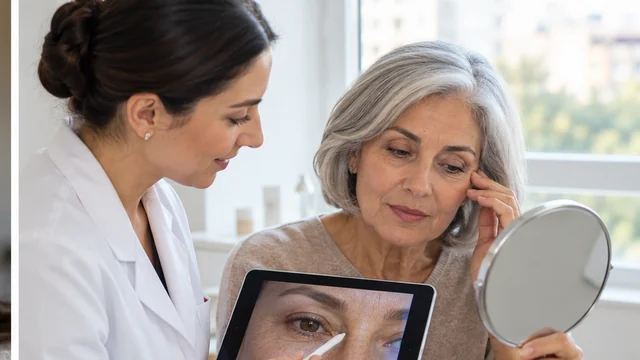
Temple Filler Benefits: What It Can Do and Where Limits Lie
You notice that your temples have become more hollow, or you hear that filling them will supposedly refresh the entire face. Is filler worth considering? Its main potential benefit is to replace volume locally in the temples and soften the visible contour between the forehead and cheekbone. Some people feel their facial balance changes, but it cannot replace a facelift, skin treatment or assessment of other reasons their appearance has changed.
This procedure is not useful for everyone. The decision should reflect your anatomy, the size of the change you want and your willingness to accept injections near important blood vessels, not a fashionable face shape. This page concentrates on the potential benefits, their costs and when another option is more sensible—not the injection technique itself.
What benefits can temple filler actually offer?
Local volume replacement. When a temple hollow is pronounced, filler placed in an appropriate anatomical plane can soften the abrupt transition between bone and soft tissue. It does not treat ageing as a process or restore “youth” to the entire face. It works in one area, and makes sense only if that area truly contributes to what concerns you in the mirror.
A softer upper-face side contour. A less concave transition between forehead, temple and cheekbone can appear smoother. Not everyone benefits: on some faces the added volume makes the upper face look wider. “Better” means closer to your personal preference, not to a universal beauty standard.
An opportunity for measured correction. Hyaluronic acid filler gives the clinician a way to discuss the amount needed for a specific purpose, and hyaluronidase can break down injected HA under certain circumstances. Reversibility is limited, however: not every unwanted effect can be removed quickly or completely, and vascular complications require emergency care regardless of plans to “dissolve the excess”.
An effect without a surgical incision. Injectable volume replacement does not involve a surgical wound, unlike plastic surgery. But no incision does not mean no risk. It remains a medical procedure whose result depends on the product, anatomy and expertise of the injector.
Benefits and limits: which concern is yours?
| Your concern | When filler may help | When it will not solve the problem |
|---|---|---|
| Visible hollows near the hairline | When an examination confirms local soft-tissue volume loss | When lighting or hairstyle mainly creates the shadow |
| Sharp forehead-to-cheek transition | When temple volume contributes to the side contour | When the principal concern is cheekbone or jaw position |
| Looking tired in photographs | In some cases of genuinely hollow temples | When sleep, skin, eyelids or lighting are more important |
| Wrinkles, pigmentation, loose skin | Not the direct goal of adding temple volume | Skin and other possible approaches need separate assessment |
| Upper-face asymmetry | Sometimes, if local soft-tissue volume differs | When the cause involves bones, muscles or a medical condition |
The key word in the table is “may”. Even an experienced clinician cannot honestly promise, without examining you, that changing just the temples will transform your whole face. Ask: “Show me the exact line that is likely to change, and tell me what will stay the same.”
Why might one person benefit from a small amount while another needs none?
A hollow may have been part of your natural appearance since youth, become more noticeable with little subcutaneous fat, or develop gradually with age-related tissue change. Lighting, hairstyle and contrast with the cheekbones can accentuate it. It is not a diagnosis. Filling every natural depression until all temples are uniformly convex is a poor aesthetic goal.
The clinician should assess both sides, facial outline, brow position, tissue thickness and movement during conversation. A video or selfie showing only the temples misses perspective and may encourage unnecessary treatment. Sudden or one-sided hollowing after injury, or hollowing accompanied by pain or other symptoms, warrants assessment of the medical cause first.
Distinguish “I would like the hollow to be less sharp” from “I want to look ten years younger”. The first offers a relatively concrete, verifiable outcome. The second is far too broad for one area. If what you expect is a lasting brow lift or the disappearance of nasolabial folds, temple volume replacement is not a reliable way to achieve it.
How convincing is the evidence for the benefits?
There is more than marketing. In a multicentre randomised trial of one specific HA filler, VYC-20L (Juvéderm Voluma XC), evaluators reported greater improvement in temple hollowing than in an untreated control group. Some participants maintained visible improvement during follow-up to 13 months. Satisfaction and perceptions of facial proportions were also assessed. This establishes a possible benefit in selected people, not a general need for treatment.
Another small prospective study of 26 women reported favourable results during 16 weeks of follow-up. However, small uncontrolled series and studies of individual products cannot predict your own result, compare all products or rule out rare complications. Consider manufacturer funding, participant exclusions and the fact that satisfaction, while meaningful, is subjective and not the same as medical safety.
Regulatory statements also need precision. In 2023, the US FDA authorised Juvéderm Voluma XC for augmentation of moderate to severe temple hollowing in adults over 21, by the injection plane specified in its decision. The manufacturer states that safety of this particular formulation for the temple region has not been studied in people younger than 32 or older than 82; this is an evidence gap, not an additional absolute prohibition. That is a US indication for a particular product, not approval of the entire filler category or proof that it is authorised or offered by a clinic in Yerevan. Other formulations can have different labels, follow-up data and restrictions.
Naturalness: benefit or an overfilled upper face?
If you want a subtle change, ask how it is expected to look when turning your head and in ordinary daylight. Completely filling the depression may make the temple look wider or produce an unfamiliar continuous bulge. Extra volume does not always improve harmony, especially if the initial hollow is slight. The right aesthetic endpoint is not defined by syringe count or matching numbers on both sides.
Nor is it fair to promise a result that nobody could ever detect. In the early days swelling can make temples appear fuller than they will later. Once it settles, the result may look more modest. Agree in advance when the clinician will evaluate the effect and what circumstances justify adjustment rather than adding more at the first moment of uncertainty.
Neither a carefully framed photograph nor the phrase “natural technique” can replace an individual assessment. For a detailed checklist of deceptive comparisons, see Temple filler: before and after. The sequence of injections is discussed separately under Temple hollow correction; the question here is whether the outcome is worth the intervention.
What do the benefits cost in recovery time?
Most people can return to routine activities relatively quickly, but that does not mean there will be no visible marks. Puffiness, redness, tenderness and bruising can follow filler injections. Some people see these reactions resolve within days; for others they remain visible for one or two weeks. It is impossible to calculate your own recovery time precisely beforehand.
If you work on camera, are preparing for an event or simply do not want to discuss changes in your appearance, ask about social visibility rather than only whether you can sit at a computer. Even a small needle mark or bruise by the hairline may be unwelcome before an important meeting. Do not make a decision based on the promise of “doing it at lunchtime and forgetting about it”.
Professional guidance sometimes recommends avoiding vigorous exercise for the first 24–48 hours, but instructions vary by product and circumstances. Some manufacturers advise restrictions on makeup and heat exposure during the first day. Do not massage your temples unless your clinician tells you to; aftercare for different filler types is not interchangeable. Ask specifically about sport, sauna, sun, sleeping position and cosmetics.
Risks to weigh against the benefit
The most familiar unwanted effects are swelling, tenderness, bruising and unevenness. Inflammation, infection, lumps, allergy and delayed nodules are also possible. A separate risk is filler entering a blood vessel. This can interrupt blood supply to the skin; tissue necrosis, loss of vision including blindness, and stroke have been reported. These serious events are rare, but a beautiful portfolio does not make the probability zero.
Following an injection, sudden severe or worsening unusual pain, blanching or marked skin colour changes, any sudden vision change, one-sided weakness or speech difficulty call for emergency medical care. Do not wait for a routine follow-up or try home massage or compresses. Tell the emergency team what was injected, where and when.
Delayed reactions are possible too. If new or worsening redness, warmth, a painful lump, swelling or fever appears days, weeks or months later, seek prompt medical assessment. Infection and inflammatory reactions are among the possibilities; a photograph cannot establish the cause. Do not try to massage, treat or “dissolve” the filler yourself.
Hyaluronidase can sometimes be used medically to break down hyaluronic acid filler. It is not a guaranteed reversal of every consequence, particularly threatened vision. Choose someone with appropriate medical qualifications, knowledge of vascular anatomy and an emergency response pathway—not merely attractive before-and-after images.
When is it better to postpone or rethink elective treatment?
| Situation | Why it matters | Sensible next step |
|---|---|---|
| Pregnancy or breastfeeding | Safety data are inadequate | Postpone nonessential cosmetic injections |
| Inflammation, rash or infection at injection sites | The local condition may be worsened | Treat the condition first and reassess the skin |
| Anaphylaxis, serious allergies or anaesthetic reactions | The exact formulation matters | Review product-specific contraindications with a clinician |
| Bleeding disorders or medicines affecting bleeding | They can affect bruising risk and decisions | Disclose all medicines; do not stop them yourself |
| Sudden new asymmetry, pain or injury | The cause may not be cosmetic | Start with medical examination and diagnosis |
| Very minor hollows but an expectation of a total facelift | The likely benefit does not match the goal | Discuss no treatment or a different approach |
This table cannot replace the contraindications for the actual product. Those depend on its ingredients and your health. The clinician should ask about previous procedures and local anatomy, not merely tick “generally healthy”. If the filler contains lidocaine, your history of reactions to this anaesthetic is relevant.
What else could you do, including nothing at all?
If the hollows concern you mostly in photographs, start by taking images in consistent lighting and with a similar hairstyle. This tests whether it is really the anatomy that bothers you. Choosing to leave a moderate natural concavity alone is entirely valid. Neither your mirror nor a friend’s recommendation creates a medical need for the procedure.
With substantial volume loss, a clinician may discuss alternatives such as fat grafting. But that is a different intervention with its own procedure, recovery and uncertainty about fat survival; it is not simply “the same thing, but natural”. Skin quality or lifting concerns require their own assessment rather than hoping temple filler will fix everything at once.
If injections themselves worry you, it is reasonable to decline all options. If you do want another opinion, ask a different appropriately qualified clinician to assess baseline anatomy, your photographs and the realistic scale of change without promising a dramatic transformation.
Questions that clarify whether the benefit is worth the risk
- What on my face indicates actual temple volume loss rather than another cause?
- What one visible change do you expect, and what specifically will you not promise?
- Why this precise product; what does its label say and what is its regulatory status locally?
- How will symmetry and naturalness be assessed without trying to erase every anatomical hollow?
- What are the usual reactions, social downtime and emergency plan for unusual pain or vision changes?
- How do you account for my previous filler, medicines and health limitations?
- Can I choose to do nothing for now and revisit the issue later without losing a medical opportunity?
What matters in a consultation is not the promised “picture-perfect” transformation but whether the clinician can explain the limits and reasons for recommending treatment. An unhurried decision not to have filler can be a good outcome too.
Additional questions
Can one treatment give a lasting result?
Some people retain a visible result for a long time, but it is not permanent and there is no repeat-treatment date that applies to everyone. Another treatment should reflect your actual appearance, not a mandatory subscription.
Must both temples receive the same amount?
No. Baseline asymmetry and the clinician’s plan can differ between sides. Equal volumes do not guarantee identical-looking contours.
Does having had filler dissolved before mean that I cannot have it again?
Not automatically. The reason, product, complications and current tissue condition matter; show your clinician the records from the earlier correction.
Sources
- FDA: dermal filler safety and limitations.
- FDA: approved US temple indication for Juvéderm Voluma XC.
- Montes et al.: randomized temple-volume study, 2025.
- Clinical study of a large-particle HA temple filler, 2023.
- American Society of Plastic Surgeons: dermal filler recovery.
- Multidisciplinary guidance on filler-related vision loss, 2026.
- Juvéderm official safety information: studied age ranges.
- Consensus review of delayed reactions to hyaluronic acid fillers, 2024.