
Female Hair Loss Treatment: How to Choose by Type of Loss
You notice more hair in the shower or a widening parting, and the search results promise the “best treatment for female hair loss.” There is no single winner until you know why the hair is thinning. Gradual female-pattern hair loss, shedding after childbirth or illness, autoimmune patches and inflammatory scalp disease call for different actions. Some need treatment over months; others improve when a trigger resolves, while certain scarring conditions must be checked promptly to prevent permanent loss.
First, identify the pattern: the treatment depends on it
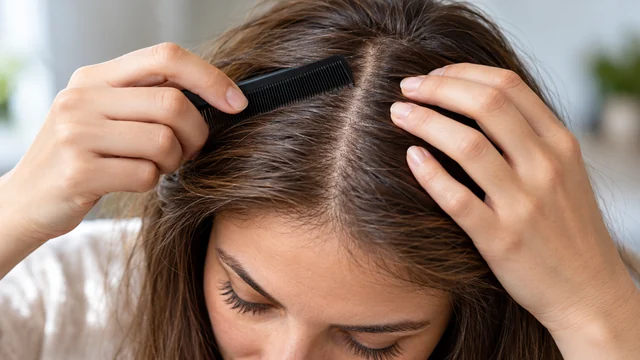
Look at the distribution of change, not just the number of hairs in the brush. A widening part and thinner hairs over the crown suggest female-pattern hair loss, also called androgenetic alopecia: a gradual, often inherited miniaturisation of hair follicles. Heavy diffuse shedding a few months after delivery, serious illness, an operation or stress may be telogen effluvium: many hairs enter the shedding phase around the same time, often without losing their follicles permanently.
Clearly defined round patches require an assessment for alopecia areata, an immune-mediated condition. Pain, burning, redness, crusts, pustules, shiny skin without visible follicular openings or rapidly growing bald areas warrant earlier medical assessment. Some inflammatory or scarring alopecias can destroy follicles that growth products cannot restore.
| Pattern | What needs assessment | More important than a “miracle serum” |
|---|---|---|
| Slowly widening part and thinning crown | Female-pattern hair loss | Diagnosis, topical minoxidil and a long-term plan |
| Sudden widespread shedding after birth or illness | Telogen effluvium | Time, ongoing triggers and correction of proven deficiencies |
| Distinct round bald patches | Alopecia areata | Dermatologist-directed care according to severity |
| Pain, inflammation, scars or rapid loss | Possible inflammatory/scarring alopecia | Prompt diagnosis and disease-specific treatment |
| Broken hairs around temples, tightly pulled hairstyles | Hair-shaft breakage or traction alopecia | Reduce tension, change styling and check scalp health |
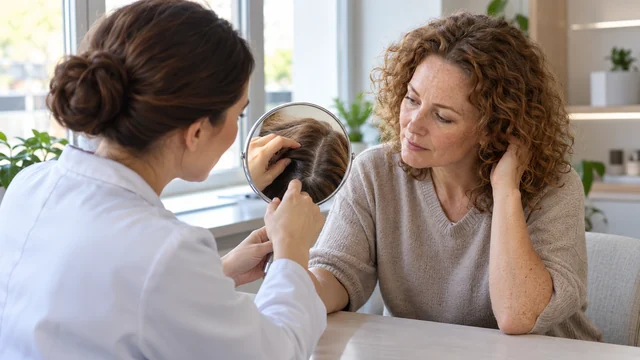
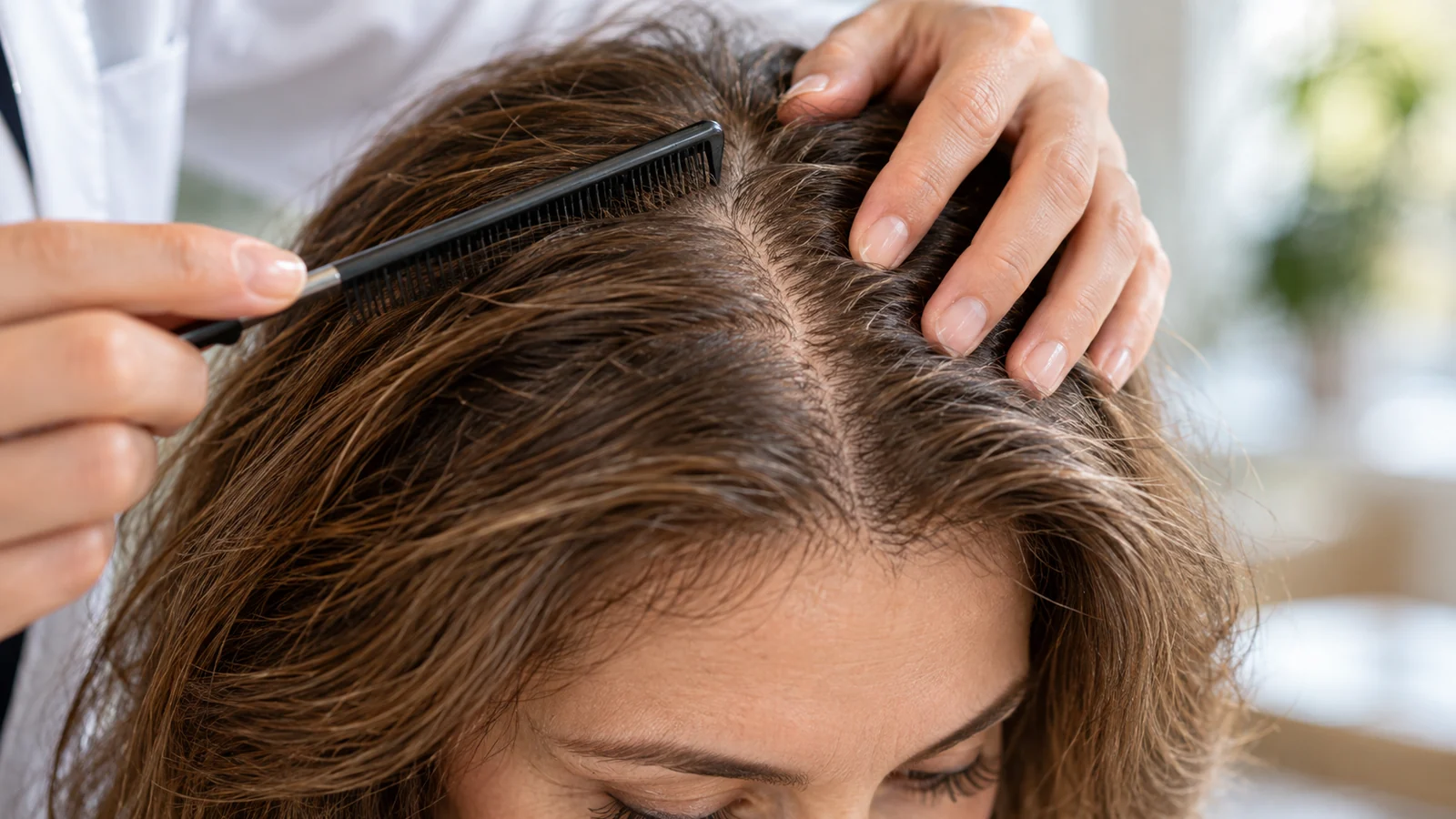
These are clues, not a self-diagnosis. Postpartum shedding and inherited thinning can coexist. A clinician asks when loss began and about medication, diet, menstrual cycle, symptoms and family history, examines the scalp and hairs under magnification, and orders iron studies, thyroid tests or a biopsy only when the findings justify them—not an identical panel for everyone.
For female-pattern thinning, which option has the clearest evidence?
Topical minoxidil is a major evidence-supported option to slow thinning and promote some regrowth. It cannot restore follicles already lost to scarring or guarantee the density you had as a teenager. Apply it to the scalp, not hair lengths, following the instructions for the specific product and a clinician-agreed plan. Concentrations and formulations licensed for women vary by country and brand; US and UK approvals are not automatically Armenian approvals.
Temporary increased shedding may occur early on. Dryness, itch and scalp irritation are also possible; accidental spread to the face may stimulate unwanted facial hair. Do not judge success after two weeks: the American Academy of Dermatology suggests roughly 6–12 months of regular treatment to assess response. When it works, continuing treatment is generally necessary to maintain the benefit. Avoid minoxidil during pregnancy, while planning pregnancy and during breastfeeding; discuss alternatives with your doctor.
If topical treatment is unsuitable or insufficient, a dermatologist may consider prescription options. Spironolactone is sometimes prescribed for female-pattern hair loss off-label in the US; the clinician considers blood pressure, kidney function, potassium, other medicines and pregnancy potential. It must be avoided during pregnancy because of fetal risk. Some specialists prescribe low-dose oral minoxidil off-label for hair loss, too; a tablet is not simply a convenient home substitute for topical treatment because its systemic effects and follow-up requirements differ.
Oral low-dose minoxidil can cause increased facial or body hair, swelling, dizziness, faster heartbeat and blood-pressure changes; cardiovascular disease calls for particular assessment. Avoid oral minoxidil for hair loss during pregnancy, while trying to conceive and while breastfeeding. A 2025 specialist consensus describes assessment and monitoring, but cannot replace large comparative trials or establish local approval for this hair-loss indication.
Finasteride and other hormone-related treatments have additional restrictions and are not a universal first purchase for women. Finasteride must not be used during pregnancy because it may harm fetal development; if pregnancy is possible or planned, discuss other options with a clinician rather than starting it yourself. Discuss fertility plans and alternatives before choosing; never copy someone else's prescription. Other measures may help selected women, but they should be weighed by evidence quality, cost and feasibility, not claims to “wake up every sleeping follicle.”
When is not starting a growth stimulant the better choice?
Postpartum shedding often peaks a few months after giving birth and then subsides. The AAD notes that for many women their usual fullness returns by the child's first birthday; this is not a guarantee, but it is a reason not to rush into aggressive programmes. Persistent or worsening shedding, a widening part or other symptoms warrant evaluation for another process. After an infection, major weight loss or severe stress, treating the cause and observing may be more useful than buying a stimulant.
Iron, zinc and biotin supplements are not universal or risk-free insurance. Take them when deficiency is demonstrated and a professional recommends it; excess intake of some nutrients is harmful. Appropriate testing and nutrition matter more than an expensive collection of capsules. When thinning occurs alongside irregular periods, pronounced acne or new coarse facial hair, a doctor may evaluate for polycystic ovary syndrome or other hormonal causes when indicated.
Why don't PRP, mesotherapy and laser testimonials produce a clear winner?
PRP involves injections of plasma prepared from your own blood. “Mesotherapy” covers numerous injected mixtures with different compositions. Low-level light devices are marketed for certain thinning patterns. Evidence quality varies widely. A 2024 systematic review of randomised studies suggested that PRP added to topical minoxidil might improve androgenetic hair-loss outcomes, but rated certainty low or very low, due to few trials, risk of bias and differing methods. This does not prove that every commercial PRP preparation or mesotherapy cocktail works. None of these options can be declared better than minoxidil for every woman.
| Option | When to discuss it | Main qualification |
|---|---|---|
| Topical minoxidil | Confirmed female-pattern loss | Several months to assess; usually continued if helpful |
| Prescription systemic treatment | Selected patients after dermatology assessment | Contraindications, pregnancy, tests and interactions |
| PRP or light-based device | Possible adjunct in selected situations | Less predictable; compare evidence and total cost |
| Mesotherapy or marketed injection mixtures | Only after checking exact ingredients and rationale | No single standard; evidence depends on the formulation |
| Treating the cause | Deficiency, inflammation, temporary shedding or damaging styling | Diagnosis matters; stimulation alone does not remove the cause |
For extensive alopecia areata, specialist options can include systemic medicines acting on immune pathways, such as JAK inhibitors approved for specific severe cases in some countries. They do not treat ordinary female-pattern part widening and require medical supervision because of their risks. Transplantation suits only some women with stable loss and sufficient donor hair; it does not stop active disease or replace diagnosis.
How will you know if the plan works, and what about everyday life?
Unlike a procedure with a short recovery period, hair treatment may be almost invisible to others but demands consistency. Scalp medication often needs daily application and time to dry; a sensitive scalp may need a different formulation. Injections may leave temporary tenderness, small puncture marks and technique-specific restrictions. Neither a “10 days later” photograph nor freshly styled volume measures true follicle change.
Take baseline photographs of the part and temples with matching lighting, angle and hairstyle; compare them at agreed intervals rather than every day. Monitor tolerability, shedding, changes seen with magnification and convenience as well as appearance. For ongoing itch, rash, dizziness, palpitations or other unusual effects, do not persevere at all costs: pause and contact your clinician. Marked systemic symptoms call for urgent assessment.
Questions worth asking before choosing treatment
- Which cause of loss do you suspect and why? Are tests or scalp biopsy needed?
- Which hairs could regrow and which can only be protected from further thinning?
- What has the best evidence for my diagnosis, and which medicines are being offered off-label?
- How do pregnancy, breastfeeding, other drugs, blood pressure and existing illness change the plan?
- What measure and timeframe will show progress, and when would we change course?
- What will months of treatment, testing and follow-up cost in total, not just one session?
If someone pushes a prepaid injection series without looking at your scalp or guarantees complete restoration, taking time to decide is sensible. The answer may be changing a tight hairstyle, treating a condition, allowing temporary shedding to resolve or starting a proven long-term therapy. “Best” means suitable for a confirmed diagnosis, your health and what you can sustain.
Frequently asked questions
Should I buy a medicated hair-loss shampoo immediately?
Shampoo can manage some scalp conditions or make hair look fuller, but it rarely substitutes for female-pattern hair-loss or alopecia-areata treatment. If there is itch or scaling, first establish its cause.
Can hair colouring distort the assessment of treatment progress?
Yes. Colour, parting, styling and length alter visible density in photographs. Compare images under similar conditions and ask whether your care routine is also causing breakage.
Sources
- American Academy of Dermatology: Female Pattern Hair Loss
- American Academy of Dermatology: Diagnosis and Treatment
- British Association of Dermatologists: Female Pattern Hair Loss
- American Academy of Dermatology: Postpartum Shedding
- American Academy of Dermatology: Alopecia Areata Treatment
- JAMA Dermatology (2025): Expert Consensus on Low-dose Oral Minoxidil
- PLOS ONE (2024): PRP Added to Topical Minoxidil — Systematic Review