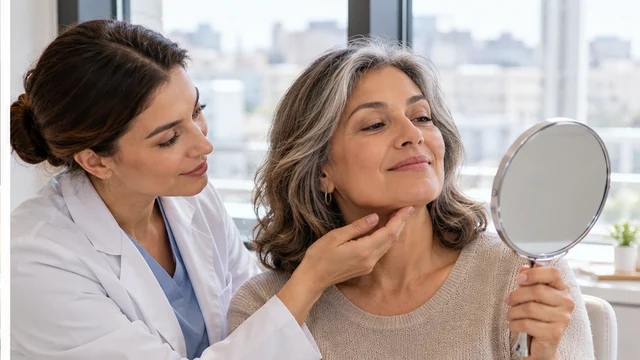

Facial fat grafting (lipofilling): what it can and cannot do
Sometimes the aim is not a new face, but restoring soft volume to cheeks or temples that have become hollow. Facial fat grafting (lipofilling) surgically transfers your own fat from another body area: it is harvested, prepared and injected in small amounts into selected facial sites. Some survives; some is absorbed. The eventual volume and duration cannot be guaranteed, so this is not merely a “natural filler”: both face and donor site must heal.
Grafting may soften hollows, change contours and replace lost tissue volume. It cannot correct major skin sagging, change bone proportions or guarantee symmetry. Another small procedure, investigation of a change or no intervention may be better. First distinguish whether your concern is volume, skin texture, firmness or lifting tissues: these are different goals.
Why does the result depend on more than the volume injected?
There are three stages. Through small punctures the surgeon harvests limited fat, often from abdomen, thighs or another suitable donor site. The fat is processed to separate fluid and other components as specified by the technique, then introduced in small portions into selected facial layers and points. Surviving cells need a blood supply from adjacent tissue.
Some fat does not survive. Early apparent volume includes injected tissue and swelling; both diminish. Retained fat may last for years, but amount and position depend on anatomy, technique, tissue nourishment, weight fluctuations and follow-up time. Decide about repeat correction after healing, not just because your face is smaller at week two than on day one.
Research confirms wide variability. A meta-analysis of facial fat grafts published online in 2020 found different retention estimates between studies, influenced by how and when volume was measured. An average percentage is not a formula to predict your shape from injected millilitres. A promise that all fat will last forever is equally unsupported.
Using your own fat avoids some issues with foreign materials, but does not automatically make the procedure safe. It can be uneven, form hard areas or fail to survive fully. This is distinct from daily skincare and from small nonsurgical injections.
Which facial changes might fat grafting address?
Cheekbone contour, mouth corners, under-eye hollows and temples reflect bones, ligaments, skin and soft tissue. A “drawn” appearance may reflect lost volume, descended tissue, reduced skin elasticity or several causes. Adding fat helps only some of these.
| Concern | When volume may be considered | What grafting does not promise |
|---|---|---|
| Hollow temples or selected cheek areas | Confirmed soft-tissue loss after appropriate anatomical and safety assessment | Identical sides, exact retention of millilitres or a guaranteed fixed contour |
| A pronounced lower-eyelid–cheek transition | Sometimes, if adjacent volume is deficient and the lower lid has been assessed | Removal of bags, pigmentation or all puffiness; the area needs particular caution |
| Sagging face or prominent jowls | At most a possible addition within a tailored surgical plan | Lifting descended tissues or replacing a facelift |
| Fine wrinkles or skin-surface changes | Sometimes adding volume makes a fold appear less deep | Predictably erasing all wrinkles or treating pigmentation and skin disease |
| Sudden or one-sided loss of volume | Only after diagnosis and medical assessment of its cause | Replacing diagnosis or treatment of an underlying wasting condition |
Cheeks, temples and isolated hollows are commonly discussed, but safety depends on blood-vessel anatomy at each site. The forehead, nasal bridge, around the eyes and temples are not routine injection locations: severe vascular complications are possible. A surgically trained clinician must determine whether, where and in which layers to inject.
Weight loss plans or frequent fluctuations make retained volume harder to predict: transferred fat is living tissue, not a fixed implant. Very little suitable donor fat can limit options. Previous fillers may distort your starting contour and make the volume genuinely needed hard to assess.
Can the result remain subtle to people around you?
Naturalness is not a number of millilitres. It depends on smooth transitions and how the face looks talking and smiling. Excess or uneven fat can cause lumps, puffiness or unnatural roundness; inadequate survival produces less effect. “A softer transition” and “significantly fuller cheeks” are separate objectives requiring different plans.
Early photos include swelling and do not show the final result. Request comparable photos months later, with consistent lighting, angle, weight, expression and no filters. Other people's authentic results show possibilities, not a forecast for you. Discuss what would be too much volume and whether unwanted fullness could be corrected.
Fat grafting is not wholly reversible: some living fat stays, and removal or redistribution may be difficult. Yet early overfilling may subside. A conservative staged plan with reassessment may be preferable to seeking a dramatic one-session change.
Fat grafting or hyaluronic-acid filler: which better fits the decision?
Both add volume, but “your own tissue” and “no surgery” do not settle the choice. Hyaluronic-acid filler needs no fat harvesting; effects vary by product and site, and a clinician can dissolve some formulations with an enzyme when indicated. This does not make every complication easy to reverse, especially vascular ones. Grafting entails surgical harvesting and separate healing but retained tissue may last a long time.
| Criterion | Facial fat grafting | Hyaluronic-acid filler |
|---|---|---|
| Source of volume | Own harvested and processed fat tissue | A prepared formulation; authorisation and indications must be checked for the country and injection site |
| Procedure and downtime | Donor site plus facial injections: surgical intervention | Usually no donor site, but injection risks and visible marks remain |
| Predictability | Some fat absorbs; final volume settles gradually | Initial volume appears sooner, but swelling and later changes also occur |
| Managing an unwanted effect | No simple guaranteed return to the old shape | Some products allow enzyme correction, but not every problem and not without risk |
| Vascular risk | Rare severe events if fat enters vessels, including blindness or stroke | Vascular blockage and visual injury are possible with fillers too |
Devices that affect skin quality cannot replace genuinely missing volume. Buccal fat removal does the opposite: reduces deep cheek volume, not fills hollows. Marked tissue descent requires a separate discussion of surgical lifting. If lighting, weight or temporary swelling explains the impression, no added volume may be preferable.
What will the first weeks look like for face and donor site?
Anaesthesia and observation depend on surgical scope. The donor site may be as uncomfortable as the face, with bruising, swelling, tenderness, small puncture scars and sometimes prescribed compression clothing. Early facial swelling can hide the actual graft contour.
| When | What to assess | Social and practical plans |
|---|---|---|
| First days | Swelling, pain and bruising at both sites; healing punctures | Arrange help and rest; do not expect an unchanged face on video calls |
| About one to two weeks and beyond | Fading marks, any hard lumps or increasing pain | Some resume regular activities; public appearances may need longer |
| Following months | Actual retained volume and contour symmetry | Do not plan correction based on early swelling; attend in-person review |
The NHS reports that bruising and swelling after surgical fat transfer may last several weeks and final volume assessment may take months. This covers various fat-transfer operations, not a guaranteed facial timetable. For camera work, ask about concealing bruises, how long to avoid makeup on punctures and whether swelling will show while speaking.
Do not massage or heat treated sites, use a sauna or return to strenuous exercise until cleared. Compression, sleep posture, cleaning and puncture care should be individually prescribed. Ask about driving after anaesthesia and an escort home.
What could go wrong, from lumps to vascular complications?
Expected temporary effects are swelling, bruising and tenderness. Other risks include infection, bleeding, seroma (fluid collection), uneven survival, excess or insufficient volume, asymmetry, firm nodules, oil cysts, fat necrosis (death of fat tissue), donor-site marks and repeat surgery. A lump is not necessarily serious, but its cause and treatment require clinical evaluation, not home massage.
Fat particles accidentally entering a facial blood vessel may block it, causing blindness or stroke. Systematic reviews report such cases, particularly after forehead or temple injection. Their frequency cannot be reliably calculated from published complication cases: case reports lack a denominator of all procedures.
Sudden visual loss or changes, an unusually severe headache, one-sided weakness or numbness, speech disturbance or sudden unusual pain during or after injections call for emergency assistance immediately. Tell responders what was performed and when. Rapid swelling, shortness of breath, chest pain or fainting also need emergency assessment. Fever, discharge from punctures, worsening pain or redness require prompt contact with the surgeon.
Appropriate surgical training, vessel-anatomy knowledge, a justified injection method, sterility, follow-up and real emergency-response capacity are crucial. “Your own fat means zero risk” is a warning sign.
When should you postpone the procedure and investigate changes first?
Rapid, especially one-sided, volume changes, pain, muscle weakness or unusual swelling merit diagnosis before aesthetics. The surgeon should review health, medications and supplements, bleeding, smoking, healing, prior operations and injections. Active infection or uncontrolled disease may mean postponement. Pregnancy and breastfeeding call for a conservative discussion; delaying elective aesthetic surgery is usually sensible.
Insufficient donor fat, unstable weight, thin skin and demands for perfect symmetry also affect suitability. Combining cheek-fat removal with grafting elsewhere involves two separate sets of risks, not simply moving unwanted fat. Age alone does not determine the result, but tissue condition and ongoing volume loss matter.
Discuss blood-thinning drugs and chronic conditions. Do not independently discontinue anticoagulants, cardiac drugs, anti-inflammatory medicines or treatment prescribed by another clinician. Changes require agreement from the prescriber. Another consultation without immediate consent is entirely reasonable if you are unsure.
Questions to insist on before consent
- Where is volume actually lost, and where are descent, pigmentation or swelling that fat will not correct?
- Why grafting instead of smaller correction or no treatment? What amount of change is enough?
- Where will fat be taken, what marks remain and how is that area cared for?
- Which facial regions and layers will receive fat? Which high-risk vascular sites are avoided or require a different strategy?
- How do you explain uncertain survival, irregularities and possible repeat treatment? When should the outcome be judged?
- Who provides anaesthesia, where is surgery performed and what emergency response exists for a vascular complication?
- When can I work on camera, exercise, travel or apply makeup? What is follow-up, and whom do I call?
- What does the written quote cover: harvesting, processing, anaesthesia, facility, follow-up, complications and possible repeat correction?
Choose neither by “lasting results in one session” promises nor by dramatic photos. Ask for comparable, unfiltered, well-healed photographs and honest limits. A good surgeon can say “investigate first”, “try a gentler route” or “do nothing”. The informed decision remains yours.
Two additional practical questions
What happens to grafted fat if weight changes later?
Retained fat is living tissue and its volume can vary with body weight. The effect is individual, which is another reason to assess weight stability beforehand.
Can previously harvested fat be reused or stored?
Processing, storage and reuse depend on medical protocols and local rules. Do not assume tissue can be banked freely; discuss feasibility, safety and legality with the surgeon and facility.