
Hair loss: causes, when to see a doctor and what to do
There are more hairs in the shower drain, your ponytail feels thinner, and an overhead photo suddenly reveals more scalp than you expected. It is tempting to buy several “growth-stimulating” products at once. But hair loss is a symptom with different possible causes, and the next step depends on its pattern and speed. Some forms improve after a trigger resolves, others need long-term treatment, and inflammatory scarring conditions especially need identification before follicles are lost.
If you notice a new bare patch, pain, burning, pronounced redness, crusting or a rapidly receding hairline, do not postpone seeing a dermatologist for a cosmetic procedure. Heavy shedding beginning several months after childbirth, a severe illness or a major dietary change may have a very different outlook. Compare treatments only after the cause is identified, not by promises of “X more hairs”.
What is happening: shedding, thinning or breakage?
Some daily shedding is normal because hair cycles through growth and resting phases. The American Academy of Dermatology gives a general guide of 50–100 hairs per day, but counting at home is unreliable, particularly if you wash less often or keep long hair tied up. A change from your own usual pattern matters more.
Excess shedding means you see more hairs with their ends intact during washing or brushing. In telogen effluvium, many follicles move into the resting phase earlier than usual. Marked shedding often appears a few months after fever, surgery, childbirth, major stress or rapid weight loss. This does not mean the roots have died; density can gradually recover if the trigger has gone.
Progressive thinning may show as a widening parting and progressively finer strands. In female-pattern hair loss, follicles gradually produce thinner hairs; genes and hormonal factors are involved. The scalp may look normal and you may never see handfuls of hair in the shower. This is not exclusively a consequence of age or menopause and can coexist with telogen shedding.
Breakage is another issue. Bleaching, heat and repeated tension can snap hair along its length even while the follicle continues growing. Short broken strands and ends of different lengths call for different care than excessive shedding from the root. Prolonged tension from tight hairstyles can also injure follicles, however, so a painful hairstyle should not be dismissed as merely uncomfortable.
Pattern guide: which causes should not be confused?
This table cannot diagnose you or replace a magnified scalp examination. It explains why two people saying “my hair is falling out” might receive very different advice.
| Pattern of change | Possible explanation | Why it changes your next step |
|---|---|---|
| Heavy shedding throughout the scalp, beginning months after an event | Telogen shedding, possible deficiency or illness | Look for the trigger; sometimes monitoring and regrowth without injections are reasonable |
| Widening parting, finer crown hairs, gradual progression | Female-pattern hair loss | Long-term treatment may be discussed; benefit often depends on continued use |
| One or several smooth, rounded bald patches | Alopecia areata or another condition | A diagnosis is essential; local treatment differs from treatment for diffuse thinning |
| A patch with scaling, broken hairs or “black dots” | Possible scalp fungal infection, although other causes exist | An examination and sometimes testing hairs or scales are needed; confirmed scalp infection may require prescription antifungal medication, not shampoo alone |
| Pain, burning, redness, scale around hairs or shiny skin without visible follicle openings | Possible inflammatory scarring alopecia | Prompt dermatology assessment is needed; already destroyed follicles cannot regrow |
| Thinning hairline beneath tight braids, a ponytail or extensions | Traction alopecia from pulling | Reduce traction now; long-standing damage can become irreversible |
When should you seek medical advice, and what happens at the visit?
Book a dermatologist if loss is rapidly worsening, continues without a clear cause, develops in patches, affects the eyebrows or lashes, or the scalp becomes inflamed, tender or crusted. Pustules, fever or marked pain call for more urgent attention. A thinning band along the hairline accompanied by itching or pain deserves particular care: some scarring alopecias progress quietly before the skin looks smooth.
If a hair-loss patch has scaling, short broken hairs or “black dots”, a scalp fungal infection is possible. It needs diagnosis and often prescription treatment; cosmetic serums are not a substitute for an examination.
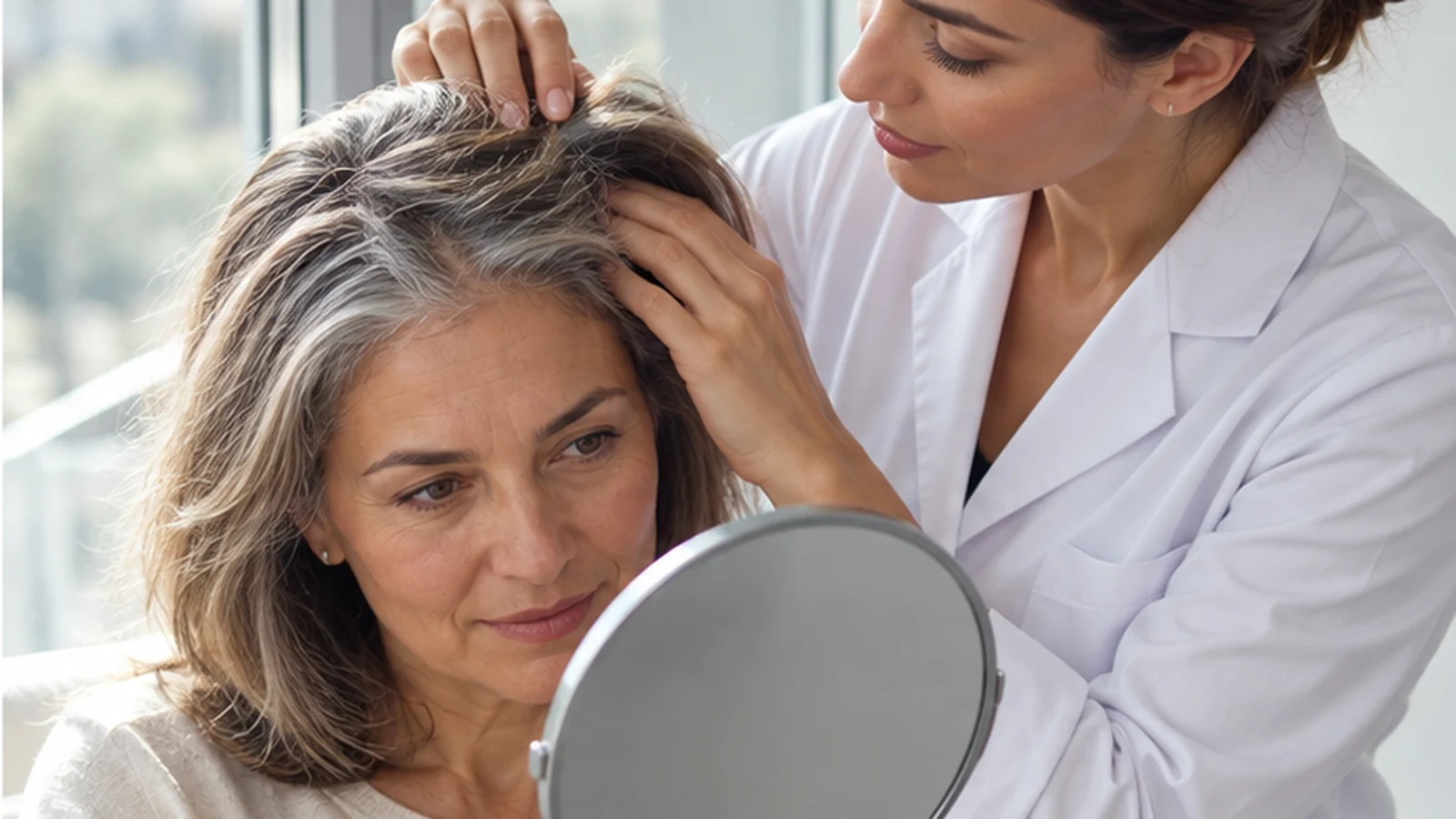
The doctor may ask when the change started and about childbirth, illness, operations, new medicines, restrictive diets, changes in your menstrual cycle and notable hormonal symptoms. Mention family history and hair practices: tight hairstyles, colouring and extensions can matter. The examination assesses the loss pattern and scalp and often includes trichoscopy, a magnified look at hairs and follicle openings. The clinician may gently pull a small group of hairs to assess active shedding.
Blood tests are chosen according to your history and examination: possibilities include a complete blood count, iron stores, thyroid function and other tests when indicated. There is no need to order an enormous “all hormones” panel or take iron, biotin and high-dose vitamins just in case. If inflammatory scarring loss is suspected, a scalp biopsy—a small sample examined under a microscope—may be needed. More than one diagnosis can coexist: postpartum shedding, for example, can reveal female-pattern thinning that was previously less obvious.
Pregnancy, childbirth and menopause: how life stages change the picture
Postpartum shedding often begins months rather than days after delivery. According to the AAD, many women regain their former fullness by their child's first birthday, although regrowth differs. If patches, inflammation, severe fatigue with other symptoms develop, or improvement takes an unusually long time, do not label everything “normal postpartum shedding”; get assessed.
Hormones change during perimenopause, but thinning may also be hereditary, nutritional or linked to something else. With irregular periods, pronounced acne or increased unwanted facial/body hair, a clinician may assess signs of excess androgens, including those associated with polycystic ovary syndrome. A wide parting alone does not prove high testosterone. Do not discontinue prescribed hormones on your own because of hair changes; discuss risks and options with the prescriber first.
Which treatments actually fit your diagnosis?
For temporary telogen shedding, addressing the trigger and allowing time may be the main approach. New hair does not grow as fast as we would like, and a one-week trial proves little. When a deficiency or disease is responsible, care should target that cause, not an identical marketed “vitamin cocktail” for everyone regardless of tests.
For female-pattern loss, topical minoxidil is among the better studied options. Some 2% and 5% formulations are FDA-approved in the United States for female-pattern hair loss; this does not establish registration of any brand in Armenia. Shedding may temporarily increase at first; irritation of the scalp and unwanted facial hair growth can occur. The AAD advises assessing the response over 6–12 months of regular use. Benefits gradually fade when treatment stops. Check the exact product instructions and regimen with a dermatologist.
Minoxidil should be avoided during pregnancy, when planning pregnancy and while breastfeeding. Prescription options for selected patients, such as spironolactone and medicines affecting androgens, have restrictions, possible adverse effects and are often prescribed off-label for female hair loss. Some can harm a developing fetus. Low-dose oral minoxidil is not the same as the topical product: its use for hair loss is off-label in some countries and requires a doctor's assessment of blood pressure, other medical conditions and other drugs. Do not start it without medical advice.
For alopecia areata, the clinician considers how widespread it is and may offer topical or injected anti-inflammatory therapy or other treatments; severe cases need different decisions. With inflammatory scarring hair loss, the first priority is controlling inflammation and preserving remaining follicles, not promising new growth on already scarred skin. In traction alopecia, relieve constant pulling before buying hair-growth products. Transplantation is not appropriate for every diagnosis and requires a sufficient donor area and stable disease.
| Approach | When it may make sense | What it cannot promise |
|---|---|---|
| Correcting an identified cause and gentle hair care | After illness, deficiency or damaging styling | May not stop hereditary thinning |
| Topical minoxidil | Some cases of diagnosed female-pattern hair loss | Not an instant return to full density; continued regular use is needed |
| Clinician-supervised prescription therapy | Selected diagnoses and circumstances | No single safe prescription works for everyone, especially during pregnancy |
| PRP, microinjections, device- and light-based methods | Sometimes discussed as adjuncts | Evidence of benefit depends on the diagnosis and the specific method; mixed-quality studies do not support a promise to “activate all follicles” for every cause of hair loss |
| Hair transplant | Selected people whose condition is stable | Does not treat active inflammation or create an unlimited supply of follicles |
How long until change, and what might other people notice?
With telogen shedding, the noticeable fallout generally precedes any regained volume: short new hairs appear gradually, and ponytail length or thickness takes longer to recover. Female-pattern loss also needs months of treatment to judge a change, and not every lost strand returns. An honest goal may be to slow further thinning and keep existing hair, rather than recreate teenage density.
Diagnostic assessment usually needs no time away from normal life: examining the scalp does not change your appearance. Topical products may leave a sticky feeling or cause irritation, affecting styling and comfort. Injections may leave tenderness, tiny puncture marks, temporary redness or bruising, so ask what will be visible before an important shoot. Surgery can involve restrictions, crusting, swelling and visibly different phases of recovery; timelines depend on the exact technique. Before a major event, avoid starting several new active treatments at once.
What can you do while the cause is being investigated?
Photograph your parting, crown, temples and hairline in comparable light, perhaps once a month. Daily pictures more often amplify worries over changes in hairstyle and camera angle. Note when symptoms began, events in previous months, new medicines and dietary changes. Brush without pulling hard; do not tolerate pain from ponytails or extensions, and use gentle hair care. Such care helps avoid damage but cannot be assumed to treat autoimmune alopecia.
You do not need to give up colouring, styling or your favourite length simply out of fear. The right approach depends on breakage and scalp condition. Wigs, toppers, different partings and volumising products are valid ways to feel more comfortable during evaluation or treatment, if you wish. This is a personal choice, not a “disguise for failure”, and you owe nobody an explanation.
How not to overpay for promises of hair growth
Glossy before-and-after images are especially misleading with hair: moisture, styling, root powder, the parting and camera angle can dramatically change how much scalp is visible. Compare the same area in similar lighting after a meaningful interval. Another person's review does not establish your diagnosis, and “clinically proven” should prompt you to ask: for which type of hair loss, in which study, with what outcome?
Before any course ask: “What is my likely diagnosis and the evidence for it? Are there signs of scarring? What happens if I do nothing? Are we trying to stop loss, increase shaft thickness or regrow a patch? When and with which photos will we assess the response? What adverse effects, pregnancy restrictions and maintenance costs should I expect?” If someone offers a package without examining your scalp or discussing causes, you can pause and seek a second opinion.
A more detailed overview of hair-loss treatment belongs after diagnosis; choosing the “best treatment” only makes sense when the conditions have been distinguished. For now, the task is not to miss an illness needing medical care or treat temporary shedding as irreversible loss. Monitoring alone can also be justified when the cause is understood and recovery expected.
Frequently asked questions
Does a white bulb at the end of a fallen hair mean its root has died?
No. A pale thickening at the end of a shed hair does not show that its follicle has died: the hair shaft and the living structures that produce it are different. Follicle survival is better assessed by examining the scalp.
Can postpartum shedding and hereditary thinning happen at the same time?
Yes. Temporary heavy shedding can make previously existing fine hair more noticeable. If density does not fully return after the postpartum period, review the diagnosis rather than repeating stimulation courses indefinitely.
Should I wash my hair less often if more comes out in the shower?
Usually not. Washing releases hairs already ready to shed, and less frequent washing makes each occasion look more dramatic. Choose washing frequency to suit your scalp and comfort, unless your clinician advises otherwise.
Sources
- American Academy of Dermatology — Hair shedding versus hair loss.
- American Academy of Dermatology — Diagnosis and treatment.
- American Academy of Dermatology — Female-pattern hair loss.
- British Association of Dermatologists — Female-pattern hair loss.
- DermNet — Lichen planopilaris.
- American Academy of Dermatology — Traction alopecia and hairstyling.
- Scalp ringworm: diagnosis and treatment (AAD)