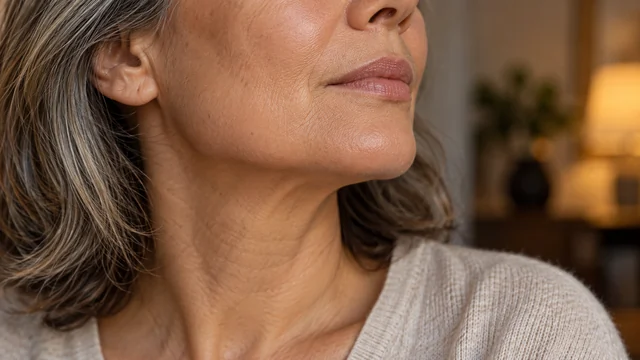

How to reduce a double chin: home and professional options
In a video call or a low-angle photograph, you notice a fold under the chin and want to reduce it. There are different approaches depending on the cause. If overall fat is the main factor, gradual weight management when appropriate and sustainable habits may reduce the volume. A small localised fat pad at a stable weight may prompt discussion of targeted treatments. If loose skin, muscle position or jaw structure creates the contour, removing fat alone may not help and can sometimes make it look worse.
Neither creams nor exercises “just for the chin” guarantee selective fat loss. A small fold under the chin does not, by itself, require medical treatment: its visibility is influenced by head angle, camera position, lighting and genetics. Before choosing a method, distinguish what is present when your head is relaxed from what appears only when you bend your head towards a screen.
Why is there extra fullness beneath the chin?
Several causes often overlap. Subcutaneous fat can accumulate locally even when a person is not overweight. With age, skin loses some elasticity and soft tissues change position. A short or recessed lower jaw and the shape of the chin affect the perceived angle between chin and neck. Changes in the front neck muscles can also alter the outline. Not every case should be labelled “fat.”
An examination with your head in a comfortable position tells more than pinching the area yourself: feeling a fold does not accurately identify the structures or establish whether a procedure is safe. A clinician evaluates skin quality, subcutaneous volume, chin and neck position, weight history and health. A new swelling, especially if firm or one-sided, needs medical causes considered before cosmetic explanations.
| Main factor | What is reasonable to consider | What might disappoint |
|---|---|---|
| Weight fluctuates; fullness extends beyond the neck | Gradual changes to diet and activity if medically indicated and personally wanted. | Local massage and jaw exercises have not been shown to selectively remove fat. |
| Small local fat deposit with reasonably elastic skin | After assessment, discuss permissible non-surgical approaches or liposuction. | Fat removal cannot tighten major excess skin or change bone. |
| Thin or loose skin without a large fat pad | Assess skin and realistic expectations of energy-based tightening; seek a surgical opinion if changes are pronounced. | Fat reduction may make a skin fold more obvious. |
| Neck muscles, jaw position or several factors determine the soft-tissue angle | A full anatomical assessment; sometimes neck or chin correction is discussed. | Fat-dissolving injections cannot change jaw anatomy or muscle bands. |
Can you avoid procedures altogether?
If there is a health reason to manage body weight, a modest sustainable reduction can decrease overall fat, including some under the chin. But nobody can predict which area will change first. Chin exercises, chewing gum, silicone jaw trainers and creams have not convincingly been shown to produce targeted loss of subcutaneous fat. Activity, nourishing food and sleep matter for health regardless of cosmetic results, not because they must sharpen the jawline.
Head position changes how visible a fold is: when the camera is very low and the chin is pressed towards the chest, soft tissue naturally gathers. A higher camera and comfortable posture may improve the angle, but do not destroy fat cells or provide a medical “lift.” For a minor concern, simply reconsidering your photos may help more than treatment. With stable weight and an inherited facial structure, strict dieting to change one camera angle may be unnecessary and ineffective.
What professional options are available?
No method suits everyone, so the decision should be based on the tissue being treated, not a fashionable treatment name. Injections that destroy fat cells, cooling procedures, operations to remove fat and skin-tightening technologies have different recovery patterns, limitations, risks and legal status.
| Approach | Potential use | Main limit and visible recovery |
|---|---|---|
| Deoxycholic acid injections, such as Kybella in the US | Reducing moderate to severe fullness due to subcutaneous fat beneath the chin in suitable anatomy. | A series of injections may be needed; swelling, tenderness, bruising and firm areas are common; nerve injury, swallowing problems and tissue damage are possible. |
| Cryolipolysis with an appropriate device and applicator | Reducing a local subcutaneous fat bulge by cooling without an incision. | Numbness and persistent tenderness can occur; rare paradoxical fat growth may require surgery. |
| Non-invasive ultrasound or radiofrequency skin tightening | Mild to moderate laxity where skin is the main issue. | The effect is generally modest and gradual; it cannot replace substantial fat removal or a surgical lift. |
| Submental liposuction | More direct removal of localised fat in a carefully selected patient. | Surgery carries risks of bleeding, infection, irregular contour and numbness; expect bruises, a dressing and restricted activities. |
| Surgical neck contouring | Excess skin, muscular changes or a combination of factors. | More invasive, with scars, visible recovery and surgical risks of its own. |
In the United States, the FDA has approved Kybella (deoxycholic acid) to improve the appearance of moderate to severe fullness caused by fat beneath the chin in adults. That US approval does not establish registration, availability or approved indications in Armenia. For Kybella, the US label permits up to 6 sessions at intervals of at least one month; that is a maximum, not a guaranteed or compulsory course. In September 2026, the FDA highlighted serious harm from injection outside the chin area and the possibility of persistent nodules even when used as directed. Infection at the injection site is a contraindication to Kybella. It should be avoided in people with pre-existing swallowing difficulties because it can make them worse. Blood-thinning medicines and previous surgery in the neck area require separate assessment. If ulceration, skin necrosis, a persistent lump or nodule, or signs of infection develop after Kybella, seek medical review; the US label instructs clinicians to discontinue further Kybella treatment for these reactions. Do not accept unidentified “fat-dissolving cocktails” or self-injection.
Cryolipolysis is not “risk-free freezing.” The FDA describes cold injuries, changes in sensation, temporary changes in lip or tongue movement when treating beneath the jaw and paradoxical adipose hyperplasia—unusual growth of fat instead of reduction. Small early trials cannot prove the absence of complications. Energy-based skin tightening has a different target: consider it when skin laxity is the real problem, rather than confusing it with fat destruction.
What will the first days look like, and when can you be seen in public?
After deoxycholic acid injections, swelling may temporarily make the very fullness you want to reduce look bigger. Tenderness, bruising and firmness can accompany it. Do not expect to look unchanged the next morning: discuss with the clinician the range of reactions for that product and technique, and what to do about an uneven smile or difficulty swallowing. Volume reduction develops over time, and the number of visits varies.
After cooling, redness, swelling, tenderness or numbness may appear. Outward recovery can feel easier than surgical recovery, but that does not rule out later complications. After liposuction, visible bruises, swelling, dressings or compression and activity limits need to be planned for. General ASPS advice for liposuction describes significant restrictions in week one, a gradual return to activities in weeks two and three, and swelling that then continues to settle; a small submental area may recover differently. Neck surgery can involve drains and a prolonged recovery too.
Keep three dates separate: when routine activity is allowed, when your appearance feels comfortable for the office and when the final contour can be judged. They are not necessarily the same day. If a wedding, important photos or camera-facing work is coming up, ask about the realistic upper range of visible swelling and allow sufficient time. Rushing cannot make any method more predictable.
Which symptoms mean you should contact a doctor?
After any invasive treatment, increasing severe pain, rapidly growing one-sided swelling, bleeding, fever, signs of infection, changes in lower-lip movement or smile, and difficulty swallowing require urgent medical assessment; difficulty breathing is an emergency. A firm bulge that grows over time after cryolipolysis needs assessment rather than another cooling session. If swelling appeared suddenly without a procedure, is painful, grows quickly or is accompanied by a neck lump, seek diagnosis before aesthetic treatment.
Tell the clinician if you are pregnant or breastfeeding, have neck conditions, prior operations, medications, infection or a bleeding disorder. During pregnancy or breastfeeding it is generally reasonable to defer elective injections and device-based contouring until a medical discussion because safety evidence for cosmetic use is insufficient. Do not stop essential medicines on your own for a procedure.
How can the result still look natural?
A natural contour does not necessarily mean an extremely sharp angle from neck to chin. Ask how the appearance would change from the side and the front, whether skin might look looser after fat removal and how the result relates to your jaw shape. When causes are mixed, the most reasonable choice may be minimal treatment or observation. If somebody promises to “remove a double chin completely with no recovery” without examining your skin and neck, ask for an anatomy-based explanation, not a slogan.
At consultation, request a comparison of at least two approaches and the option of doing nothing. Check the product or device identity, its authorised indications in your country, the practitioner's experience beneath the jaw, emergency procedures and all price drivers: number of visits, anaesthesia, dressings, follow-up and possible revision. Before-and-after photos should match in head tilt, tongue position, lighting, expression and follow-up interval. You do not have to decide the same day; taking time is more important than a limited-time offer.
Frequently asked questions
If I have had a double chin since adolescence, must my weight be the cause?
No. Inherited amounts of subcutaneous fat and the shape of the chin can influence your profile even with a stable weight in the normal range.
Can I repeat cryolipolysis if a hard bulge appeared after the first session?
Have it examined first to rule out paradoxical fat growth or another complication; do not repeat the procedure blindly.
Why is the fold more visible after losing weight?
Reducing fat volume can reveal reduced elasticity and excess skin more clearly. This calls for tissue assessment, not stricter dieting.
Sources
- Cleveland Clinic: causes of a double chin and limits of home methods.
- FDA: September 15, 2026 Kybella safety information.
- DailyMed: Kybella indications, limits and risks.
- FDA: risks and limits of non-invasive contouring, including cooling.
- American Academy of Dermatology: possibilities and limits of skin tightening.
- American Society of Plastic Surgeons: liposuction recovery.