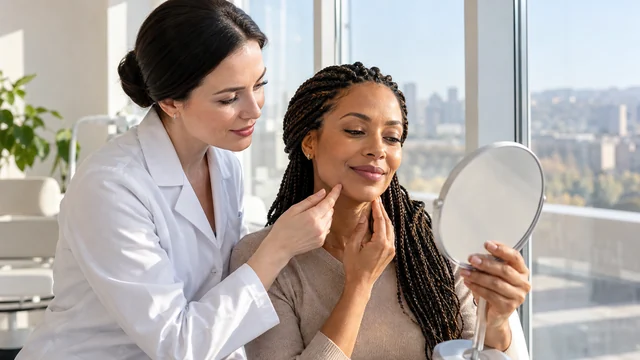
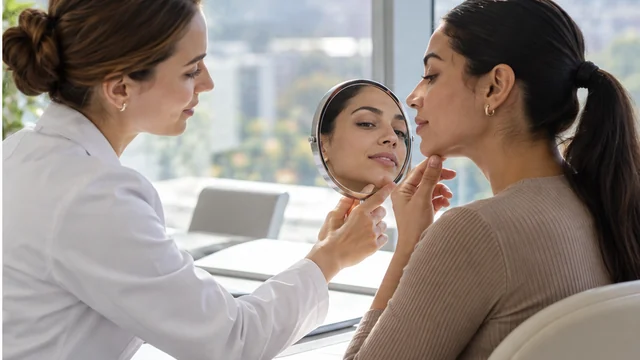
Microbotox: Pores, Shine and Fine Surface Lines Explained
If you like your expression but wish your pores, shine or fine surface lines were less noticeable, “microbotox” can sound like a compromise. Separate the promise from the technique. Microbotox, microtoxin and mesobotox are not separate brands: they are techniques that distribute small injections of botulinum toxin, mainly superficially within the skin. They differ from conventional intramuscular injections in target, distribution and depth. The name does not mean risk-free treatment, zero muscular effect or regulatory approval as a pore treatment.
Early studies suggest intradermal botulinum toxin A might temporarily reduce oil production and visible pore size or improve some fine lines in certain people. But samples are small, techniques differ and durable effectiveness remains uncertain. For strong expression lines, indented acne scars or lost facial volume, microbotox alone often misses the main issue. Targeted alternatives or a simple skincare plan may be more predictable.
Is it the same as Botox or a different product?
“Microbotox” does not identify the medicine. Each registered botulinum toxin A product has its own storage, dilution, indications, potency units and instructions. Units from different brands are not interchangeable. “Micro” describes the injection pattern, not total dose, manufacturing quality or safety. Ask for the exact brand, manufacturer, formulation and its regulatory status in the country of treatment.
The October 2024 US FDA prescribing information for BOTOX Cosmetic (onabotulinumtoxinA) describes intramuscular cosmetic use for specified expression lines and platysmal bands. Intradermal treatment for pores, shine or general “skin quality” is not a separately approved indication in that particular US label. This is an example of off-label use, not proof that all such treatment is unlawful worldwide. Regulations and labels for other products, revisions and countries must be checked separately; American rules do not replace Armenian requirements. Therapeutic BOTOX labeling, including some intradermal uses, must not be confused with BOTOX Cosmetic approval for facial pores.
“Botox,” “Dysport” and “microbotox” are not equivalent terms. For differences between specific products, see Botox versus Dysport. This page instead asks whether superficial injections improve your particular skin concern, how robust that evidence is and what they may trade against normal facial movement.
Why inject so superficially?
Traditional aesthetic botulinum toxin injections target expression muscles. The drug temporarily inhibits acetylcholine release, the chemical signal between nerve and muscle, reducing contraction and softening related lines. Microbotox involves many small doses placed mainly in the dermis, the layer beneath the skin surface. Effects on superficial muscle fibers and sebaceous glands are being investigated; the mechanism of apparent pore changes is not conclusively established.
Superficial injection does not exclude spread into nearby muscles. Facial structures are close together, and skin depth and muscle anatomy vary by area. Unintended weakness in the lower face may change smiling, speaking or lip movement. Neither “all your expressions will certainly remain” nor “complications are impossible” is trustworthy. Region selection, a properly qualified clinician and assessment of your facial movement before treatment matter.
What might the technique change—and what won't it?
| Your goal | Reasonable expectation | What to consider before automatically selecting microbotox |
|---|---|---|
| Oiliness and visible pores | Temporary improvements reported in small studies; size and reproducibility uncertain | Evaluate seborrhea, acne, skincare, retinoids and other indicated therapies |
| Fine surface lines | Some softening possible, with no promise for deep folds | Establish whether movement, dryness, sun damage or volume loss causes them |
| Pronounced expression wrinkles | Superficial injection is not equivalent to precise intramuscular relaxation | Conventional botulinum treatment individualized to dose and expression |
| Acne scars, deep pits and enlarged-looking pores | No basis for promising reconstruction of scar tissue | Acne treatment and scar-type-specific options |
| Lower-face sagging | Small-study “lifting” is not a surgical facelift | Assess skin, volume and supporting structures; declining remains an option |
Pores are normal skin structures. Their appearance depends on sebum, follicles, lighting, age and skincare. Blurred pores in an after photo may reflect a temporary cosmetic effect, not permanent closure. If the real problem is oiliness, first ask whether acne, irritation from aggressive routines or another dermatologic disorder contributes. Treating active inflammatory acne may be more useful than cosmetic masking.
What does the research show, and what is disputed?
A 2024 systematic review/meta-analysis covered 10 studies and 153 participants: five randomized trials and five prospective cohorts. The authors reported promising changes across some skin measures but found insufficient accumulated data for definitive conclusions. Products, dilutions, sites and measurement methods varied considerably. The studies searched were published through March 2023, and improvement in skin hydration was not convincingly shown.
In 2025 other researchers flagged possible extraction errors in sebum and pore measurements in that meta-analysis, potentially changing its conclusions for those outcomes. This does not prove the technique never works, but advertising precise success percentages is unjustified. Evidence for one preparation or injection pattern cannot establish results for every patient. Expert roundtables offer practical opinions and hypotheses, not large independent comparative trials.
A further prospective study was published in July 2026. In 30 adults with oily skin and visible pores, measurements of sebum and pore size were lower six weeks after intradermal injections in both cheeks. But there was no control group, and follow-up lasted only six weeks. It therefore cannot separate a treatment effect from other explanations, establish durability, or promise you the same result. This is another preliminary signal, not a validated standard regimen.
If offered a specific percentage of “pore reduction,” a fixed number of months of effect, or guaranteed preservation of your smile, ask which drug, technique, participants and measurements support it. Without that match, it is not evidence for your plan. Some people may notice a change in photographs; others may notice little or none.
What happens during treatment, and does it hurt?
The examination matters more than the needles: a clinician should inspect the skin, clarify your goal and ask you to smile, frown and close your lips while assessing baseline symmetry and medical history. Disclose earlier toxin injections and dates, adverse reactions, current conditions and medicines. Compare photographs only with matched lighting, distance and expression; a filtered selfie is a poor baseline.
After cleansing, cooling or topical anesthesia may be used. Many shallow injections can feel like repeated pinches or stings rather than a single prick. Small raised bumps, redness and pinpoint bleeding or bruising are possible. Good anesthesia does not guarantee a pain-free session. The clinician should explain the treated areas and follow-up; you do not need to select needle depth, concentration or injection pattern yourself.
Will your face still look like you?
“Natural” means different things to different people: keeping smile creases, freely raising the eyebrows, or only having slightly less shine. State your priority plainly: “A modest reduction in oiliness is fine, but I don't want my smile changed.” Ask why the planned areas should spare important movements and why the risk still cannot be excluded completely.
A very cautious plan may produce only a small cosmetic benefit. More injection points do not guarantee improvement. Unlike certain fillers, botulinum toxin cannot be instantly dissolved if its muscle effect is unwanted. Usually the effect must gradually wear off while a clinician advises on symptomatic care. Do not accept extra injections under pressure.
What recovery looks like at home and work
| When | Possible appearance | Practical implication |
|---|---|---|
| Immediately | Small bumps at injection points, redness, tenderness | Even if you can resume activities, close-up photos that day may be uncomfortable |
| Following days | Dots generally fade but small bruises may remain | Do not assume makeup will hide everything; follow application instructions |
| Once the effect develops | Oiliness or texture may change; unwanted neighboring muscle weakness may also become apparent | Check facial movements, not just still skin |
| Following months | Any effect gradually fades; there is no universal duration for all protocols | Do not schedule automatic repeats without assessing benefit and tolerance |
Standard botulinum toxin treatment often does not require leave from work, but microbotox creates many superficial punctures that may be more socially visible for you. Avoid booking it only hours before photography or public speaking unless you accept unpredictable dots or bruises. Discuss the schedule and onset with the clinician rather than expecting a precise guarantee. Resume exercise, cosmetics and active skincare according to individual instructions; avoid vigorous rubbing of injection sites.
When postponing or declining makes sense
Botulinum toxin is a prescription medicine, not a serum. Hypersensitivity to toxin or ingredients and infection at the site are contraindications in the BOTOX Cosmetic label; check the label for the product actually used. Neuromuscular disorders, existing swallowing or breathing difficulties, impaired muscle control, past complications and medicines affecting neuromuscular transmission (including some antibiotics and muscle relaxants) require particular care. Do not stop prescribed drugs on your own.
There is not enough direct evidence to promise safety for elective intradermal aesthetic injections in pregnancy or breastfeeding. Discuss postponement; information from other medical uses of botulinum toxin does not establish the safety of this technique in these circumstances. Other recent injections, operations or active skin inflammation also warrant reviewing dates and areas.
Soreness, bruising, swelling and headache may occur. Less commonly, eyelid or brow droop, smile asymmetry, weak lip movement or other unwanted muscle effects can occur. Product labels warn of possible spread beyond the injection site. Difficulty breathing, swallowing or speaking, or increasing generalized weakness requires emergency medical care. Do not wait for a follow-up or call these symptoms normal adjustment. New double vision or deteriorating vision after injections also calls for urgent medical assessment.
What to choose instead for healthier-looking skin
If pores and shine are the concern, begin by reviewing tolerance of gentle cleansing, appropriate moisturizer, sun protection and dermatologist-guided options for acne or oiliness. Treat active inflammatory lesions rather than only their appearance. Uneven colour or photodamage may call for other approaches, but those have their own risks and are not automatically safer.
For clearly dynamic lines, conventional targeted toxin injections may be worth discussing with their own limitations. Prominent scars require classification and a separate plan. Do not transfer a microbotox protocol to other anatomy: trap tox, for instance, has different targets and risks. A clear goal prevents paying for the wrong technique or altering facial expression when skincare would do.
Questions that put you in control
- Exactly which product will be injected, where was it obtained and what does its local label authorize?
- Why intradermal injections rather than standard muscle treatment or a noninjectable option?
- How will you assess oil-gland activity and distinguish visible pores from scars?
- Which facial movements could change if the effect spreads unexpectedly?
- What will be visible tonight and over the next days, given my work or photography plans?
- Who will review me, and whom should I contact for asymmetry or functional symptoms?
- What further costs might arise, what counts as worthwhile improvement, and can I decline without being pressured?
When comparing before/after images and reviews, check lighting, expression, makeup, time since treatment and concurrent procedures. Neither a well-known brand nor a fashionable technique name replaces evidence for your own case. Price reflects the product, area, professional work and follow-up; current registered products, local prices and availability in Yerevan require independent verification. You are free to stop after the consultation if the trade-off no longer appeals to you.
Frequently asked questions
Is this the same as “baby Botox”?
Not necessarily. “Baby Botox” may refer to lower doses with conventional intramuscular injections, whereas microbotox usually means numerous shallow intradermal injections. Marketing terms overlap: ask about depth, medicine and clinical goal instead.
Can facial excessive sweating be treated at the same time?
Excessive sweating needs its own diagnosis and indication. Evidence for intradermal treatment at one site, such as the armpits, cannot be directly applied to the entire face or to aesthetic pore treatment.
Does microbotox help rosacea?
Preliminary reports describe effects on certain types of redness, but they do not establish microbotox as standard rosacea therapy. Start with diagnosis, triggers, skin barrier and dermatologist-recommended treatment.
Sources
- FDA — BOTOX Cosmetic prescribing information, October 2024 (US product-specific label).
- Rahman et al., 2024 — intradermal botulinum toxin A systematic review and meta-analysis.
- Cai and Zhang, 2025 — critique of meta-analysis data.
- Microtoxin expert roundtable, 2023 — approaches and limitations.
- American Academy of Dermatology — Botulinum toxin FAQ.
- CDC, April 2026 — injection safety and product sourcing
- DailyMed, 2026 — therapeutic BOTOX, separate indications and routes
- Dominguez-Salgado et al., 2026 — small uncontrolled prospective study of pores and sebum.