
Why Skin Tags Appear: Causes of Acrochordons
Why do soft skin growths appear?
You notice a small, soft flap of skin on your neck and, some time later, another beneath your arm. Is it the necklace, hormones, blood sugar, or something more serious? These growths are often casually called papillomas, but the more precise terms are acrochordons, soft fibromas, or skin tags. They are benign skin growths, generally soft and sometimes attached by a narrow stalk. There is no single proven cause. They occur more often alongside certain factors: repeated friction within skin folds, age, family predisposition, pregnancy, higher body weight, and conditions affecting glucose metabolism.
An important distinction: having one or several typical skin tags does not mean you have diabetes, a viral infection or a hormonal disorder. Equally, metabolic conditions can exist without any skin tags. This article focuses on possible causes and when a skin change is worth discussing with a clinician; choosing a removal method is a separate decision.
What is actually associated with skin tags?
Friction and skin folds. Common areas include the neck, armpits, groin creases, underneath the breasts and sometimes the eyelids. Skin rubs against skin, a collar, a bra strap, a chain or underwear. Researchers consider repeated irritation a possible contributing factor, but it does not explain every case. A necklace does not infect your skin, nor does it prove that it caused any particular growth.
Age and family history. Skin tags become more common with age. If close relatives have them, you may be more likely to notice them too. This is a predisposition, not a fixed inheritance pattern: neither age nor family history predicts how many growths you will develop.
Weight and metabolism. Skin tags have been reported more frequently in people with obesity, insulin resistance, type 2 diabetes and metabolic syndrome. Insulin resistance means the body's cells respond less well to insulin. Much of the evidence is observational: it shows that conditions occur together, not that high insulin directly caused each growth. Skin appearance alone cannot assess your metabolic health.
Pregnancy and hormonal changes. Soft skin growths may appear more frequently in pregnancy, when hormonal and growth signals, body weight and contact between skin folds can change. This does not mean every skin tag warrants hormone testing. A typical growth without troublesome symptoms can usually be assessed routinely. Avoid trying to remove it yourself, especially without a confirmed diagnosis.
Possible mechanisms. Scientific papers discuss growth factors and the possible role of human papillomavirus (HPV). Some small studies detected HPV DNA in skin-tag tissue, whereas others found no association; detecting viral DNA does not itself establish that the virus caused the growth. Skin tags must therefore not be equated with viral warts. Looking at a soft growth cannot diagnose HPV, let alone reveal how someone acquired an infection or anything about their sexual health.
| What you notice | What it may suggest | What it does not establish |
|---|---|---|
| Growths where clothing rubs | Friction may have contributed to their appearance or irritation | It does not prove clothing was the sole cause |
| Several family members have skin tags | A familial predisposition is possible | There is no inevitable inherited diagnosis |
| Numerous skin tags alongside diabetes risk factors | A reason to discuss routine metabolic health assessment | Skin tags alone cannot diagnose diabetes |
| Growths appearing during pregnancy | They may relate to normal physiological changes | They do not automatically indicate a dangerous hormonal disorder |
| A new, unusual-looking “papilloma” | It may be a different kind of skin lesion | An internet label cannot confirm its type or cause |
What skin tags usually do not mean
A genuine, typical soft fibroma is not cancer and is not considered a precancerous condition. It is not caused by poor hygiene or inadequate skincare, and harsh peels or antiseptics are not needed. Even good skincare cannot guarantee that no new growths will appear: it cannot directly alter ageing, family traits or some metabolic factors.
The word “papilloma” can be alarming. In everyday speech, however, people use it for different things: soft fibromas, viral warts and certain moles. Their causes, potential for transmission and diagnostic approaches differ. A genuine skin tag should not automatically be treated as a contagious wart. Equally, a growth in the genital area should not be labelled a skin tag without examination: a clinician must consider genital warts and other lesions.
Another myth is that cutting off one growth makes the others spread. Professional removal of a benign skin tag does not trigger infectious spread. New growths may appear elsewhere later because the underlying predisposition remains. If something appears again at the original site, find out whether tissue remained or a new lesion developed rather than automatically assuming an ordinary recurrence.
When should you look beyond the skin?
One stable, soft growth is generally not a reason for urgent “full hormone testing.” But if many new growths appear over a relatively short time, particularly together with weight gain or known diabetes risk factors, consider talking with your GP or family doctor. They will take account of your age, family history, blood pressure, medication, pregnancy status and symptoms, and decide whether standard glucose or HbA1c testing is appropriate. Tests are chosen on the overall clinical picture, not by counting skin tags in a photograph.
Also notice whether there are pronounced dark, velvety patches in skin folds. This can be acanthosis nigricans, sometimes associated with insulin resistance. It does not independently confirm a diagnosis, but can make a metabolic assessment more relevant. If numerous skin growths of uncertain type suddenly appear, first check that they really are skin tags rather than, for instance, seborrhoeic keratoses.
The consultation is not about finding a disease behind every small growth; it is about not missing prevention appropriate to your overall risk. Previous test results, family history and how you feel matter alongside your skin. Do not start blood-sugar medication or change prescribed treatment based on a skin sign alone.
When does a growth need examining?
A typical skin tag is soft, skin-coloured or slightly darker, often on a small stalk, and may cause little trouble for years. It can redden with friction, but sudden pain, persistent bleeding, a wound that does not heal, rapid enlargement or a noticeable change in shape or colour call for an in-person examination. Such changes are not necessarily dangerous: a stalk can twist and lose its blood supply. The reason cannot be determined reliably at home.
If shaving makes it bleed, apply gentle pressure with clean gauze or a clean cloth. Seek urgent medical care for heavy bleeding or bleeding that does not stop. Increasing surrounding redness or warmth, pus, worsening pain or fever also warrant prompt medical attention. A lesion on the eyelid that affects vision or irritates the eye deserves examination by a clinician experienced in that area.
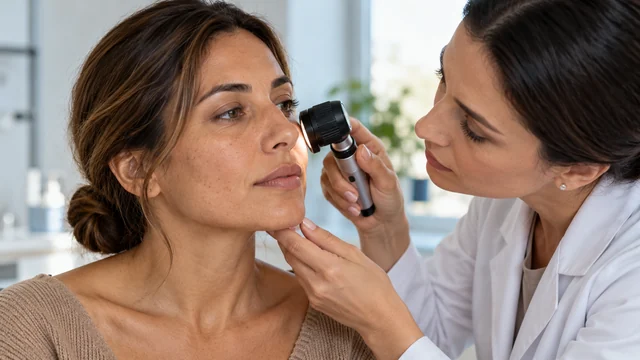
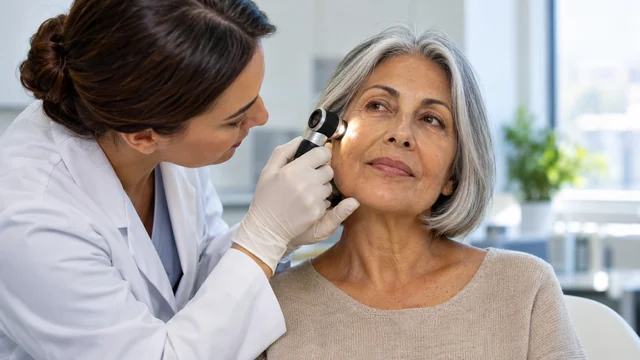
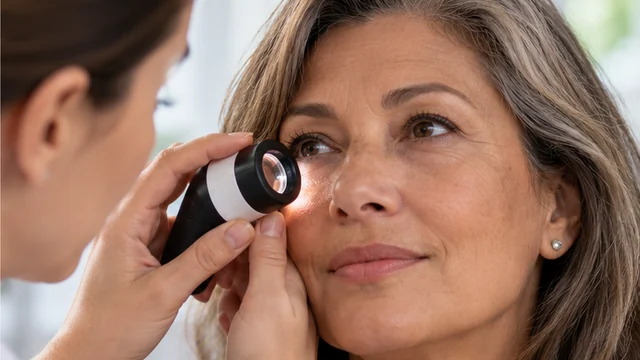
Colour alone is not enough to diagnose a lesion: normal skin tags can be dark, while unusual lesions may also feel soft. A clinician assesses the history, site and surface and may use a dermatoscope, a magnifying instrument for inspecting skin. If the diagnosis is uncertain, a biopsy and laboratory examination of tissue may be needed. Destroying a suspicious growth before its nature can be established is unwise.
| Situation | Reasonable next step |
|---|---|
| A small, soft growth has been unchanged for a long time and causes no discomfort | Removal is optional; mention it at a routine visit, especially if the diagnosis is uncertain |
| It repeatedly catches on underwear, jewellery or a razor | Reduce friction and discuss removal once the diagnosis is confirmed |
| Many new growths have appeared suddenly | Arrange a skin examination and, if appropriate, discuss metabolic risks with a clinician |
| It grows quickly, bleeds spontaneously, ulcerates or changes appearance | Do not cauterise at home; arrange an in-person assessment promptly |
| It is on an eyelid or the genitals, or looks atypical | Do not diagnose it from a photo; see a suitably qualified specialist |
Can you prevent skin tags?
According to clinical reviews available as of October 2026, no method is known to reliably prevent all skin tags. Choosing comfortable clothes and jewellery that rub less may reduce irritation, but not your individual predisposition. Supporting metabolic health through movement, nutrition and management of risk factors with a clinician is worthwhile whether or not your number of skin tags changes. Claims that “detoxing” will eliminate all of them are not backed by reliable evidence.
Do not tie off a stalk with hair or thread, cut it with nail scissors, apply wart-removal acids or use an online “removal pen.” Risks include bleeding, burns, infection, scarring and delay in diagnosing a different condition. Such attempts are particularly risky around the eyes or on sensitive skin. If you choose removal, first confirm the diagnosis and discuss medical options; choosing not to remove anything is also reasonable.
Before your appointment, think about when you first noticed the growth, how quickly it changed, whether clothing rubs it and whether similar lesions appeared before. A dated ordinary photograph can help comparison, but not provide a diagnosis through an app, a magnified image or someone else's before-and-after photos. Ask: “Are you sure this is a skin tag?”, “Do I need dermoscopy or tissue analysis?” and “Do I have separate reasons to check my blood sugar?” These questions are more useful than searching for one culprit.
A few additional questions
Can a skin tag develop after weight loss?
Yes. Changing weight does not undo every pre-existing influence, and remaining skin folds can continue rubbing together. This does not mean losing weight brought no health benefit.
Why can two people of the same weight have different numbers of skin tags?
Frequency depends on age, family traits, the shape and location of skin folds and other factors, not weight alone. You cannot compare two people's health by their number of tags.
Do skin tags on the neck alone justify HPV testing?
Typical skin tags on their own are not an indication for HPV testing. Cervical screening and assessment of genital lesions follow separate medical indications.
Sources
- American Academy of Dermatology: Skin tags — why they develop, and how to remove them.
- DermNet: Skin tag (Acrochordon).
- StatPearls / NCBI Bookshelf: Skin Tag (Acrochordon), updated 13 December 2025.
- American Family Physician: Diagnosing Common Benign Skin Tumors, 2024.
- Cleveland Clinic: Skin Tags (Acrochordons).
- Gupta et al. 2008: HPV and skin tags, observational study
- Pezeshkpoor et al. 2012: HPV and skin tags, negative case-control study