Fotona Resurfacing: What the Name Covers and What to Expect
You may be considering Fotona resurfacing to smooth rough texture, soften acne marks or fine lines, but you do not want an unexpected week of visible peeling before work. The essential distinction is that “Fotona resurfacing” is not one standardized procedure. Fotona makes laser platforms. Depending on the model, handpiece and mode, the treatment could be a superficial peel, fractional ablation requiring wound care, or heating without removal of the top skin layer. The brand alone cannot tell you which one you will receive.
Choose a specific concern and protocol, not simply “Fotona” on a price list. A moderate approach may suit minor texture changes or sun damage; deep scars or considerable skin laxity need a different discussion and sometimes a different treatment altogether. Age itself is not an indication.
What does “Fotona resurfacing” actually mean?
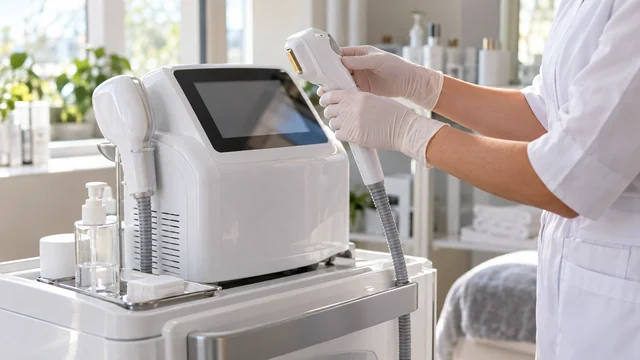
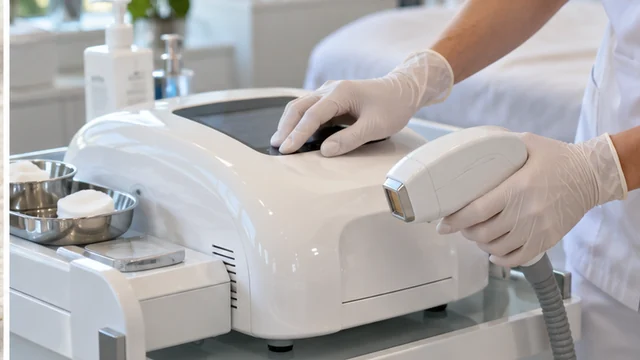
Certain platforms in the SP Dynamis family combine Er:YAG 2940 nm and Nd:YAG 1064 nm lasers. Er:YAG energy is strongly absorbed by water in the skin and, at ablative settings, removes fine surface layers; the depth depends on energy, pulse duration, number of passes and pattern. Nd:YAG has other tissue-heating uses. Having both wavelengths within one console does not turn every session into resurfacing; configurations may also differ.
Er:YAG itself has distinct modes. Fully treating an area and treating it fractionally are not equivalent. Fractional ablation creates microscopic zones separated by relatively untreated skin; full-field ablation exposes a larger continuous surface. According to Fotona's description, SMOOTH mainly aims at controlled heating without comparable surface removal. Ask what a promise of “resurfacing without injury” means: it may refer to a non-ablative procedure rather than an ablative peel.
Names such as SP Dynamis, SP Spectro, Dynamis Pro and configurations with scanning attachments are not interchangeable: power, software modes, accessories and capabilities can differ. Fotona 4D is also the name of a multi-step branded protocol, not another term for deep Er:YAG resurfacing. Ask for the exact model on the equipment label, wavelength, setting mode, handpiece and intended effect on your particular area.
A guide to the modes: what change are you choosing?
| What the service is called | What it does | What to clarify before consenting |
|---|---|---|
| Superficial Er:YAG peel | Limited removal of upper skin; intensity depends on settings | Open skin, crusting and makeup restrictions |
| Fractional Er:YAG resurfacing | Many small ablative zones with untreated skin between them | Treatment density, scar and pigmentation risk, visible marks |
| Full-field or deeper Er:YAG ablation | More extensive removal of tissue requiring healing-surface care | Actual social downtime, infection prevention and review plan |
| Fotona SMOOTH / combination with Nd:YAG | Mainly thermal treatment without equivalent ablation | Realistic changes and why it is being called resurfacing |
The table explains treatment principles, not settings to copy. The same label may describe quite different protocols at different practices. Do not choose power levels or numbers of passes from a social-media video.
Which concerns may improve, and which are unlikely to?
The clearest potential benefit concerns relatively superficial texture changes: fine lines, some sun damage, roughness and certain shallow scars. For acne scarring, a clinician should first identify the scar type. Narrow, deep ice-pick scars, broader depressions and scars tethered to deeper tissue are not expected to respond identically. Some need subcision, focal techniques or combined approaches; one laser pass will not correct every scar.
Conversely, if the main concern is red vessels or a few brown spots and the surface is otherwise smooth, a more targeted vascular or pigment treatment, possibly a light-based technique, may fit better than ablation. If active acne, rosacea or dermatitis is involved, diagnosing and controlling the inflammation is often the first step.
Do not expect permanently invisible pores, complete removal of any deep indentation, a surgical lifting effect, a stop to ageing or identical outcomes across patients. Collagen remodeling is gradual; do not judge scars immediately after swelling subsides. Increasing intensity or treated area can mean more intervention but also a more demanding recovery. More aggressive is not automatically better for your priorities.
How strong is the evidence behind sweeping marketing claims?
Manufacturer information describes modes and engineering capabilities; that identifies a device, but it does not prove that a particular combination outperforms alternatives. Studies of Er:YAG resurfacing as a treatment class support improvement in some wrinkles and scars, but results from different devices, depths and protocols cannot simply be assigned to an unspecified Fotona session.
Comparative reviews of CO₂ and erbium-based lasers show a trade-off: for some concerns, including atrophic acne scars and some wrinkles, more aggressive CO₂ ablation may produce greater improvement at the cost of more pain and longer recovery. A 2026 review included five comparative studies with 130 analysed participants; it pooled fractional Er:YAG and erbium-glass lasers even though these are distinct technologies, and its data cannot automatically be attributed to a specific Fotona device. When only randomized studies were analysed, the apparent CO₂ advantage for the primary response outcome was no longer statistically conclusive. This is a small, heterogeneous evidence base, not a ranking of brands. Outcomes depend on scar anatomy, skin and practitioner technique. Ask for evidence on the proposed protocol and comparable unretouched photographs, rather than promises about “the strongest laser.”
US FDA 510(k) records exist for certain Fotona devices, including SP Dynamis and a separate Dynamis Pro Family decision in September 2026. These are US substantial-equivalence clearances of named devices, not endorsements of every advertised outcome or of every possible technique, and they do not establish registration, ownership or availability in Armenia. Check the exact model and regulatory jurisdiction separately.
What happens during a visit, and what does it feel like?
Before treatment, the clinician should assess tanning, previous dark marks after inflammation, herpes, infection, abnormal healing, medicines and prior procedures. A spot changing shape or colour or bleeding must not automatically be treated as cosmetic pigmentation: it needs a diagnosis first. Before meaningful ablation, ask about pain control, preparation, wavelength-appropriate eye protection, and wound care.
During treatment, feelings can range from substantial warmth or tingling to painful brief pulses. There may be a smell of heated tissue and extraction of laser plume. Comfort depends on the mode, site and anaesthesia; modern equipment does not guarantee painless treatment. Eye protection specific to the laser wavelength is essential for facial treatment; regular sunglasses are not suitable.
One useful question is: “Will this disrupt my skin barrier?” The answer determines washing, makeup, skincare and scheduling. Genuine ablation requires care of a healing skin surface; it is not equivalent to putting on ordinary moisturizer after a facial.
What will you look like afterwards? Healing and being ready to go out are not the same
| Stage | Gentle thermal or minimally ablative approach | More intensive Er:YAG ablation |
|---|---|---|
| Immediately | Warmth, redness and mild swelling possible | Pronounced redness, sensitivity, sometimes a moist surface and swelling |
| Following days | Dryness or fine flaking; some people show few outward marks | Crusting, obvious peeling, special cleansing and protection |
| Once the surface closes | Colour and texture gradually settle | Pinkness can persist after apparent healing; makeup only when approved |
| Weeks and months later | Judge changes once the reaction settles | Remodeling continues; persistent redness or colour change needs assessment |
These are patterns by type of skin injury, not a calendar for your session. The American Society of Plastic Surgeons describes roughly a week of recovery for typical erbium resurfacing, but that average does not mean everyone looks normal on day seven. Gentler modes may need less downtime; extensive or combined treatment may need more. Being medically healed and looking ready for an on-camera meeting or celebration are different milestones.
If a wedding, photoshoot or sunny trip is only a few days away, discuss postponing treatment or choosing conservative care. Do not scrub away flaking skin. Before healing is complete, makeup, acids, retinoids, overheating from exercise, pools and saunas should only resume when the treating clinician says it is appropriate. Plan shade, a hat and individualized ultraviolet protection outdoors.
When is it especially important to slow down?
Recent tanning, irritated or infected skin, active herpes, impaired healing or a tendency to abnormal scarring warrant particular assessment and sometimes deferral or a different option. Darker skin and a history of post-inflammatory hyperpigmentation do not always rule out laser care but affect risk, preparation and settings. Disclose isotretinoin, systemic steroids, photosensitizing medicines and immunosuppressants. There is no single stopping interval for all circumstances; never stop prescribed medication on your own.
Elective ablative cosmetic treatment is generally deferred during pregnancy because direct safety evidence is limited. Breastfeeding requires a separate assessment: risks differ from pregnancy and depend partly on anaesthesia, medicines and aftercare; neither an automatic ban nor proven safety is justified. With recurrent cold sores, the clinician may discuss antiviral prevention; it is a medical decision, not advice for everyone to take tablets.
Short-term redness, swelling, dryness and peeling may be expected depending on depth. Complications can include unintended burns, bacterial or viral infection, lasting darker or lighter patches, prolonged redness and scarring. Increasing pain after initial improvement, spreading redness, pus, fever, blisters or changes in vision require prompt contact with your clinician; visual symptoms or severe reactions require urgent medical care. Do not conceal these signs with heavy makeup.
What should you compare: Fotona, Fraxel, CO₂, or no laser?
Ablative Er:YAG Fotona physically removes microscopic surface layers. The familiar Fraxel DUAL instead uses non-ablative fractional thermal treatment at 1550/1927 nm. Both may be called skin renewal, but sensations, indications and aftercare differ. Fractional CO₂ is another ablative approach and may need substantial visible recovery. Compare them by scar or wrinkle type, not by logo recognition.
If uneven colour and vascular redness are the main issues, read about IPL photorejuvenation and arrange pigment diagnosis. If substantial sagging is the priority, surface treatments do not replace assessment of lifting options. Treating acne, practising sun protection or following dermatologist-prescribed skincare before reconsidering lasers can be sensible; choosing no treatment for now is also legitimate.
How to discuss the plan without buying a brand name
Ask the clinician to record the precise Fotona model and handpiece, whether ablation is planned and how extensive it will be, the particular problem targeted and why. Clarify how visible recovery could be in your case; when washing, creams, makeup, exercise and sun exposure are acceptable; who handles complications and when follow-up occurs. If a course is proposed, ask how the next session is decided and when treatment should stop if progress is insufficient.
Bring ordinary daylight photographs and describe your priority: “I prefer a modest change without much time off,” or “I can accept recovery for more work on texture.” That is more useful than asking for maximum rejuvenation. Check whether anaesthesia, post-care products and follow-ups are included in the quoted amount; the brand name alone cannot establish the full cost.
Further questions
Can Fotona resurfacing target only individual scars? Sometimes a clinician can treat selected scars if their shapes and the surrounding skin allow it; this may limit the treated area, but it does not remove the need for recovery or guarantee an even result.
Can resurfacing be repeated with a different handpiece? Possibly, but healing and the previous result must be examined first. Prior energy exposure, pigment response, scarring and the new purpose all affect a safe decision; a new attachment is not a reset button.
What if someone offers Fotona 4D instead of resurfacing? That is a different series of steps and modes. Ask which step, if any, actually removes surface tissue and which relies on heating, and how that matches your goal and available recovery time.
Sources
- Fotona — SP Dynamis platform and modes, manufacturer information
- FDA — SP Dynamis and related devices, 510(k) K101306
- FDA — Dynamis Pro Family, 510(k) K252723, 2026
- NCBI Bookshelf / StatPearls — Er:YAG resurfacing and complications
- ASPS — recovery after laser skin resurfacing
- Lasers in Medical Science, 2026 — CO₂ and erbium-based lasers for acne scars
- Systematic review — comparing CO₂ and Er:YAG for wrinkles
- 2026 review — cosmetic procedures in pregnancy and lactation
- Review — preventing eye injuries in laser and light treatments