Fraxel DUAL: How the Fractional Laser Works and Who It Suits
You may have heard the word “Fraxel” from friends or seen skin photographs after a course. Before booking, it is reasonable to ask whether the texture will really improve, and how conspicuous your face may look while it recovers. “Fraxel” is a registered device-family name, not a general term for every fractional laser. For this comparison we mean the particular Fraxel DUAL 1550/1927 system, not an arbitrary fractional laser, an ablative Fraxel re:pair, or a newer model simply because the branding looks similar.
For depressed acne scars, fine lines and certain sun-related changes, Fraxel DUAL may be one option after skin assessment. But it cannot erase every scar, replace a lift or promise imperceptible recovery. The most relevant question is which wavelength would target your concern, at what intensity, and what trade-off is acceptable to you.
How does Fraxel DUAL work, and why are there two wavelengths?
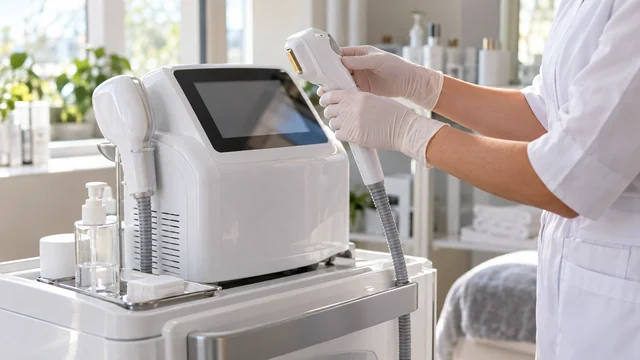
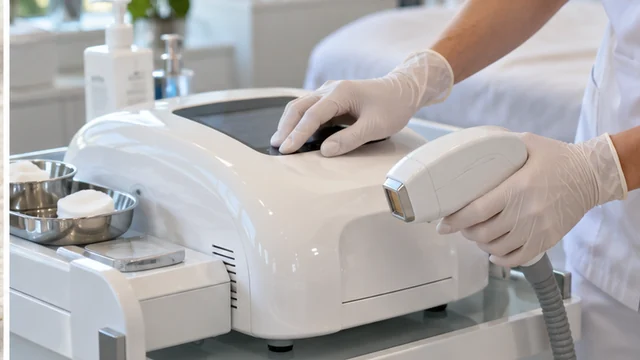
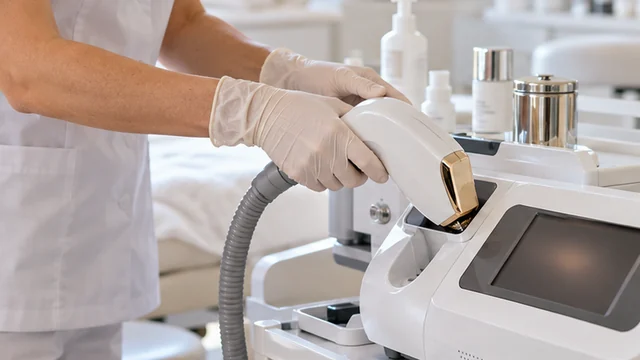
Fraxel DUAL uses 1550 nm (an erbium-glass laser) and 1927 nm (a thulium laser). It delivers energy in many small zones rather than treating the entire surface evenly. Controlled thermal injury in the skin triggers healing and later remodeling, while tissue between the zones supports recovery. It is a non-ablative fractional system: this is not the same as surgically removing a continuous skin layer, although swelling, peeling and barrier disturbance may still occur.
Broadly, 1550 nm is often discussed for texture, some acne scars and wrinkles; 1927 nm more often for selected superficial pigment concerns. These are not two interchangeable “strengths”: their depth and targets differ. A clinician may select one or both, but the number of passes, treatment density and other parameters matter as much as the nominal wavelength. Do not infer your course from a friend's settings or a brand video.
“Fractional” describes how energy is distributed, not the brand. Fractional CO₂ and Er:YAG treatments can be ablative, while other fractional lasers are non-ablative. Fraxel re:pair and other newer Fraxel products are not automatically equivalent to DUAL. Obtain the exact model identity rather than agreeing to “Fraxel” as though it were one unchanging protocol. Fotona
Which models and indications have an official basis?
The specific US indications for Fraxel DUAL 1550/1927 are documented in the FDA K130193 record from 2013. For 1550 nm, these include resurfacing, certain pigment changes, periocular wrinkles, acne scars and surgical scars; for 1927 nm, selected pigmented lesions including solar lentigines and freckles, as well as actinic keratoses. This is a 510(k) substantial-equivalence decision about a particular device for the US market, not a guarantee of cosmetic results or advice to treat a suspicious lesion without diagnosis. Current Solta Medical webpages also describe newer systems, including Fraxel FTX; its instructions, parameters and marketing claims must not automatically be transferred to DUAL. US records also do not establish device registration, ownership, availability or operator qualifications in Armenia.
A device indication is not a diagnosis. Actinic keratosis is a precancerous skin lesion and similar-looking spots can have other causes; medical examination and sometimes biopsy or an entirely different treatment are required. A changing, bleeding, atypical or unexplained mark must not be approached as a cosmetic laser target before diagnosis.
A US device decision does not establish whether a particular revision, attachment, clinician or clinic is registered or available in Armenia. A photograph of a machine on a website is not enough. Before consenting, ask for the exact model identification, servicing documentation, who will treat you and which protocol is proposed.
Which concern might each option address?
| Your main concern | What to discuss for Fraxel DUAL | When a different plan may fit |
|---|---|---|
| Depressed acne scars | 1550 nm as one method of gradually improving atrophic texture | Tethered, very deep or narrow scars may need subcision or other techniques |
| Fine lines and uneven texture | Gradual, usually partial improvement, not elimination of all wrinkles | Deep folds or excess skin do not resolve with a non-ablative course alone |
| Superficial sun spots | Consider 1927 nm after confirming lesions are benign | Discrete vessels may suit a vascular or light-based approach |
| Melasma | Individual assessment of darkening and recurrence risks | Often start with sun protection and dermatologist-prescribed topical therapy |
| Marked change in facial contour | Fraxel does not replace a lift | Another approach, or no procedure, may be preferable |
The table cannot diagnose scars from a photograph. Rolling scars are broad wave-like indentations, boxcar scars have more defined edges, and ice-pick scars are narrow and deep; they may need very different techniques. Treat active inflammatory acne first where appropriate, so new scarring is not developing during a cosmetic course.
How strong is the evidence, and what can before-and-after photographs conceal?
Research on non-ablative fractional lasers supports potential improvement of some atrophic acne scars and signs of sun damage, but response varies with scar morphology, device settings and skin characteristics. A 2026 review specifically considered the dual 1550/1927-nm system in more pigmented skin (phototypes III–VI), but differences in methods and remaining evidence gaps matter. It was sponsored by Bausch Health, and several authors had ties to Solta Medical; this warrants attention to independence, not automatic dismissal. Study participants, techniques and outcome measures are not uniform. Evidence for the 1550-nm category does not guarantee a particular result with the named Fraxel DUAL device, and manufacturer photos are not independent comparative evidence.
Melasma needs special caution. In a 2010 randomized split-face trial of 29 people with melasma, 1550-nm fractional therapy at the studied settings performed less favourably than topical combination treatment; nine of the 29 participants developed post-inflammatory darkening. That is a risk warning, not an estimate of your own probability. Newer studies examine different protocols and combinations, but they do not make laser therapy a universal first-line treatment for melasma. A US labelled indication does not guarantee improvement or lasting disease control. Promises to “remove pigment forever” are a reason to stop and discuss photoprotection and other treatments.
Before-and-after photographs are meaningful only when lighting, camera angle, facial expression and time since treatment match. Temporary swelling can briefly make shallow depressions seem less pronounced. Ask whether images show one visit or a full course, whether combined treatments were used, and how long follow-up lasted. An unusually smooth filtered portrait is not a clinical outcome measure.
Does it hurt, and what happens during a session?
Before Fraxel, a clinician should review tanning, photosensitivity, medications, medical conditions, healing and scarring history, recurrent herpes and skincare. You may be asked to modify topical products under guidance. Pain control often involves topical anaesthetic and cooling, with laser safety eyewear. Expect heat, prickling or sharp stings; treatment of different areas can feel different, and nobody should promise painlessness.
The density of treated microzones must be balanced against comfort and downtime. More intense does not always mean more suitable or more effective for your scar pattern. Post-inflammatory darkening deserves particular caution in phototypes III–VI; a small randomized acne-scar study in IV–VI phototypes reported more pigmentation with greater treatment density. Protective eyewear must stay in place. Ask how the skin will be cooled, how discomfort is handled and how it will be cleaned afterward. A plan should explain how the clinician responds if the skin reacts more strongly than expected.
There is no single number of treatments or interval between them suitable for everyone. Some goals need a series of visits with assessment between sessions, but the course should change if results are insufficient or pigmentation worsens. Ask when a meaningful result can be judged: early swelling and later collagen remodeling should not be confused.
What might your face look like the next day, day three and beyond?
| Period | Possible effects after non-ablative Fraxel DUAL | Relevance to everyday life |
|---|---|---|
| Treatment day | Redness, heat, swelling and a sunburn-like sensation | Avoid scheduling before an important evening event |
| Following days | Bronzing, dryness, roughness, fine flaking, sometimes considerable swelling | Bright lighting and close-up video can show texture; makeup only as instructed |
| As the surface settles | Gradual return toward normal appearance, sometimes lingering pinkness | Being fit for work and looking unnoticed are different measures |
| Weeks and months | Continued texture remodeling and pigment assessment | The final outcome cannot be judged from the first photographs |
The timeline intentionally does not promise an exact recovery day. Appearance depends on microzone density, use of 1550 versus 1927 nm or both, the treated area, previous skin responses and the aftercare plan. “Non-ablative” does not mean invisible: bronzing, roughness or puffiness may be obvious on camera even when ordinary activities are medically possible.
While skin is irritated or the surface barrier is unsettled, use gentle cleansing and restorative care as instructed. Scrubs, acids, retinoids, vigorous exercise, sauna, pools and makeup must wait as advised for your particular session. Sun avoidance and protection are important. Do not pick peeling skin or force a return to strong products to make it recover faster.
When could risk outweigh the wish for smoother skin?
The manufacturer's US safety information calls for screening, particularly for keloid or excessive scarring risk, wound-healing concerns and medicines. It specifically flags systemic corticosteroids and isotretinoin or similar drugs. This is not an instruction to discontinue treatment yourself: the treating clinician must review the current label for the precise model and decide whether to postpone the cosmetic procedure. Active infection, cold sores and significant irritation also warrant investigation before treatment.
Elective laser resurfacing is generally postponed during pregnancy because direct safety evidence is limited. During breastfeeding, discuss the procedure and any related medicines or anaesthetic, and consider deferring when practical. Darker phototypes, melasma and previous post-inflammatory marks call for a careful discussion of alternatives. Phototype alone is not the only factor: recent tanning, inflammation, prior reactions, the target and practitioner experience all count.
The manufacturer lists possible blistering, burns, temporary or permanent skin colour changes, infection, scars, prolonged redness, delayed healing and eye injury. Local heat, swelling and flaking may be expected within limits. Worsening pain, spreading redness, pus, fever, blisters or any visual disturbance call for prompt medical assessment; eye symptoms need urgent attention. Do not self-prescribe antibiotics, steroids or bleaching agents without examination.
Fraxel or an alternative: deciding without pressure
For uneven acne scars, type, depth and tethering to deeper tissue matter more than the brand. If redness and vessels dominate, compare IPL photorejuvenation or a vascular laser. For a stronger change in pronounced texture, an experienced clinician may discuss ablative Er:YAG or CO₂ resurfacing, recognizing greater or different recovery risks. Sometimes controlling acne, sun protection or simply observing the skin is preferable.
Before consenting ask: Which exact Fraxel model? Which wavelength and why? What is realistic after one stage and a full course? When do we decide progress is inadequate? When can I wear makeup and return to public-facing work? What warning signs call for urgent contact, and who provides follow-up? Clarify whether consultation, anaesthesia, skincare and check-ups are separately charged. Take time to decide if the promises do not match your actual skin concern.
Further questions
Will my skin remain sensitive forever after Fraxel? Temporary sensitivity and sun reactivity can occur, but a permanently sensitive skin barrier is not the intended or usual outcome. Persistent discomfort or redness should be assessed rather than assumed to be normal.
Can Fraxel treat around the eyes? Certain manufacturer's indications mention periocular wrinkles, but treatment close to eyes requires site-specific eye protection, training and risk evaluation. Do not assume a standard facial protocol can be carried onto the eyelids.
Can Fraxel follow fillers or botulinum toxin? There is no single reliable interval covering all combinations. Tell the clinician exactly what was used, where and when; placement and healing may change the order and timing of procedures.
Sources
- Fraxel / Solta Medical — US indications and safety statements for 1550/1927
- FDA — Fraxel DUAL 1550/1927, 510(k) K130193
- FDA — original 510(k) K130193 indications for Fraxel DUAL 1550/1927 (2013)
- Randomized study — 1550 nm in phototypes IV–VI with acne scars
- Randomized trial — 1550 nm versus topical treatment for melasma
- Lasers in Surgery and Medicine, 2026 — fractional lasers in pigmented skin
- AAD — initial principles of melasma care
- ASPS — general safety of laser skin resurfacing
- 2026 review — cosmetic procedures in pregnancy and lactation
- Review — preventing eye injuries in laser and light treatments