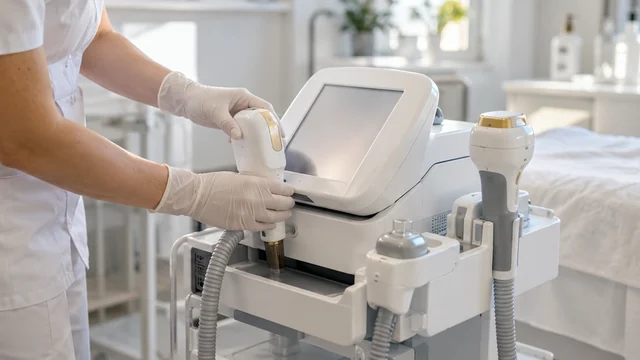

Alma Harmony XL PRO Reviews: Why the Handpiece Matters
You have read glowing reviews and worrying ones about Alma Harmony XL PRO and cannot tell which to trust. The main thing: you cannot interpret a Harmony XL PRO review without knowing the applicator and the problem being treated. This is not one uniform treatment. The same platform may use pulsed light (IPL/AFT), different lasers and fractional technologies. Treating pigmentation and performing more intensive resurfacing can feel very different afterwards. What matters is not the average “rating of the machine”, but whether that person’s case is comparable to yours.
Why do two genuine reviews of the same device contradict each other?
Harmony XL PRO is a modular platform. The manufacturer lists, among others, ClearLift (Q-switched Nd:YAG laser), Er:YAG-based iPixel, AFT IPL light applicators and lasers used for vascular concerns. Facilities can have different sets of applicators. So “I had Harmony and needed no recovery” tells you nothing certain about another applicator or a different energy setting. The name on the device is only the starting point.
The original concern matters even more. Superficial pigmented spots, vascular redness, marks after acne, scars and hair removal call for different approaches; the degree of change and number of sessions cannot be compared directly. Even with the same technology, responses vary with skin phototype, tanning, diagnosis, depth of the problem, medication and practitioner experience. “One solution for the entire face” is a reason to ask more questions, not to assume it will work.
What should you look for in a review before deciding?
| What the review says | What it really tells you | What to clarify |
|---|---|---|
| “Harmony removed my spots” | One person may have noticed improvement in a particular type of pigmentation. | Was the condition diagnosed? Which applicator, what kind of spots, sun exposure before/after and how long after treatment was the photo taken? |
| “Painless; straight back to work” | They may have tolerated a relatively gentle protocol well. | Which technology, body area, pain relief, and what did the skin look like that evening and the next day? |
| “I got a burn/darkening afterwards” | A reason to examine safety carefully, not to label every reaction “normal clearing”. | Was there a clinical assessment? What were the settings and tanning history, and how was the complication treated? |
| “The result lasts forever” | One review does not prove durability. | How long was follow-up, do triggers persist, and was maintenance care needed? |
A useful review identifies the initial concern, exact applicator, sequence of visits, sensations and photographs with known intervals. Better still, it describes temporary changes that looked worse before they improved. An anonymous star rating may reflect a sincere experience, but it cannot predict yours. A clinic’s or manufacturer’s gallery is not an independent sample: published cases are usually selected.
How do you distinguish recovery from an unpleasant surprise?
Light-based treatments may cause warmth, redness, mild swelling and temporary darkening of some pigmented spots. More intensive fractional protocols may lead to stronger redness, roughness, crusts and a recovery period other people can see. Precise timing depends on the applicator, treatment intensity and your own response. “No downtime” in a promotional description is not a personal promise of clear-looking skin the next morning.
Imagine you have a photo shoot or important meeting on Friday. Choosing between gentle treatment and resurfacing is not simply choosing how strong the result will be: it also changes how visible recovery may be. Even if you are medically fit to resume daily activities, redness, temporarily darker spots or peeling may be unwelcome in photographs. Ask the clinician for a separate account of how your skin might look the following day, several days later and at your event, rather than a vague “downtime” number. If there is uncertainty, postpone the session.
Before choosing a date, ask for more than a prediction of how your skin may look the next day. Request instructions for the exact applicator: when you can resume your usual makeup and active skincare, exercise, sauna visits and prolonged sun exposure. Restrictions differ by protocol. If the clinician cannot explain them in advance, or you cannot follow aftercare or attend an assessment if something goes wrong, postponing is reasonable. Even a “gentle” session may not suit your social calendar.
Severe pain that increases, blisters, a burn-like wound, changes in vision after treatment near the eyes, rapidly spreading swelling or signs of infection warrant prompt contact with a doctor. Vision changes or a severe reaction need emergency care. The US FDA MAUDE reporting database contains an individual report of a burn and loss of pigment after Harmony XL PRO. Such a report shows a possible event; it does not establish its frequency or allow conclusions about every applicator or practitioner.
Where can reviews help, and where does research matter more?
Reviews can describe subjective experience: how comfortable the procedure was, whether warmth was noticeable, how clearly aftercare was explained and whether the person felt able to attend a meeting. They are poor evidence for burn frequency, comparative effectiveness or durability. Those questions need studies of a specified applicator, protocol and diagnosis. For example, a published retrospective study looked at a Harmony XL PRO IPL applicator for rosacea. The study included 82 patients; 96.1% had skin phototype II or III, so the findings do not represent every use of the platform and should not be extrapolated to darker skin, resurfacing or tattoo removal.
Professional guidance also recommends asking about the clinician’s experience with your skin tone and concern. That is more informative than counting likes. Before treating persistent dark patches, establish what they are: melasma, post-inflammatory hyperpigmentation and other conditions respond differently to light. A new, changing or bleeding pigmented lesion needs a dermatology assessment first; a machine must not be used to lighten it without a diagnosis.
When is it particularly unwise to rely on another person’s experience?
Arrange an in-person skin assessment rather than deciding from reviews if you have a recent tan, an active infection or broken skin in the treatment area, a tendency to pigment changes or scarring, recent procedures, or medications that may increase light sensitivity. Tell the clinician if you are pregnant or breastfeeding: whether to undertake an elective procedure needs individual discussion, not an assumption of safety because online commenters reported no problems. Some restrictions are applicator- and protocol-specific; there is no single reliable “Harmony suits everyone except…” list.
If you are prone to melasma, a plan for pigment control and light protection is especially important; aggressive energy treatment is not always the best first step. Persistent redness without a diagnosis requires a distinction between visible vessels and inflammatory skin disease. Deep scars may not become smooth after one visit. No intervention, gentler skin care or appropriate medical treatment are all legitimate alternatives.
At the consultation, ask for your plan—not “the most powerful machine”
- What are we treating? Ask for a diagnosis or precise aesthetic goal and an explanation of what the device will not change.
- With what, exactly? Obtain the applicator’s name and energy type, and ask why it fits your skin phototype.
- How will my face look? Discuss likely redness, crusting, restrictions and social visibility without a promise of a fixed day of complete recovery.
- What if improvement is limited? Discuss criteria for success, follow-up, other methods and total planned cost without imaginary packages.
- Who handles a complication? Ask about practitioner qualifications and experience with your skin, eye protection, written aftercare and a way to reach medical help for warning signs.
Ask to see photographs of patients with comparable concerns, taken under similar lighting, without demanding the same outcome. For a broader overview of technologies, you can read about the Harmony XL PRO platform; judging one person’s treatment review remains a separate task.
How do you know you have answered your original question?
A useful outcome of reading reviews is neither “everyone is delighted” nor “never try this”. You know which applicator is being described, what it was used for, what the person expected, how recovery looked and how long the result was observed. If those details are missing, do not turn the review into proof for or against treatment. You may remain undecided, seek a dermatologist’s assessment and decline a session if the risks or uncertainties do not suit you.
Additional questions
Can reviews of Harmony XL be applied to Harmony XL PRO?
Not without confirming the exact model, applicator and protocol. Similar product names do not guarantee the same effects or recovery.
Can I apply makeup immediately after treatment?
That depends on whether the skin surface was disrupted and which applicator was used. Do not conceal irritated or crusted skin on your own; ask the treating clinician for individual advice.
Sources
- Alma Lasers — Harmony XL PRO platform details
- VL/PL IPL in rosacea, Journal of Cosmetic Dermatology (2025)
- US FDA MAUDE — Harmony XL PRO burn and hypopigmentation report (2026)
- American Academy of Dermatology — questions before cosmetic treatment
- American Academy of Dermatology — melasma and sun protection