
BBL HEROic Reviews in English: How to Check What They Say
Imagine two opposing English-language BBL HEROic reviews: one praises a more even skin tone, while the other describes swelling and disappointment. These are illustrative examples, not verified patient accounts. Which story matters for you? A single review cannot predict your outcome. It becomes more useful when the exact device, starting skin concern, treatment conditions and length of follow-up are known. Read positive and negative accounts with equal care: neither a selection of happy patients nor one complaint replaces a personal assessment of risks.
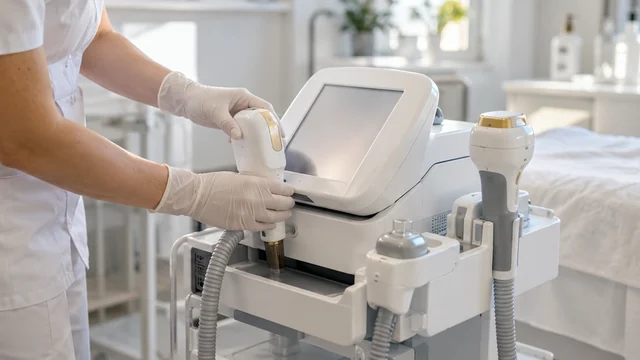
BBL HEROic is Sciton’s branded broad-spectrum pulsed-light system—not a laser or a surgical lift. The manufacturer describes automated pulse positioning and delivery control. Those are device-design claims, not independent proof that burns cannot occur or that it outperforms every competitor. Research on IPL as a treatment class supports discussing visible small vessels and certain superficial pigmentation changes, but does not guarantee the result pictured in any particular HEROic review.
First check: which BBL treatment is the review actually about?
Search results mix BBL, BBL HERO, BBL HEROic, Forever Young BBL and treatments that combine BBL with other procedures. They are not interchangeable descriptions. Some review sites feature the earlier BBL HERO generation; its testimonials should not automatically be treated as HEROic results. If someone had BBL plus MOXI, another laser treatment or a peel, you cannot reliably attribute every change to one element. Check the date, the equipment named in clinical paperwork and the other treatments carried out that day.
| What the review says | What to ask | Why it matters |
|---|---|---|
| “Skin looks amazing” after a session | What was being treated and when was the photo taken? | A first impression, lighting and makeup do not show durability. |
| “No downtime” | No discomfort—or simply able to go out despite visible marks? | Medical ability to work and social invisibility are different. |
| “It burned / swelled” | Was the reaction assessed? Are phototype and recent tanning known? | The complaint matters, but its cause cannot be diagnosed from a post. |
| “BBL HERO review” | Is the HEROic version actually confirmed? | Earlier-generation reviews do not establish outcomes for HEROic. |
| “Better than IPL” | Which IPL device, filters and skin types were compared? | One brand is being compared with a very varied device class. |
What reviews can—and cannot—reasonably tell you
If a clinician has diagnosed superficial sun spots or small visible blood vessels, light therapy may be worth considering. Studies of IPL for rosacea-related vessel redness have often reported improvement; however, a 2024 systematic review found important methodological limitations in the research it included. That does not justify a promise that everyone will achieve the same clearance. Light treatment does not eliminate the tendency for rosacea to flare, replace care for inflammatory breakouts, or lift sagging tissue as surgery might.
A “natural” outcome usually means potentially softening the contrast of spots or redness while retaining freckles, facial expressions and skin features that you like—not changing the shape of your face. Explain which areas you do not want lightened. “I look unrecognisable” might reflect makeup, a photo filter, another treatment or the person’s genuine reaction; without context, it is impossible to tell.
The day after treatment: three reactions not to confuse
Expected and temporary: warmth, short-lived redness or tenderness, sometimes puffiness; treated superficial pigmented patches may initially look darker. None of these reactions is required to prove a treatment has worked. Being able to work does not mean you will look completely unchanged on an important video call or at a photo shoot.
Unclear and worth calling the clinic about: a reaction more intense or prolonged than described to you, increasing discomfort, new unexpected pigmentation or marked swelling. Do not rely on a commenter telling you to “wait it out.” Send dated photographs to the treating team and ask whether you need an examination.
Needs urgent assessment: blisters, a significant burn, severe or worsening pain, signs of infection, or any visual disturbance after exposure to intense light. Do not dismiss these as normal pigment “coming out.” Eye protection matched to the specific device’s light spectrum is essential during treatment; symptoms affecting vision need particular urgency, especially after work near the eyes.
Many IPL descriptions speak of little medical recovery time, but they do not promise an invisible face the very next day. For a wedding, professional broadcast or holiday, agree on a reasonable buffer with your clinician rather than booking a first session just before it. Makeup, strenuous exercise, heat, sauna and sun precautions depend on the treatment intensity and your actual skin response. Ask for written aftercare instructions rather than copying a reviewer’s routine.
Whose experience may not apply to your skin
Skin phototype—how the skin responds to sunlight—and recent tanning affect light-treatment safety. With more pigmented skin, the risk of unwanted colour changes can be higher if settings are unsuitable. This is not a blanket prohibition, but it is a reason to review practitioner experience, settings and alternatives. With melasma, the recurrent, often patchy pigmentation condition, light treatments can worsen discoloration or trigger relapse. A review about an isolated sun spot does not answer a question about melasma.
A new or changing mark, or one that grows, itches or bleeds, needs dermatologist assessment before an attempt to lighten it. Attractive review photos and offers to “remove everything in one visit” are no reason to treat an unidentified pigmented lesion. Discuss pregnancy, medicines (especially those associated with photosensitivity), previous light reactions and recent strong tanning in advance. Elective cosmetic light treatments are commonly deferred during pregnancy as a precaution; individual restrictions should be checked against the medical history and documentation for the actual device.
Five checks before trusting a convincing English review
- Starting concern: visible vessels, isolated sun spots or general texture? Mixed goals make comparisons harder.
- Exact technology: HEROic, HERO or a combined procedure? Is there a date and evidence of the model?
- Similarity: is the reviewer’s skin tone, tendency to pigment, tanning and previous care at least roughly comparable with yours?
- Follow-up point: do they describe the result after recovery, not only immediately? Do they mention returning redness or spots?
- Conflicts of interest: paid content, gifted sessions, affiliate codes or manufacturer-supplied photos? Is the link disclosed?
A useful review need not be glowing. A clear account of sensations, expectations, the sequence of changes and the clinician’s response to a problem is more valuable. Do not dismiss a negative report merely because it is isolated: it can raise questions about complications, but cannot tell you how often they occur. A hand-picked collection of posts with no defined sampling method cannot measure the likelihood of a result.
What to ask a clinician instead of “Are all the reviews good?”
Ask which of your diagnosed concerns the light will address and why HEROic is being recommended. Find out what protocol is proposed, who evaluates suspicious skin lesions, how eyes are protected, how recent tanning or light-sensitising medications affect the plan, and whom you can contact about a complication. Request comparable clinical examples photographed under similar lighting, with follow-up dates and permission to publish. No comparable pictures are better than untraceable ones.
Compare the whole plan, not just the per-session price: assessment, a possible series of visits without guaranteed numbers, aftercare, reaction checks and any extra procedures being proposed. You may seek another opinion or decline. For a deeper check of photos, see BBL HEROic before and after; for different recovery scenarios, see BBL HEROic downtime. This page’s central point is about reviews: use them to frame verifiable questions, not to replace clinical judgment or your consent.
Additional questions
How can I keep my own record of changes after treatment?
Keep dated before-and-after photos in the same lighting and from the same angle, and separately note symptoms and products used. This can help your clinician, but personal photos are not a clinical study.
May I ask to see the original English-language review?
Yes. When a review has been translated or reposted without a link, ask for the original and check the device name, date, circumstances and any advertising relationship.
Sources
- Sciton — BBL HEROic (manufacturer description)
- DermNet — Intense pulsed light therapy
- Systematic review of IPL for rosacea (2024)
- American Academy of Dermatology — lasers and lights for rosacea
- American Academy of Dermatology — changing moles
- Clinical review of eye-injury prevention during light and laser procedures (2023)