Laser Facial Peel: How to Choose the Right Intensity
Someone offers you a “laser facial peel” and promises smoother skin, without explaining how many days the redness might show. First ask which technique they mean. “Laser peel” is neither a particular device nor a standardized procedure. In one practice it means gentle superficial laser renewal; elsewhere it means fractional resurfacing that injures the skin surface. Those differences can decisively affect the outcome, risks and your calendar.
A laser delivers energy to selected skin layers to modify the surface or induce subsequent tissue remodeling. It cannot solve every concern at once: deep folds, marked volume loss, vascular problems and pigmentation may require different approaches. With an important event approaching, the first question is not “How powerful is it?” but “What will I look like tomorrow and in one week?”
What does “laser facial peel” actually mean?
Unlike a device trademark, the expression has no single manufacturer, instruction leaflet or regulatory clearance. The exact device model, wavelength, ablative versus nonablative mode, fractional versus full-field treatment, depth and clinician's training all matter. An offer of a “certified laser peel” proves little without identifying the device and its documentation for the country concerned.
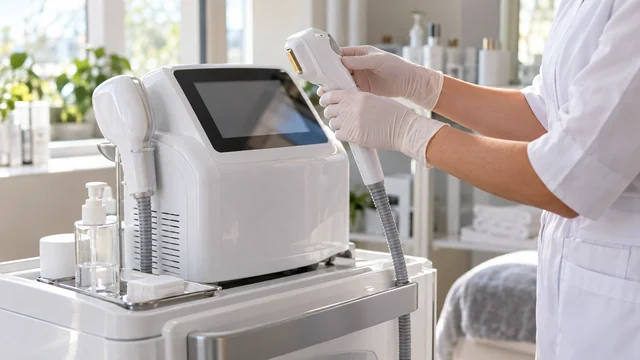
An ablative laser vaporizes tiny areas of tissue near the surface; certain CO₂ and erbium laser modes belong to this group. Nonablative devices primarily heat tissue without removing the surface; recovery is often gentler, but effectiveness and number of visits may differ. Fractional means the energy is delivered in small treatment zones with untreated skin between them; it does not tell you whether the procedure is ablative.
CO₂, Er:YAG and nonablative fractional platforms are not interchangeable versions of one peel. Even the same machine can produce markedly different downtime when depth or treatment density changes. Deep CO₂ resurfacing has its own dedicated discussion; this page helps you identify which kind of “laser peel” is being proposed and whether it suits you.
How should you choose the intensity for your concern?
Fine lines, certain acne scars and uneven skin texture may improve with an appropriately selected laser. But “peel” does not mean deep depressed scars will disappear or that the jawline will tighten visibly. Significant tissue descent, sagging and loss of facial volume involve more than the epidermis. Sometimes different methods are combined at separate times; sometimes an active skin disease needs treatment first.
| Your situation | Main consideration | What must not be promised |
|---|---|---|
| Uneven texture, fine superficial lines | Gentle fractional settings or an alternative skincare plan after phototype assessment | Complete removal of every wrinkle |
| Post-acne scars | Scar type and depth; combined approaches may be needed | The same response of all scars in one session |
| Melasma or tendency to dark marks | Diagnosis, sun protection and conservative treatment before energy | No risk of pigmentation worsening |
| Active rash, infection or unfamiliar spot | Examination and treatment of the underlying cause first | A peel as a replacement for diagnosis |
| Significant tissue sagging | Independent assessment of volume and supporting tissues | A surgical lift from surface renewal |
Skin phototype is a risk factor, not a blanket ban on treating darker skin. When post-inflammatory hyperpigmentation—dark marks after irritation—is more likely, the clinician must be especially careful with the technique and settings. A review of nonablative fractional laser studies in darker phototypes reports potential benefit in selected conditions, while pointing to the need for conservative settings and gaps in evidence for the darkest phototypes. That is more informative than “suitable for everyone.”
How visible is the treatment—not just how long does skin heal?
Two questions are often mistaken for one: when does the skin stop needing special medical care, and when will you feel happy appearing without makeup at work? Gentle nonablative treatment may leave only temporary redness and slight swelling. Stronger ablative resurfacing can cause weeping, crusts, pronounced peeling and longer-lasting pink skin. There is no universal date on which the face looks normal again.
| Stage | What may happen | Practical choice |
|---|---|---|
| Treatment day | Heat, tightness and redness; an ablative surface may be raw | Do not schedule photography, sports or a “back to normal” appearance immediately |
| First few days | Swelling, dryness, flaking; crusts and exudate with more intensive treatment | Follow personalized care; do not pick crusts or apply cosmetics to unhealed areas |
| Roughly weeks one to two | The skin barrier often recovers after ablative treatment, but timing varies widely | Ask when makeup, exercise and usual skincare can safely resume |
| Following weeks and months | Pinkness and sensitivity can persist; texture changes gradually | Maintain sun protection and judge the outcome only after recovery |
The American Society of Plastic Surgeons gives approximate healing ranges around a week or two for certain CO₂ or erbium resurfacing treatments; these are not promises for every setting. Pinkness can last much longer in some people. If a wedding, work trip or photo shoot is in one week, deep resurfacing is incompatible with guaranteed inconspicuous recovery. Postponing it, or considering a gentler approach without a zero-downtime promise, is reasonable.
Makeup is suitable only once skin has healed fully and the treating clinician approves it. Covering crusts or weeping areas with foundation does not shorten downtime; products can irritate an impaired skin barrier and conceal changes that need review. Saunas, vigorous exercise, pools, sea swimming and direct sunlight must be discussed for the chosen treatment depth. Never apply advice for a light session to ablative resurfacing without checking.
Will it hurt, and what happens at the appointment?
Before treatment, the clinician discusses your goals and examines phototype, scars, pigmented lesions, inflammation and any history of herpes. Disclose medications, previous procedures and unusually difficult healing. With your consent, photographs may be taken. The skin is cleansed and the eyes are protected appropriately. Cooling, topical numbing or another anesthesia plan is chosen according to the procedure.
Sensation ranges from brief hot pinpricks to considerable pain during intensive resurfacing. “Completely painless” has little meaning without naming the setting. Ask what level of discomfort is expected, who will supervise, and what you should say or do if pain feels abnormal. Before treatment, the medical team should explain how you can reach them afterward rather than handing everyone an identical aftercare sheet.
Afterward you may need gentle cleansing, prescribed protection for a healing surface, and consistent sun protection after the barrier has recovered. Adding acids, retinoids, home scrubs or unverified “healing” ointments yourself does not speed recovery. Your clinician should specify products and when you may restart active skincare, depending on whether the surface has been broken.
When should you postpone laser treatment, and what are warning signs?
Do not begin a cosmetic “laser peel” over an unexplained lesion, active infection, herpes outbreak or significant inflammation. A tan, recent strong sun exposure, a tendency to abnormal scarring, conditions that delay healing and medicines that affect recovery require an individual plan. Discuss any past isotretinoin use too: current practice varies with the technology and treatment depth, so the same mandatory drug-free interval for everyone is inappropriate. Never stop prescription medication independently. A 2025 international consensus addresses specifically fully ablative resurfacing; its warnings cannot automatically be applied to every superficial “peel.”
Pregnancy and breastfeeding are reasons to defer an elective aesthetic treatment; any genuine medical indication must be assessed separately. Suspected melasma requires diagnosis first, because aggressive treatment can worsen pigmentation. With recurrent cold sores, a clinician may prescribe antiviral prevention around the mouth; do not start antivirals on your own.
Mild redness, swelling and peeling can be normal. Increasing rather than diminishing pain, spreading hot redness, pus, bad odor, fever, visual deterioration or unusually deep painful wounds call for urgent medical review. Eye symptoms require emergency care. Do not wait for the next routine check or try to conceal the reaction with cosmetics.
How to distinguish a natural outcome from aggressive correction
Natural-looking skin still has pores and facial expressions. A suitable laser may improve aspects of texture and tone, but vessels, oil glands and expression lines remain normal features. Deeper treatments may correct certain problems more visibly while increasing risks of prolonged redness, pigment change and scarring. This is a trade-off, not a contest to use maximum power.
When reviewing before-and-after photos, check that lighting, angle and expression match, that there are no skin-smoothing filters and that the “after” photo was taken after full healing. Lighting can conceal redness and exaggerated contrast can make texture changes appear greater. Ask whether the photographs show a comparable phototype and the same device and protocol, not simply “laser results.” Reviews are not proof of the risk level of your chosen setting.
Clarify what the quoted price covers: consultation, anesthesia, consumables, possible preventive medicine, post-treatment visits and management of complications. Without the machine model and depth, two “laser peels” cannot sensibly be compared by price. This page does not verify any Yerevan clinic's equipment, availability or prices. A reputable consultation leaves room to choose basic skincare, another therapy or no treatment at all.
Six questions to ask before deciding
- What exact device model and treatment mode are proposed—is it ablative or nonablative, fractional or full-field?
- Which of my concerns can this mode realistically help, and which cannot it address?
- How do my phototype, pigment history and past procedures alter the plan?
- What should I expect to see tomorrow, in a week and after full healing?
- Who will treat me, ensure eye protection and examine any suspicious lesion?
- Whom do I contact outside working hours for infection, increasing pain or an eye problem?
If the answers are vague, you do not have to give consent that day. Ask for written aftercare instructions for the specific method, a follow-up date and an emergency contact. You can also ask for another opinion; wanting healthy skin without a long period of social downtime is a valid preference.
Frequently asked questions
Can only one scar be treated instead of the whole face?
Sometimes localized treatment is possible, but it depends on scar type, transition edges and the laser chosen. Discuss possible differences in color and texture between treated and untreated skin.
Is laser an option if I freckle easily?
Freckles alone are not an automatic exclusion. Your clinician must assess phototype, sun exposure, the exact type of spots and the risk of post-inflammatory pigmentation before choosing a method.
Should I ask for a test spot?
A test area can be useful in selected cases, particularly where pigment response is uncertain, but it does not guarantee that treating the full face will have no complications. Ask what the test can actually establish.
Sources
- American Society of Plastic Surgeons: recovery after laser resurfacing.
- American Society of Plastic Surgeons: resurfacing risks.
- ASOPRS: laser approaches and recovery.
- Dermatologic Surgery (2024): nonablative fractional lasers in darker phototypes.
- ISAPS: laser skin rejuvenation.
- International consensus (2025): preventing complications of fully ablative resurfacing