Male Pattern Hair Loss: How to Recognise It and Next Steps
Has the hairline at your temples moved back, is more scalp showing at your crown, or does your hair look different in photographs taken under overhead lighting? This may be male-pattern hair loss, or androgenetic alopecia: gradually thinning hair in a recognisable pattern. “May” matters: other conditions and temporary shedding can look similar. An assessment should clarify the cause, identify what can still be preserved and help you choose how much treatment you are comfortable with—not promise to restore every strand at any cost.
In typical androgenetic alopecia, hair follicles are sensitive to dihydrotestosterone (DHT), a derivative of testosterone. Over time, they produce progressively finer, shorter hairs. This is a genetically influenced sensitivity, not necessarily an excess of male hormones on blood tests. The process can start soon after puberty and often progresses over years, at an individual pace. Medicine cannot permanently remove the inherited tendency, but in some men it can slow loss and improve visible density.
How can you tell whether this is hereditary thinning?
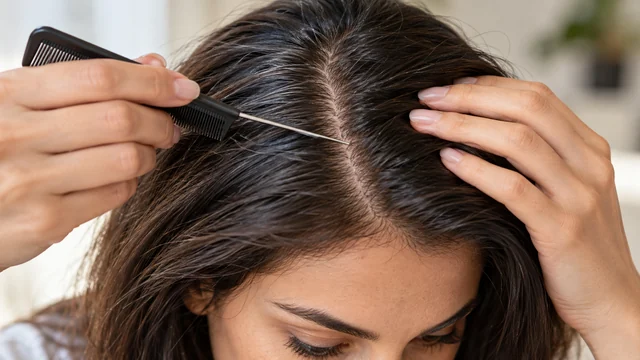
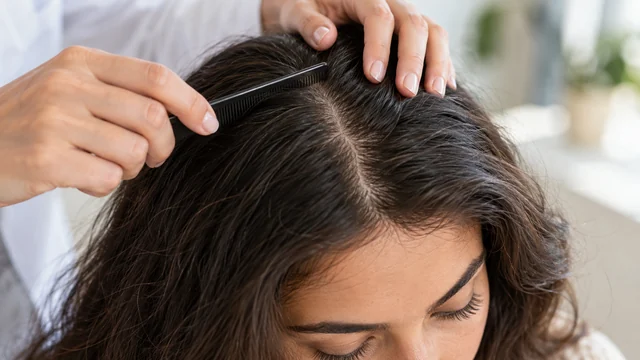
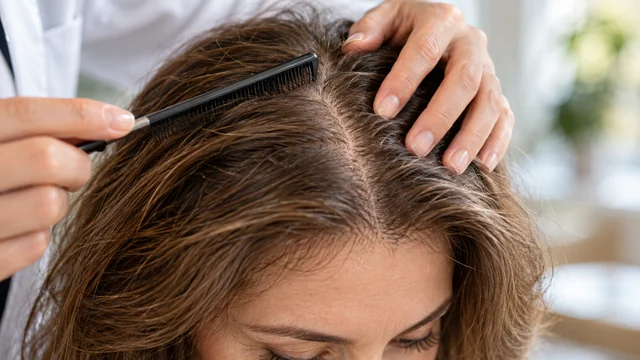
The clinician usually asks when the change began, whether relatives have a similar pattern, which medicines and supplements you use, and whether you have had illness, surgery, weight loss or major stress. They then examine the scalp and hair. With a typical pattern, the temples, front and/or crown thin while the sides and back are relatively preserved. Magnification may reveal hairs of different diameters—a sign of miniaturisation. A single photograph is unreliable: camera angle, styling, wet hair and light all change the impression.
Trichoscopy means examining the scalp and hair through a magnifying device. A broad “hormone panel” is not routinely needed for every man with a typical pattern. Blood tests and, occasionally, scalp biopsy are reserved for relevant symptoms, an unusual presentation or suspicion of another cause. Two processes may also coexist—for instance, hereditary thinning and temporary increased shedding after illness.
| What you notice | Possible explanation | Sensible next step |
|---|---|---|
| Sudden heavy shedding all over the scalp months after illness, surgery or a restrictive diet | Telogen effluvium, possibly alongside hereditary thinning | Discuss recent events, nutrition, medicines and appropriate tests with a dermatologist |
| Separate round, smooth patches without hair | Alopecia areata or another disorder | See a dermatologist rather than self-treating with “receding hairline” products |
| Itch, pain, redness, heavy scales, pustules or shiny scarred areas | Inflammation, infection or scarring alopecia, in which early recognition matters | Arrange a medical examination promptly |
| Hairs break, styles pull tightly or harsh chemicals are used | Hair-shaft damage or traction alopecia | Review hair care and have the scalp assessed |
A painful patch that appears quickly, pus, crusting or worsening inflammation calls for prompt in-person assessment. Other general symptoms may lead the doctor to investigate more than hair loss. This is not a reason to assume a serious disease, but it is a reason not to cover the problem with cosmetic procedures before identifying it.
What can realistically change—and what is your goal?
First decide what matters most: slowing further thinning, making the crown look fuller, changing the front hairline, or escaping constant worry about your hairstyle. Those goals are not interchangeable. Medicines work through follicles that still function; restoring former density where follicles are long gone is unlikely. Transplantation moves your own follicles but does not stop remaining natural hair from thinning. Concealers change appearance immediately without changing the disease.
A useful baseline is a set of photographs of dry hair at the same length, parting, camera position and lighting: front, both temples and crown. Daily photos mostly exaggerate perceptual fluctuations. Compare at intervals agreed with the doctor, taking account of the hair-growth cycle. A teenage hairline need not be the objective; many people prefer a natural, sustainable improvement over maximum density.
Which options are discussed after the diagnosis is confirmed?
Topical minoxidil. Apply the specific solution or foam to the scalp, not the hair lengths, as the product instructions explain. It may support some functioning follicles and make thinning less visible, but cannot revive every long-bald area. Early temporary shedding, itch, dryness and irritation can occur. Unwanted hair outside the target area can result partly from transfer of the medicine. If you have heart disease or a damaged, inflamed scalp, consult a clinician before using it. Stop using it and seek medical assessment if you develop marked weakness, palpitations, swelling or chest pain. Benefits take months to assess and are generally lost after treatment is discontinued.
Oral finasteride. It reduces DHT formation and must be prescribed with indications and contraindications in mind. The US label for 1 mg tablets covers male-pattern hair loss, but does not establish the registration status of every product in Armenia. Treatment is best discussed while follicles are still present. The label for this particular US tablet formulation does not establish efficacy for bitemporal recession, so regrowth of any desired hairline must not be promised. Benefits are evaluated over months and require continued use. Reduced libido, erection problems and ejaculatory problems are recognised adverse effects. The European Medicines Agency has confirmed suicidal thoughts as a side effect of finasteride tablets, with frequency unknown; its advice for mood changes while taking 1 mg for hair loss is to stop the tablets and contact a doctor as soon as possible. Thoughts of self-harm require urgent emergency help. The US label also states that these tablets are not indicated for women. Anyone who is pregnant or may become pregnant should not handle crushed or broken tablets because of the risk to a male fetus; the tablet coating prevents ordinary contact with the active substance only while the tablet remains intact. Discussing these risks before starting is part of an informed choice, not a formality.
Other medicine regimens. In some countries, specialists use dutasteride, low-dose oral minoxidil and certain combinations outside specific authorised hair-loss indications. Do not substitute these for topical treatment yourself: systemic effects, adverse reactions, interactions and licensing rules differ. A prescription must account for the country, exact formulation and medical history. Combination therapy is not automatically better because it contains more drugs.
Procedures. Hair transplantation may reshape the hairline or add coverage when there is an adequate donor supply. It is surgery, and it requires planning for the stability of loss and realistic density: donor follicles are finite, while surrounding untransplanted hair can keep thinning. Platelet-rich plasma (PRP), microneedling and low-level light devices are sometimes proposed as add-ons. Protocols and study quality vary, so results are less predictable than marketing photographs suggest. Steroid injections are used for certain other forms of alopecia, not as a standard answer to male-pattern thinning.
| If your goal is | What is worth discussing | Main limitation |
|---|---|---|
| Slow early progression | Confirm the diagnosis; discuss minoxidil and/or prescription options | Long-term adherence; possible contraindications and adverse effects |
| Hide visible scalp right now | Haircut, thickening camouflage products or hairpieces | Camouflage does not restore follicles |
| Restore a markedly receded hairline | Assessment for transplant candidacy | Finite donor supply, surgery, unnatural-line risk and later loss of native hair |
| Treat sudden or painful hair loss | Investigate the cause first | The usual hereditary-hair-loss regimen may address the wrong condition |
How long will results take, and what will other people notice?
Medicine does not work in a few weeks. Hair grows slowly, so agree on review points months ahead rather than counting hairs in the shower every morning. The finasteride label notes that at least three months of daily use is generally needed before benefit appears; a visible change may require longer observation. Professional guidance also assesses topical minoxidil over several months, sometimes more. Stabilisation without obvious regrowth can still be a meaningful result.
A transplant has a very different social recovery. Immediately afterwards, donor and graft sites can be visible, with crusts, swelling and changes to normal routines. Timings depend on technique, graft count and the surgeon’s instructions. Do not schedule surgery immediately before a major event based on a promise that you can return to work the next day. Transplanted hair growth is judged considerably later, even once visible healing has occurred. Hair concealers give the fastest cosmetic change but need regular maintenance and may wash off.
What can you safely do at home?
No shampoo eliminates genetic DHT sensitivity. Gentle washing as needed, treating seborrhoeic dermatitis if present, avoiding constantly tight hairstyles and eating adequately support the scalp and hair shafts, but do not replace evidence-based androgenetic alopecia therapy. Avoid iron, biotin, zinc or hormone supplements “for growth” without a demonstrated deficiency or another medical reason: they may do no good, have side effects and interfere with laboratory results.
If shedding suddenly increases after illness or stress, do not rush to buy an expensive procedure. Added telogen shedding sometimes settles as the body recovers while the hereditary component remains. If the change in appearance does not trouble you, observation without treatment is a valid choice. Emotional comfort matters as much as millimetres of hairline: avoiding photographs or constantly hiding hair is a reason to talk about your goals, not proof that you need a procedure.
How can you judge photos and promises?
Before-and-after images are meaningful only when hair length, light, head angle and follow-up timing match. Styling, a recent transplant or concealment can produce a different visual effect from a real change in hair numbers. Ask what was performed, which medicines were used at the same time, how long the result was followed and whether only exceptional cases were selected. A single testimonial cannot predict your own response or give your personal chance of success.
Be wary of guaranteed regrowth without a diagnosis, pressure to buy a large “stimulation” package immediately or systemic medicines prescribed without discussing your health. Find out who diagnoses the condition, how progress is measured, what happens if there is no benefit and whether you can decline without pressure. The decision remains yours even after a paid consultation.
Questions worth asking at your appointment
- What makes you think this is androgenetic alopecia? Do you see signs of another or additional cause?
- Are tests needed for me specifically, and what would their results change?
- At my stage, is preserving hair, modest thickening or considering transplantation more realistic?
- How do this medicine’s risks relate to my health, other drugs and future plans, and when should I stop?
- When will we assess benefit objectively, and when would the cost and effort no longer be worthwhile?
- If surgery is an option, how much donor hair is available, and what may happen to my untransplanted hair?
A worthwhile consultation ends not with a package but with a clear diagnosis, a goal, criteria for changing or stopping treatment and a monitoring plan. Detailed regimens belong in the separate page on male-pattern hair-loss treatment; other causes are covered in causes of hair loss. This page’s decision is whether the pattern is truly hereditary or needs a different medical route.
Frequently asked questions
Will shaving the head make hair grow back thicker?
Shaving cuts the shaft but does not alter the follicle or its inherited DHT sensitivity. The blunt tip of short regrowing hair can simply feel thicker.
Can a tight cap cause inherited hair loss?
Ordinary hat wearing does not cause androgenetic alopecia. Continual strong pulling, rubbing and irritation can, however, cause separate scalp or hair-shaft problems.
Does finasteride affect a PSA test?
Yes. Finasteride can lower prostate-specific antigen (PSA). Tell the doctor ordering or interpreting your test that you take it.
Can I use styling products with topical minoxidil?
Often yes, provided the medicine is applied to the scalp exactly as directed, allowed to dry and not mixed with irritating products. Discuss the formulation with a doctor if dermatitis develops.
If no men in my family went bald, does that rule it out?
No. Inheritance is complex and can show differently between relatives. Family history informs an assessment but never replaces examining the hair and excluding other conditions.
Sources
- British Association of Dermatologists — Male pattern hair loss
- American Academy of Dermatology — Hair loss diagnosis and treatment
- DailyMed/FDA prescribing information — Finasteride tablets, rev. May 2026
- European Medicines Agency — Finasteride and dutasteride safety review
- DailyMed — Topical minoxidil solution, product-specific OTC label