Scalp Analysis: When It Is Needed and What It Can Show
You notice more hair on your brush, itching beneath your hair, or a widening part. Online services offer “scalp analysis” from a photograph, camera image, or even one hair. But useful diagnosis starts not with an impressive magnified image, but with a question: what has changed, why, and does the underlying cause need treatment? Trichoscopy—examining the hair and scalp with a special magnifier—helps a dermatologist see signs you cannot see in a mirror. It supplements a medical history, examination, and, when needed, tests; it does not replace them.
If someone offers a “hair-growth treatment” before establishing why your hair is shedding, it makes sense to clarify the diagnosis first. Sometimes adjusting care and observing is enough. Sometimes it matters to identify an infection, inflammatory disorder, or scarring alopecia promptly, because hair follicles may suffer irreversible damage. Conversely, one alarming camera image does not mean you will lose your hair permanently.
Which scalp concerns actually deserve an examination?
Evaluation is not just for shedding. It can help with persistent flaking and redness, burning, pain, patches of missing hair, breakage, pustules, or areas of unusually smooth skin. Your clinician will ask when the changes began, whether they follow a seasonal pattern, what happened to your health over recent months, which medicines you use, and whether you have given birth, had surgery, experienced significant stress, or restricted your diet. These details often matter more than counting hairs in the shower drain.
An important distinction is hair shedding from the follicle versus breakage of the hair shaft: photographs may look alike, yet causes and treatments differ. Breakage can result from traction, chemical damage, or particular disorders. Generalized thinning, a wider part, and round bare patches likewise call for different diagnostic decisions. Detailed routes for treating female hair loss are covered on the female hair-loss page; here the central issue is identifying which investigations are truly useful.
Similar-looking symptoms can lead to different decisions
| What you see or feel | What the clinician needs to distinguish | Why it changes the next step |
|---|---|---|
| Small flakes, oiliness, itch | Seborrhoeic dermatitis, irritation or contact reaction to hair dye or products; sometimes psoriasis | Dandruff care may help, but persistent thick plaques or inflammation need assessment |
| Flaking together with broken hairs and patches | Among other possibilities, fungal infection of the scalp | Fungal testing is needed; a mask or ordinary shampoo may not clear an infection |
| Widening part without marked inflammation | Progressive reduction in hair thickness, diffuse shedding, or overlapping causes | The pattern of loss, history and indications for blood tests shape the plan |
| Smooth patch, pain, burning, redness around hairs, or loss of follicular openings | Possible inflammatory scarring process | Do not delay dermatology assessment: preserving remaining follicles matters |
| Pimples, crusts, tenderness or discharge | Folliculitis, infection, or another inflammatory condition | Examination, and sometimes microbiological tests, come before cosmetic procedures |
This table is not a self-diagnosis tool. Dandruff does not rule out concurrent hair loss, and absence of itch does not prove scalp health. Several causes can coexist: after an illness, someone may shed more hair while density along the part has also been gradually changing. Treating one visible sign without the history can therefore lead to the wrong “one-size-fits-all” therapy.
What happens at the appointment, and what can trichoscopy show?
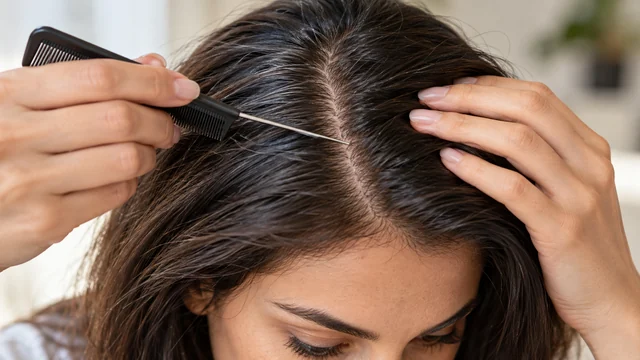
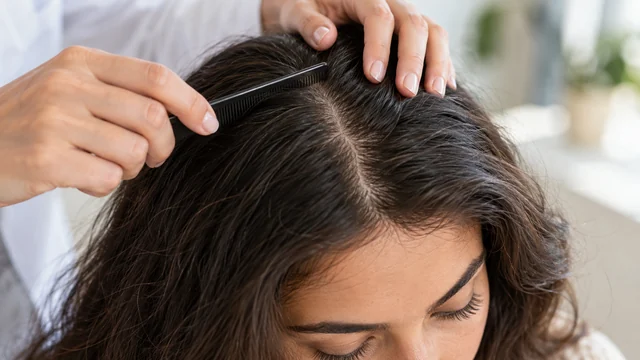
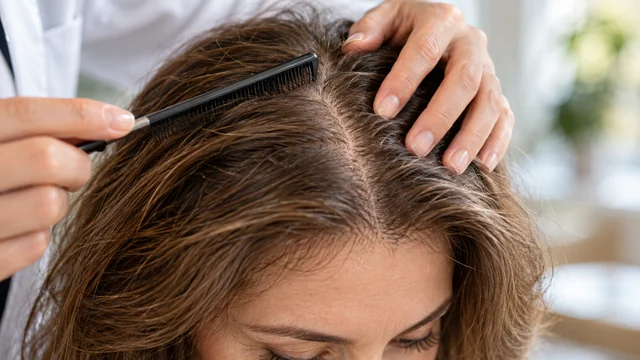
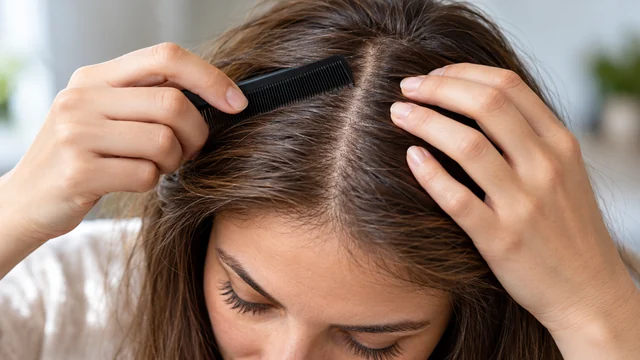
First, the clinician asks about the pace of change, family history, hair care and symptoms, then examines the whole scalp and sometimes the eyebrows, nails and other skin. They may gently check how easily hairs come away and whether the shaft is intact. The distribution also matters: along the part, at the temples, or in separate patches.
Magnified examination itself does not puncture the skin: it is usually painless, leaves no bruises or crusts and requires no break from work or social plans. If a clinician proposes taking a sample, a biopsy or another test, ask about anaesthesia, wound care and separate recovery; this is a different step, not part of every “camera analysis.”
Under magnification, trichoscopy helps assess hair-shaft thickness and variation, breakage, scales, redness, vascular patterns and follicular openings—the tiny holes from which hairs emerge. Loss of these openings, interpreted alongside symptoms and examination, can signal scarring. But the instrument cannot independently diagnose a vitamin deficiency or hormonal cause, or produce a definitive diagnosis. These conclusions require clinical interpretation and sometimes further investigations.
Images of several scalp areas, photographs of the whole part and consistent lighting can help track change. Ask which sites will be re-examined: a random photo taken with a different attachment and angle is hard to compare. Mention recent dyeing, root-concealing powder, oil or styling products; residue can obscure findings. Before trichoscopy, some clinicians ask you not to wash your hair for 2–3 days to preserve signs of scaling; preparation for other questions may differ. Follow the instructions for your own examination and do not stop prescribed treatment yourself.
When are blood tests, fungal samples or biopsy needed—and when are they not?
An indiscriminate “test everything for hair” panel is rarely helpful. For shedding, a clinician may request selected tests if the history and examination suggest iron deficiency, thyroid dysfunction, or another problem. Hormone testing makes sense when there are relevant features and a clear clinical question; a photo of a part is not a reason for a broad hormone panel. Results need interpretation in the context of your health, not against advertised “ideal hair levels.”
If fungal infection is suspected, skin scales or hair samples may be examined microscopically and/or cultured. When scarring alopecia is suspected or the diagnosis remains unclear, a dermatologist may recommend a biopsy: a small piece of skin is taken under local anaesthetic for tissue examination. This is an invasive diagnostic step worth discussing separately—including the sampling site, a possible small scar and how the result would change treatment. Not everyone with itch or shedding needs one.
Commercial “computer diagnostics” without a clinician, mineral analysis of hair, or assessment by an algorithm alone are not equivalent to a medical evaluation. Attractive charts showing density, “scalp age” or an estimated microbiome balance should not justify medicines or injections without a defined clinical problem.
When should you not wait?
Seek a prompt medical assessment if a bald patch expands quickly; the skin hurts, burns, looks markedly inflamed, forms thick crusts or produces pus; shiny smooth areas without visible follicular openings appear; or marked redness and hair loss develop along the hairline. These signs do not prove a particular diagnosis, but infection and scarring alopecia should be considered without delay because timing can matter.
Increasing painful swelling, fever, rapidly spreading redness or feeling generally unwell call for urgent medical assessment. Do not apply harsh acids, heat an inflamed area, or cover it with heavy cosmetics just to conceal the problem until the appointment.
Choose the next step after diagnosis, not instead of it
| Situation after assessment | Reasonable next route | What this route does not promise |
|---|---|---|
| Mild scaling without warning signs | Gentle care, sometimes a medicated shampoo suited to the identified cause; review the response | Shampoo does not treat every kind of hair loss |
| Confirmed inflammation or infection | Treat the particular disease and monitor symptoms | Scrubs, salon peels and serums are not substitutes for necessary medication |
| Non-scarring shedding after illness, childbirth or stress | Clarify causes and observe; address associated factors when indicated | Regrowth is not equally fast for everyone; procedures are not mandatory |
| Suspected active scarring alopecia | Prioritize dermatologist assessment and diagnosis-directed anti-inflammatory treatment | Cosmetic serum cannot restore follicles already destroyed and replaced by scar tissue |
| Diagnosed chronic thinning | Discuss evidence-based options, tolerance, monitoring and duration of care with a clinician | Density may recover only partly; some options require ongoing maintenance |
Laser “helmets”, mesotherapy, PRP and salon detox programmes may sound appealing, but their evidence, indications and risks differ. The clinician should explain which confirmed diagnosis the proposed intervention is meant to treat, whether benefit has been shown for your situation and which better-studied options exist. “Improves circulation for everyone” is not sufficient evidence. Mentioning a service in an informational article does not establish that any particular clinic offers it.
Is gentle care enough for the moment?
Without warning signs, it is generally sensible before the appointment to avoid painfully tight hairstyles, rough brushing and frequent overheating. Wash as needed, depending on scalp comfort; there is no need to “train” an uncomfortable scalp by washing less often. Keep a record of products used before the symptoms began, and note whether itch worsens after colouring, a new mask or a particular product.
Do not start prolonged courses of hormonal, antifungal or powerful anti-inflammatory drugs on your own. Do not stop prescribed medication just because you notice shedding; discuss a possible link with the prescriber. Supplements without a proven deficiency do not guarantee thicker hair, and excessive amounts of some substances can cause harm.
How to judge progress without anxious daily counting
Hair grows in cycles, so meaningful change often takes time to become visible. Comparable photos of your part and the wider area, with similar hair length, lighting, styling and head position, are more informative. For itchy or inflamed conditions, symptom relief matters as much as hair counts. For chronic hair loss, stabilization may be a worthwhile outcome even if former density does not return.
The number of hairs seen after washing also depends on washing frequency; it is no replacement for clinical evaluation. Ask how long to wait before repeating the examination for your particular diagnosis. Frequent paid camera checks without a change in management may add little. If symptoms are improving and active treatment is not indicated, observation agreed with your clinician is a valid choice.
Questions that distinguish diagnosis from selling a procedure
- What provisional diagnosis do you suspect, and which alternatives still need to be excluded?
- What did trichoscopy show, and what cannot be concluded from an image alone?
- Would the proposed tests or biopsy change treatment? What would happen if we deferred them?
- Are there signs of infection or scarring that make delay unsafe?
- How will we distinguish treatment response from natural recovery and monitor the trend?
- What evidence supports this specific procedure, what are its risks and repeat-treatment needs, and which simpler options exist?
A good consultation need not end with buying a treatment course. Its value is understanding what is known, what remains uncertain and which next step is justified. Cost is a fair question, but compare offers by the scope of assessment, clinician qualifications and follow-up plan—not the number of images on a screen.
Further questions
Can I come for an examination while wearing hair extensions?
Tell the clinician in advance. Attachments may hide areas to be examined and cause tension; for a complete assessment of some sites, they might need to be removed. The decision depends on your symptoms and the examination technique.
Should I keep a hair-loss diary?
Briefly recording when symptoms began, health changes, medicines and photographs of the same areas is more useful than counting every hair each day. A diary is particularly helpful for intermittent symptoms.
Can one appointment rule out every scalp disease for good?
Not always. Some conditions change over time, and some diagnoses require lab confirmation or repeat examination. Ask which new symptoms should prompt an earlier return.