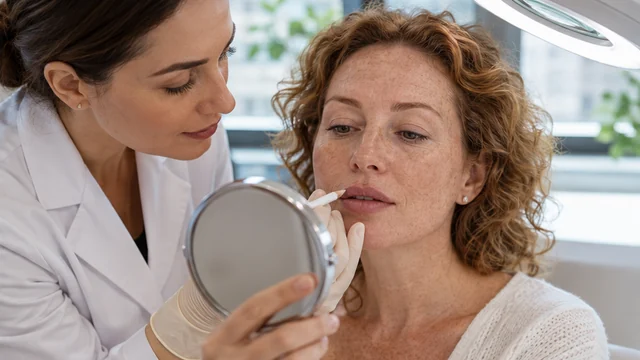

Radiesse: calcium hydroxylapatite filler and what to know
If your jawline seems less defined or your cheeks no longer have the support they once did, someone may have suggested Radiesse. It is sometimes offered even when the main concern is skin quality. Radiesse is an injectable product made of calcium hydroxylapatite (CaHA) microspheres suspended in a gel carrier. In certain forms and uses it provides immediate volume and may later stimulate production of components of the body's connective tissue. It is not a universal nonsurgical lift, however, and diluted Radiesse for skin quality is not the same treatment as a product used for structural volume.
Why the material changes your decision—and the possibility of correction
Unlike hyaluronic-acid fillers, Radiesse consists of calcium hydroxylapatite microspheres in a carboxymethylcellulose gel. The carrier gel initially fills space; over time the material changes and is resorbed, with tissue remodeling, including collagen production, observed in the treated area. Because biological responses vary, no one can promise exactly the same 'firming' effect to everyone.
There is an important distinction if unexpected fullness worries you. Hyaluronidase, which clinicians may use with some hyaluronic-acid fillers, does not dissolve Radiesse's calcium hydroxylapatite. You cannot assume that an unwanted contour can be reversed as readily as is sometimes discussed with HA fillers. Nodules, excessive volume or other reactions may require observation and different management methods, each with limitations. A restrained plan and clear agreement on the intended effect matter even more here.
There are Radiesse and Radiesse (+) products; the plus version contains lidocaine to lessen injection discomfort. Indications depend on the particular formulation, jurisdiction and technique. In the United States, the FDA approved Radiesse (+) in 2021 for deep augmentation to improve moderate or severe loss of jawline contour in adults older than 21. Other US labeling covers nasolabial folds and the backs of hands for specified formulations. Separately, on 31 March 2026 the FDA authorized Radiesse without added lidocaine diluted 1:2 with sterile saline for décolleté wrinkles in adults aged 22 or older. This is a specific indication, not approval of arbitrary hyperdilution everywhere. None of these US authorizations proves registration or availability in Armenia.
Do you need volume, contour definition or a skin-quality treatment?
Standard, comparatively dense Radiesse may be used for selected tissue deficits and contouring in appropriate anatomical areas. When diluted or hyperdiluted, it is distributed differently, with the intended focus more on biostimulation and skin quality than immediate structural sculpting. These are different plans with different expectations, evidence and limitations. The clinician—not the patient—must determine concentration, placement and depth.
| Your priority | What Radiesse might be discussed for | What should not be promised |
|---|---|---|
| More support in a selected facial area | Targeted correction of tissue loss with a standard formulation where appropriate and authorized | Uniform rejuvenation of the whole face or removal of substantial loose skin |
| A more defined jawline | Assessment of existing contours and whether Radiesse (+) is suitable, including local indications | An identical outcome regardless of bone structure, fat distribution or skin |
| Thin, less resilient skin without wanting more volume | Diluted CaHA may be discussed on the basis of consensus and clinical literature | That it has approval everywhere or large randomized trials for every site |
| Deep folds and pronounced jowls | Only one element of a wider assessment; a different route may be needed | A result equivalent to surgical lifting |
| Fuller lips or correction of shadows under the eyes | The manufacturer has not established Radiesse safety and efficacy in these regions | The assumption that 'any good filler will work' |
This is not only a matter of personal taste. Overfilling can make some faces look heavier, while using volume to 'lift' loose tissue may accentuate facial width. A subtle outcome starts with identifying where tissue has truly been lost. If the deficit is not clear, you can compare consistent photographs, get an independent opinion or do nothing for now.
Where is the evidence stronger, and where are the gaps?
For particular approved Radiesse indications, clinical trials underpin US FDA decisions. Structural contour correction is evaluated differently from improvements in skin quality after hyperdilution. In a review of facial treatment literature published in 2024, researchers considered CaHA potentially useful for several areas, including nasolabial folds and the jawline. At the time of that review's search they found no randomized controlled trials of diluted and hyperdiluted Radiesse for the facial protocols assessed. This conclusion is limited by date and body site: in March 2026 the FDA separately authorized a specified diluted décolleté use on the basis of its own dossier; that does not validate arbitrary facial or body hyperdilution.
Earlier expert consensus papers on hyperdilution describe clinical experience in the neck and body. Expert agreement does not establish identical results for every woman, nor does it grant regulatory clearance for every area mentioned. A 2024 systematic review of body treatments also found a shortage of randomized trials for the protocols reviewed at its search date; newer evidence relevant to the décolleté authorization must be evaluated separately. 'This mixture will build collagen and tighten any skin' is therefore too confident. A biological rationale and clinical observations exist, but the magnitude, approach and duration are individual.
The manufacturer mentions effects lasting up to two years for some applications. That upper limit from clinical or promotional material is not a two-year guarantee for every site. Initial filling, gradual tissue changes and remaining product effect are different components that patients may experience differently. Early swelling can obscure the real contour, so photographs taken immediately afterward are a poor basis for judging success.
What happens at the visit, and what should you establish first?
A clinician should examine your face at rest and in movement and ask about previous treatments, skin characteristics, vascular and medical risks, medicines and allergies. For Radiesse, identifying whether you need actual volume or skin-quality work without conspicuous filling is especially important. Ask for the full product name, whether it contains lidocaine, the intended area, its status under local labeling and the rationale for the plan. You need not agree to multiple syringes at once if the role of each remains unexplained.
You may feel needle pricks, pressure or spreading fullness. Sensation varies by site and technique; the lidocaine in Radiesse (+) does not make treatment entirely painless and may itself matter if you have an allergy. You should be able to report unusual pain, stop the procedure and receive an explanation. Knowledge of vascular anatomy and an emergency plan matter more than marketing claims about a needle versus a cannula.
Ask to see a sealed package and have the batch number recorded in your medical notes. Certifications and supply chain need to be checked for the local market. Radiesse's international profile is no proof that it is available at every Yerevan clinic. A social-media post, sale listing or the word 'official' cannot replace documents demonstrating the particular supplier and lawful use.
When will your face look familiar again? A social recovery plan
| Time after the visit | Possible appearance and sensations | Implications for your plans |
|---|---|---|
| Immediately afterward | Some fullness may be visible at once, but swelling contributes to the effect; skin may feel tender | Do not judge symmetry from a photograph at the clinic door |
| First few days | Swelling, bruising, tenderness or a local firm area may occur | Many can work, but the change may show on a video call or at a celebration |
| Following weeks | Local reactions often lessen; persistent lumps need assessment | Compare contours consistently; do not rush to add more volume |
| Months | Gradual tissue changes and weakening of the initial effect may occur | Base any further treatment on the actual result, not an advertising schedule |
Not needing extended medical leave does not mean you will look exactly as usual in tomorrow's photos. If wedding pictures, travel or a gathering where you do not want to explain a bruise are important, allow substantial time and discuss it before treatment. Ask for written aftercare guidance on makeup, exercise, sun exposure, massage, touching the area and out-of-hours contact. The US patient guide specifically for Radiesse (+) advises limiting sun and heat exposure to the treated area for 24 hours or until initial redness and swelling have resolved. Advice for that particular version does not replace your individualized aftercare plan. Do not massage lumps yourself or try home 'dissolving' injections.
When is Radiesse unsuitable, or better postponed?
According to US manufacturer information, Radiesse is contraindicated in people with hypersensitivity to components, a history of severe allergy or bleeding disorders; Radiesse (+) adds the concern of allergy to lidocaine or related agents. Active skin infection means postponing until it resolves. Safety in pregnancy and breastfeeding has not been established, so postponing an elective aesthetic procedure is preferable. Inform the clinician about medicines that affect bleeding and other medical conditions, and never stop prescribed treatment yourself.
Also disclose earlier fillers, implants, a history of nodules, autoimmune or inflammatory conditions. These do not always amount to an absolute prohibition, but compatibility and timing require review. Radiesse should not be injected into the lips or around the eyes merely because it is called a collagen stimulator: the manufacturer has not established its safety and effectiveness there. A new, unexplained painful lump needs assessment before any attempt to cover it with filler.
Emergency signs following any filler injection include severe or increasing unusual pain, white or mottled gray-blue skin, sudden visual changes, problems speaking, facial drooping, weakness or numbness in the limbs. Obtain immediate emergency medical care rather than messaging a receptionist. Rarely, material entering a vessel can cause skin necrosis, blindness or stroke, and injury may be permanent. Fever, spreading redness, discharge or growing tenderness warrants urgent evaluation for infection. Even a seemingly ordinary lump that persists or grows should be examined.
How do you recognize a reasonable plan rather than unnecessary fullness?
Ask the clinician to show which structural feature on your face each proposed injection would address. Agree on how success will be judged: contour, profile, fold or skin quality. Ask about a no-injection option and, where justified, a minimal-volume approach. Establish whether follow-up is available, which problems would require additional treatment and how complications are managed when hyaluronidase cannot dissolve the product.
When reviewing before-and-after photos, examine head angle, a relaxed jaw, identical lighting and the interval after injection. Makeup or weight change may make results look more impressive. Reviews can illustrate communication and access to help; they cannot measure serious complication rates or prove brand superiority. You are not obliged to undergo a procedure if the likely benefit feels too small.
Compared with Profhilo, mainly discussed for skin quality in its classic form, Radiesse may affect support and contours more substantially when appropriately used. Compared with hyaluronic-acid options Stylage and Juvederm, its material and lack of routine hyaluronidase reversibility are central differences. Sculptra also differs in composition and the timeline of volume change; comparing biostimulators cannot be reduced to the word 'collagen'.
No reliable local price can be quoted without a verified offer: it depends on amount, version, objective, area, technical complexity, number of visits and follow-up. Ask whether reviews, possible corrections and urgent complication care are covered. Be especially wary if you are promised a fully reversible effect, offered injections in any anatomical region or denied a clear explanation of the material.
In short: Radiesse may be appropriate for a clearly defined contouring goal or, in selected protocols, for skin-quality work, but these are not the same intervention. Potential advantages must be weighed against the greater difficulty of correcting unwanted outcomes, restrictions in some areas and your anatomy. Consent after a full discussion, seek a second opinion or decline treatment: all are valid choices.
Additional questions about Radiesse
Can Radiesse affect later medical imaging?
The history of injected materials can matter when interpreting scans or assessing a new lump. Keep the product name, date, treatment area and batch number, and tell the clinician ordering the examination.
Can I choose the lidocaine version without checking allergies?
No. Added anesthetic does not remove the need to discuss reactions to local anesthetics and other ingredients. The manufacturer lists known lidocaine allergy as a contraindication to Radiesse (+).
If the result looks too pronounced, when can another product be added?
No universal internet timetable can answer that. A clinician must establish whether the fullness is from product, swelling or inflammation, identify existing materials and weigh the risks of combining them. Self-administered 'corrective' injections are unsafe.
Sources
- Merz Aesthetics: US indications and warnings for Radiesse and Radiesse (+).
- FDA: 2021 Radiesse (+) jawline indication decision.
- FDA: separate 1:2 diluted Radiesse décolleté indication, 31 March 2026.
- Guida et al.: systematic review of CaHA facial treatments, 2024.
- Galadari and Guida: review of CaHA body applications, 2024.
- Expert consensus on hyperdiluted CaHA, 2019.
- FDA: risks and emergency warning signs of injectable fillers.
- Merz Aesthetics: official US Radiesse (+) lidocaine patient guide, precautions and aftercare.