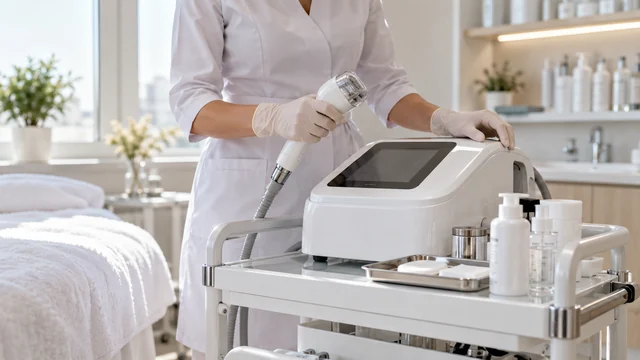
Volnewmer RF: Non-Invasive Lifting for the Lower Face
You may have seen Volnewmer RF described as a “non-surgical lift” and wondered how much your jawline would really change. First, an important distinction: Volnewmer is a specific non-invasive monopolar radiofrequency device from Korean manufacturer CLASSYS, not a surgical facelift. Its tip delivers heat to tissue while contacting the skin. The proposed cosmetic benefit is a modest change in firmness and some superficial signs of laxity, not guaranteed repositioning of deeper, descended tissues or removal of prominent jowls. Choosing another approach—or choosing no procedure—is equally legitimate.
What Volnewmer actually is: device, frequency and tips
CLASSYS describes Volnewmer as a 6.78 MHz monopolar radiofrequency (RF) system. “Monopolar” refers to the electrical current path through tissue between a treatment electrode and a return electrode, not to a proven depth of lifting. RF energy produces tissue heating, while contact-based circulating-water cooling is designed to protect superficial skin under specified operating conditions. The manufacturer also describes skin impedance monitoring, vibration and the shape of the treatment tip. Those are design features, not proof that pain or burns are impossible.
Technical documents list four tip sizes: I, 0.25 cm² for small areas; F, 3 cm²; V, 4 cm²; and S, 16 cm² for larger areas. There are two handpieces, and the 2024 US submission lists a maximum output of 115 W. Tip area does not itself establish that every anatomical site can safely be treated. The precise device configuration and instructions, proximity to the eyes, skin thickness and tissue condition matter. A letter printed on a tip or the advertised number of pulses is not enough to judge whether settings are safe.
Versions matter too. FDA records contain Volnewmer clearances K240248, dated 29 April 2024, and K253504, dated 13 July 2026. The latter document identifies an added software-controlled Repeat Mode for sequential, automated energy delivery; intended use, frequency and principal specifications remain the same. When comparing providers, ask for the exact software configuration and tip being used rather than assuming that the specifications of one brochure apply to every installed system.
Why the FDA wording matters more than an “approved” advertisement
The US FDA evaluated Volnewmer through 510(k) clearance, a determination of substantial equivalence to an already legally marketed device for the stated intended use. The indications in both K240248 and K253504 concern electrocoagulation and haemostasis (control of bleeding) of soft tissue in dermatologic procedures. This is not a separate FDA finding that Volnewmer produces a surgically equivalent facelift, outperforms Thermage, or achieves a specified jawline lift. The slogan “FDA-approved lifting” conflates different regulatory and clinical claims.
The manufacturer also mentions Korean regulatory authorisation, but authorised uses do not automatically transfer between the US, Korea, Europe and Armenia. Local registration, device labelling, permitted practitioners and installed configurations need verification in the relevant country. Without independently checking a particular Yerevan provider, neither its possession of the device nor the legality of a proposed protocol can be confirmed. Even a lawfully marketed machine does not answer how much change is likely for your particular skin.
What can change if your concern is the lower face?
RF heating may contract some collagen fibres and initiate later tissue responses. Evidence for the broader category of monopolar RF procedures suggests that modest changes in skin firmness are possible, but the size of any individual benefit varies. Different RF systems use different tip geometries, cooling methods, energy delivery patterns and indications. Results obtained with another model must not be presented as if Volnewmer itself had been tested.
One small published Volnewmer study assessed roughness and fine wrinkles: 50 people enrolled, 45 were included in the final analysis, and outcomes were checked immediately and one month later. A separate prospective Volnewmer study published in 2026 included 22 women, followed for eight weeks without a separate control group, and measured facial contour changes. These are two small studies with different endpoints, not evidence of predictable lifting for every individual. Publications reviewed through October 2026 do not include large independent head-to-head trials proving that Volnewmer outperforms other devices or produces results lasting years. Brief follow-up cannot substantiate a long-term outcome promise.
| Your main concern | How closely Volnewmer matches it | What to check first |
|---|---|---|
| Mild loss of cheek firmness or early laxity | A modest change in texture or firmness may be worth discussing | Expected scale of change in someone with similar anatomy |
| Pronounced jowls or excess neck skin | RF does not reposition deep tissue as surgery can | Whether surgical assessment or abandoning a “lift” promise makes more sense |
| Visible nasolabial folds caused by volume change | Heating does not replace lost volume in the way filler can | Whether skin, fat, ligaments or tissue position explains the appearance |
| Deep expression wrinkles | Muscle movement is not Volnewmer's main target | Whether a device is being presented as a substitute for every injection |
| Need to look flawless tomorrow | Redness, sensitivity or swelling are possible | Whether there is enough time before the event and a reaction plan |
If your face is thin, asymmetrical or scarred, if pigmentation is a concern, or if earlier procedures altered its contours, planning is particularly individual. Relevant features include not only age but also subcutaneous fat, tissue condition, treatment history and the features you want to preserve. You can explicitly say that keeping your face soft and recognisably yours matters: heat-based treatments require thoughtful energy control and assessment of soft-tissue volume.
What does treatment feel like, and why cooling is not anaesthesia?
Typically the practitioner examines the area first, discusses illnesses, implants and prior treatments, and takes comparable photographs with your consent. The system's specified contact materials and protocol are then used. The operator places the tip on the skin and delivers RF energy in successive applications. You may feel alternating warmth and cooling, sometimes uncomfortable deep heat or local tingling. Treatment parameters and the number of applications should follow device instructions and individual tolerance, not somebody else's “shot count” on social media.
Advertisements may call the procedure “painless” or say anaesthesia is unnecessary. Volnewmer does incorporate cooling and vibration, but one person's pain-free experience is no universal guarantee. Tell the operator immediately if you feel sharp burning or as though your skin is being scorched; do not endure it in hopes of a stronger effect. Asking to reduce intensity, stop or reconsider treatment does not mean you caused it to fail.
There are no deliberate needle punctures, so the multiple pinpoint wounds associated with RF microneedling are not expected. Volnewmer and RF microneedling are distinct technologies. An FDA warning issued in October 2025 about certain serious RF-microneedling complications must not automatically be assigned to Volnewmer. Nevertheless, non-invasive contact RF heating can itself cause burns or persistent pigment or texture changes if energy is delivered improperly or the patient is poorly suited to treatment.
Recovery without the promise of “zero downtime”
Immediately after heating, you may notice redness, warmth, slight puffiness or tenderness. These reactions are often short-lived but no exact clearing date can be promised. No punctures does not mean everyone will look camera-ready that evening. Mild redness may be unimportant for working from home, whereas even modest swelling can matter before a photo session or celebration.
That evening, check how the skin feels as well as how it looks. Advice about vigorous exercise, sun exposure, hot environments, exfoliating acids and makeup should come from the current skin reaction and the instructions for the specific device. The blanket claim “everything is fine after two hours” is unreliable. Do not deliberately reheat the area to enhance the result. Follow the individual care plan, and seek medical advice for a marked reaction rather than following tips written for another machine.
Any later change need not look like an instant upward movement of the cheeks. Subtle differences in texture or firmness are easier to assess in comparable photographs at an interval agreed with your clinician than in daily bathroom selfies taken from different angles. Decide in advance what would count as worthwhile improvement, when to assess it and what to do if you see virtually none. Do not commit to an extended course without agreed criteria for continuing.
Who may be unsuitable, and what symptoms need attention?
RF devices call for particular caution with pacemakers, implanted defibrillators, metal or other devices near the treatment field. The FDA mentions relevant circumstances in general RF guidance, but their application and the exact exclusions for Volnewmer must be checked against its current instructions and your treating clinician. Tell the practitioner about all implants, even ones not immediately under the tip, as well as previous operations, skin disorders, altered sensation and medications. Active infection, damaged skin or an unexplained lesion warrants medical assessment before cosmetic heating.
Because sound safety data for elective cosmetic RF during pregnancy and breastfeeding are lacking, postponement and discussion with a clinician are the prudent choices. A smaller tip is no reason to disregard cancer, impaired healing or neurological symptoms. Ask for the contraindication list of the actual device and configuration, not one remembered from a different RF machine.
Increasing pain, blisters, skin that turns unusually white or dark, a significant burn or new loss of sensation deserve prompt medical assessment rather than concealment with makeup. Rapidly progressive swelling, severe allergic symptoms or other dangerous general symptoms call for emergency help. Before treatment, establish who can be contacted after the clinic closes and how adverse events are managed and documented.
Volnewmer or Thermage: what is your real decision?
Both brands use RF technology, but they are different devices with different regulatory files. The 2024 US Volnewmer dossier names Thermage FLX as a predicate device; substantial equivalence for clearance does not mean identical aesthetic outcomes. A separate comparison page covers Thermage versus Volnewmer in detail. Here the central question is why this particular Volnewmer device has been proposed for your face. RF microneedling, ultrasound-based HIFU, fillers and surgery act on different structures and involve different risks and recovery demands. Related reading
At consultation, ask which tip is planned and why; whether you can see device labelling and the instructions; how safety is evaluated with implants, thin skin and prior procedures; and which study supports the proposed duration of benefit. Clarify the full cost including possible repeat visits, who operates the device and who treats complications, without relying on invented “standard local prices”. Compare before-and-after pictures only with the same lighting, facial expression, head position and post-treatment interval; otherwise a supposed lift may be a camera-angle effect.
A particularly useful question is: “What would you recommend if I want only a minimal change and am not comfortable with an uncertain result?” The answer may be sun protection, appropriate skin care, monitoring, a dermatologist's assessment of a different concern, or simply declining the procedure. That does not mean the technology has failed; it means the choice respects your anatomy, possible modest benefit, risks and expectations.
Further questions
I have dental implants or braces. Can I have Volnewmer?
Dental work needs an individual check of its position and materials against the current device instructions. The name of a dental implant or brace alone does not establish either a universal permission or prohibition. Mention it before anyone selects a treatment area.
If the effect is small, should the energy simply be increased?
No. How hot a treatment feels does not measure aesthetic benefit. The clinician should reassess the reason for laxity, tissue condition, device documentation and risks. Requesting higher output merely to see more change can be unsafe.
Can the number of shots in a price list tell me whether the device is good?
No. A single pulse count ignores tip area, anatomy, individual parameters and compliance with instructions. Compare the quality of assessment, rationale and arrangements for complications—not the headline shot number.
Sources and documents
- Manufacturer's Volnewmer device overview — CLASSYS
- FDA 510(k) K240248: original device dossier — US FDA
- FDA 510(k) K253504: updated decision — US FDA
- Published Volnewmer fine-wrinkle clinical study — PubMed
- Small prospective Volnewmer study — peer-reviewed article / PMC
- Systematic review of RF and skin findings — PubMed
- FDA overview of non-invasive body-contouring RF precautions — US FDA
- FDA safety communication dated 15 October 2025 on RF microneedling (not Volnewmer)