XERF by Lutronic: Monopolar Radiofrequency Lifting Explained
You may have encountered XERF in a review of nonsurgical lifting and wondered whether to consider it instead of familiar RF devices or a surgical lift. XERF is a particular noninvasive monopolar radiofrequency system made by Lutronic (Cynosure Lutronic), not a generic name for RF skin tightening. A contact tip delivers energy that heats tissue without puncturing the skin. Its possible use for modest improvements in skin firmness and facial contours is being studied. “A facelift without surgery” does not mean a surgical facelift's effect: any response depends on the degree of laxity, treatment area, protocol and practitioner.
What exactly is the XERF system?
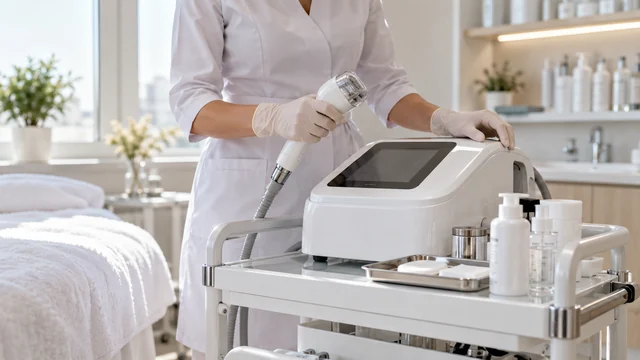
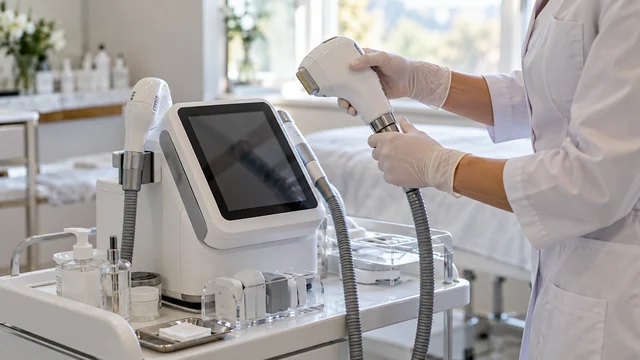
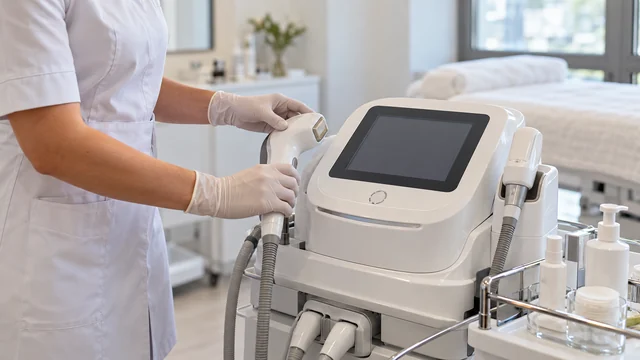
The FDA documentation for XERF application K251327 describes two operating frequencies, 6.78 and 2 MHz, monopolar RF energy, contact electrodes and a return pad. This is neither a laser nor microneedling RF: it uses no skin punctures or light at a specific wavelength. High-frequency current travels through tissue and controlled heating produces thermal changes in collagen-containing structures. The two frequencies change how energy is distributed, but actual depth and safety depend on settings, contact, tissue thickness and monitoring sensations, not a promotional diagram of skin layers.
Technical material may refer to “superficial, middle and deep levels” and different treatment tips. These are modes and accessories of this specific platform, not a guarantee that precisely the same layer will be heated in every person. Ask which XERF model, tip, local product documentation and area-specific protocol are proposed. Published researchers may have used configurations that another operator does not have.
A system's mechanism is not the same as the legally cleared indication. On 11 August 2025, the US FDA granted XERF class II 510(k) marketing clearance for electrocoagulation and haemostasis in dermatologic and general surgical procedures. This is not a separate FDA endorsement of facial rejuvenation, double-chin removal or eyelid lifting. US 510(k) clearance neither establishes Armenian registration nor confirms availability in Armenia; both would need to be verified locally.
What might improve—and what will not?
Discussion of noninvasive RF may make sense for mildly reduced firmness, early blurring of the jawline or shallow creases. In prospective observations involving a dual-frequency system, investigators reported improvements in appearance ratings at 30 and 90 days. Another retrospective XERF evaluation included only 16 women who completed follow-up and found changes in skin metrics and certain eyebrow-area measurements over three months. Such signals are preliminary, not proof of a pronounced, consistent lift in all ages and facial types.
RF does not replace lost temple or cheek volume, remove excess skin the way surgery can, or treat pigmentation, visible vessels or active dermatitis. If facial heaviness is mostly from substantial fat pads, descended tissues or skeletal anatomy, a gentle device treatment may deliver too little visible change. If the only concern is a dynamic frown line, the target is muscle activity rather than heating the skin.
Three concerns, three different decisions
| What bothers you | Possible role of XERF | When to discuss something else |
|---|---|---|
| Slight loss of cheek firmness or a softer jawline | A modest tightening effect is possible; its size is individual | With marked sagging, discuss surgical assessment and the limits of devices |
| Dryness, uneven skin tone or deeper pigmentation | RF does not directly address these causes | Have the skin diagnosed and consider appropriate care or a condition-specific pigmentation/inflammation treatment |
| Deep lines visible at rest or pronounced volume loss | It does not restore volume or guarantee smoothing | Review facial anatomy, alternatives and each option's own risks |
| Wanting subtle contour refinement while keeping usual facial movement | No injections or punctures may fit these priorities | Even a subtle goal warrants discussing the chance of little noticeable benefit |
How convincing is the evidence for XERF itself?
Evidence about the wider RF category cannot all be counted as evidence for XERF. A four-centre study published in 2026 included 39 people, each receiving two treatments four weeks apart. Clinician appearance scores improved at 30 and 90 days, and the small study recorded no persistent adverse events. However, follow-up was short, there was no sham-treated control group, and the manufacturer supplied equipment, consumables and a research grant. It cannot justify a guaranteed percentage of lifting or years of durability.
A 2026 retrospective study assessed one session in 16 women using photographs, skin-quality measures and patient satisfaction. Its small sample, missing control group and an author's involvement in brand education limit inference. That does not invalidate observations, but the appropriate description is “preliminary clinical evidence,” not definitively proved efficacy. Before-and-after images should use the same facial expression, lighting, head angle, hairstyle and follow-up interval: each can alter how the lower face looks.
There is no strong basis to promise that one session replaces a series or that everyone requires a series. Nor is a long-term, head-to-head ranking of XERF against Thermage FLX, microneedling RF and surgery established for equivalent outcomes. A useful consultation distinguishes what may realistically change in your face from what will remain.
What happens during a visit and how does it feel?
Before choosing parameters, the clinician should ask about illnesses, medications, previous fillers and procedures, heat reactions and implanted electronic devices. Skin quality, tissue mobility, facial fat, asymmetry, sensation and areas where heating may be undesirable are assessed. Skin is then prepared, the system's required return electrode placed, and selected areas treated with the contact tip. This explains the principle, not how to perform it yourself.
Patients commonly describe increasing warmth with short, more intense pulses. Some tolerate it without anaesthesia; others need the pace or settings adjusted, so “completely painless” is not a reliable promise. Tell the practitioner immediately about sharp or localised burning. Contact, skin appearance and feedback must be reassessed during treatment; more intense energy does not automatically mean a better result.
Visit length depends on the area, number of passes and assessment; the brand name alone provides no reliable duration. Discuss anaesthesia, pain relief, preparation and aftercare before lying on the treatment couch. For thin facial areas, ask exactly which tips and restrictions the maker permits: a protocol used on cheeks must not automatically be transferred to eyelids.
Recovery: what might other people see?
Without punctures there may be fewer visible marks than with microneedling RF, but “no downtime” overstates the evidence. Immediately afterwards, warmth, redness, tenderness or mild swelling can appear. Published small studies largely report transient, mild reactions, but cannot predict how an individual will look at dinner. Significant thermal injury is possible if heat-based devices are incorrectly used.
If you have photographs, a major meeting or travel tomorrow, allow a buffer: even otherwise ordinary redness can disrupt makeup or plans. For the first day follow written advice about hot showers, saunas, vigorous exercise and strong skincare; limits vary by treated area and intensity. Do not put ice directly on skin or use a harsh peel to “speed renewal.” Daily sun protection is sensible regardless of the procedure.
Do not judge success in the mirror an hour later: any immediate tightening may partly be temporary tissue response. Studies assessed appearance after about one and three months, more consistent with gradual remodelling, although final timing and persistence vary. Agree on follow-up photographs and a concrete success measure, such as the jawline at the same angle—not the vague notion of a “younger face.”
When is postponing or declining preferable?
Extra caution is needed with pacemakers or other implanted electronics, metal near the treated area, impaired sensation, active infection, wounds, significant inflammation or conditions affecting healing. Check restrictions in the actual model's current instructions against your medical history: different implants do not carry identical restrictions. During pregnancy or breastfeeding, postponing elective cosmetic RF is prudent because specific safety data are inadequate, not because harm has been proved.
With a very lean face or existing loss of volume, discuss whether contour changes could look undesirably hollow. Energy distribution and effects on subcutaneous tissues are relevant. This is not proof that XERF inevitably “melts fat,” but it deserves an individual assessment. A suspicious skin lesion should be diagnosed by a dermatologist before any energy is delivered over it. Previous severe heat reactions, poor healing or a complication with another device call for an individual risk plan.
Expected reaction or a reason to seek help?
| After treatment | What to do |
|---|---|
| Mild, fading redness and warmth without deterioration | Follow aftercare and monitor the change |
| Increasing pain, a sharply defined burn, blister or change of skin colour | Contact the treating clinician that day instead of waiting for a review; seek urgent care for significant injury |
| Increasing swelling, marked asymmetry, infection signs or unexpected sensory loss | Arrange prompt in-person assessment; do not conceal it with makeup or repeat the session |
A separate safety issue: the XERF tip recall
FDA recall Z-0146-2026 concerns specific XERF EFFECTOR 60 tips. The company initiated it on 4 September 2025; the FDA posted it on 14 October 2025, and the recall was listed as open on 23 October 2026. It covers particular catalogue and lot numbers manufactured from 1 April to 20 August 2025. Manufacturing defects could rarely cause adverse events, and recipients were instructed to stop using affected units and return them. It does not mean all XERF systems were recalled or that affected tips are being used in Armenia.
Ask which exact tips will be used, whether lot numbers have been checked against current corrective notices and how replacements are documented. A photograph of the console cannot answer this. Recall status can change: check it before treatment rather than trusting an old social-media post or printout.
How does XERF compare with the alternatives?
Thermage FLX is another specific monopolar RF system, with its own documentation, tips and protocols. Being in the same category does not make energy delivery, comfort or outcomes identical. Microneedling RF creates controlled skin punctures and has different recovery and possible texture-related uses; “deeper” is not by itself a reason to choose it. Microfocused ultrasound works by a different physical mechanism and deposits energy differently. A surgical facelift changes tissue position surgically and may be more appropriate for substantial excess skin, at a very different level of risk and recovery.
Fillers add volume; botulinum toxin treatments address some expression lines. Doing nothing is also a legitimate option: reduced skin firmness is not itself a disease needing treatment. Compare the underlying concern, realistic limits, safety, visibility of the result and willingness to recover—not glossy promotional videos.
What should you ask before consenting, and what determines cost?
Ask for the exact manufacturer and model, official device information, planned areas and tips, operator training and an up-to-date check for recalls. Which of your concerns is this treatment actually intended to address? How many visits are justified, when is the follow-up, and what counts as an insufficient result? Discuss pain, burns, sensory changes and unwanted contour changes explicitly.
A written quote should clarify treatment area, number of sessions, consultation, disposable tips, possible follow-ups and what happens after an adverse reaction. No reliable “usual price in Yerevan” can be stated without verifiable local offers, and online mentions do not prove clinic availability. If you hear guarantees of no jowls, “zero risk,” or pressure to prepay before an examination, pause and seek a second opinion.
The decision in brief: XERF is a particular dual-frequency RF system with emerging clinical observations, but evidence for its cosmetic results remains limited and regulatory wording must be read precisely. It might suit a person seeking modest noninvasive firmness improvement with realistic expectations. Confirming the model and tip, your risk profile and the limits of achievable change matters more than the brand's appeal.
Questions not covered above
Can XERF be combined with fillers or botulinum toxin injections on the same day?
There is no universally safe timing rule for every combination. Disclose the products and injection locations, discuss expected heating depth and each treatment's instructions; a clinician aware of your procedure history should decide sequence and interval. Do not conceal recent injections.
Can XERF be used on the neck or around the eyes?
Technical suitability and permitted areas depend on specific tips, current labelling and the operator's training. A protocol published for one anatomical site cannot simply be transferred to another; protecting delicate eye structures is especially important.
If I see no effect after a session, should the power be increased?
There is no “higher power equals better lifting” rule. First review comparable photographs, the time elapsed, the original cause of the concern and the safety of another exposure. Sometimes declining further sessions is preferable.