
How to Remove Facial Vessels: What Reduces Visible Veins
In a daylight photograph you notice a fine red line beside your nose or a network of lines across your cheeks. You may want them gone without a long recovery, but the first step is understanding what you are seeing. If they are persistent, enlarged superficial blood vessels, a cream generally cannot erase them; a dermatologist may be able to make them less visible using a vascular laser or intense pulsed light (IPL). If, instead, your face flushes in episodes, stings or develops bumps, a device procedure alone is not enough: the cause of the redness and inflammation needs assessing first.
Not every red dot is a “burst capillary”, and not all redness is a network of vessels. Make the distinction before buying a serum, booking a treatment or attempting to remove a spot at home. Some people choose to leave visible fine vessels alone. Typical telangiectasias—small dilated blood vessels near the skin surface—are often harmless.
Is it a single line, general flushing or a new spot?
Look at your skin in diffused light, without a magnifying filter. Fine reddish branches that remain day after day are more likely to be telangiectasias. Widespread redness that comes and goes after heat, spicy foods or alcohol may reflect reactive skin or rosacea. Rosacea can also involve burning, sensitivity to cosmetics, inflamed bumps and sometimes eye irritation. Managing the condition in detail belongs in our separate article about rosacea; here the question is what to do about the visible vessels themselves.
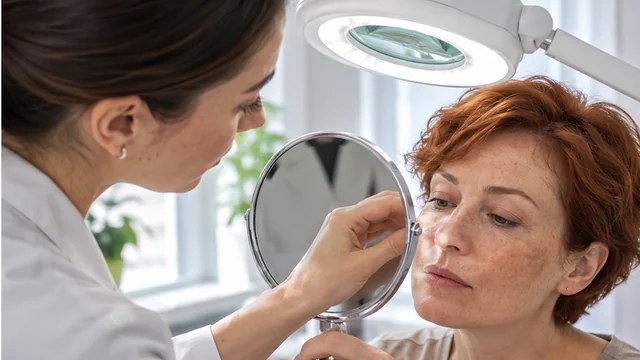
Vascular networks can have different causes: skin characteristics and heredity, ageing, prolonged sun exposure, rosacea, or unmonitored use of potent steroid products on the face. Dilated vessels can also occur with other illnesses, so an unusual spot appearing suddenly should not automatically be treated as cosmetic. A doctor may examine it with a dermatoscope, a magnifying instrument for examining skin, to distinguish a vessel from a pigmented or other lesion.
| What you notice | What it may indicate | A reasonable next step |
|---|---|---|
| A persistent fine red branch on the nose or cheek | A dilated superficial vessel | Discuss a vascular procedure with a dermatologist, or leave it alone |
| Patchy redness, flushing, burning and bumps | A possible inflammatory condition, including rosacea | Clarify the diagnosis and control symptoms before discussing vessels |
| An isolated red dot that grows, bleeds or changes | Not necessarily a telangiectasia | Arrange an in-person examination before cosmetic treatment |
What actually reduces the visible network?
A vascular laser delivers light energy absorbed by haemoglobin, the pigment in blood. The aim is to affect the dilated vessel and make it less conspicuous, depending on its depth, size, location and the person's skin. Dermatologists use different laser types, including pulsed-dye lasers and other vascular systems; the device name alone does not guarantee appropriate settings. Settings for individual lines and widespread redness may differ.
IPL is not a laser: it delivers broad-spectrum pulses of light. It can also reduce visible vessels and some diffuse redness in appropriately selected patients. You cannot fairly choose IPL over laser—or the reverse—from an advertisement claiming that newer technology must be better. Vessel type, skin phototype, tanning, tendency to pigment changes and the clinician's experience matter. A course of sessions may be needed, and new vessels developing later do not necessarily mean the earlier treatment failed.
Electrocoagulation or electrodesiccation, which uses electrical energy on a small vessel, is sometimes considered for limited areas. But even targeted treatment can cause crusting, burns, a small scar or discoloration; do not select it simply because it sounds easy. Injection sclerotherapy is widely used for certain leg veins, but it should not be regarded as a standard home treatment or a universal approach to facial vessels.
| Approach | What it aims to do | What it cannot promise |
|---|---|---|
| Gentle skin care and UV protection | Reduce irritation and triggers for further redness | Cannot remove an established, persistent vessel line |
| Vascular laser or IPL | Reduce the visibility of suitable superficial vessels | Does not automatically treat every cause of redness or rule out recurrence |
| Targeted electrosurgical treatment | Address selected isolated lesions | Still carries a risk of scarring or pigmentation change |
| Green colour-correcting concealer | Camouflage redness for a particular day | Does not physically change the vessel |
Can you remove facial vessels at home?
You can help skin react more calmly, but should not try to cauterise vessels yourself. Use gentle washing without scrubbing, a moisturiser that does not sting and broad-spectrum sun protection with SPF 30 or higher. If your skin reacts to acids, alcohol-based toners, fragrances or very hot water, temporarily remove the trigger. Sun protection is especially valuable when visible vessels accompany sun-damaged skin.
Serums containing niacinamide or soothing ingredients can reduce the feeling of irritation for some people, but convincing clinical evidence that ordinary cosmetic skin care eliminates an established dilated vessel is lacking. Do not put vasoconstrictor medicines, eye drops or steroid ointments on your face on social-media advice: they do not safely replace diagnosis and may worsen the situation. If a dermatologist prescribes a product for rosacea-related redness, that does not necessarily mean it treats the individual vessel lines.
What will your skin look like after laser or IPL—and when can you be seen in public?
Treatment can feel like brief hot snaps or stings. Pain tolerance differs; discuss cooling and pain relief in advance. Afterwards the skin may feel warm and look red or slightly swollen. Some vascular settings produce obvious purple marks called purpura, resembling small bruises. Crusts can also occur. “No downtime” does not mean “no visible marks the next morning”: cosmetic visibility can last longer than limitations on everyday activity. According to the American Academy of Dermatology, redness after some rosacea-directed laser treatments usually settles within two weeks, while purple marks may remain for one to two weeks. These are planning guides, not a recovery promise for your particular settings.
If you have a wedding, photoshoot, sunny trip or presentation planned, do not schedule your first procedure immediately before it. Ask the clinician how the skin is likely to look after the exact settings proposed, when makeup is safe again and what sun protection is needed. During the first days, harsh products, overheating and rubbing are usually discouraged; the clinician should individualise the timing to your skin's reaction. Do not cover newly injured skin with cosmetics until cleared to do so.
Temporary redness, swelling and small bruises may be expected. Increasing pain, blisters, pronounced darkening, oozing, signs of infection or a change in vision are not intended treatment effects: seek prompt medical assessment, and urgent care for visual symptoms. Pigment changes and scars are uncommon but possible, especially with unsuitable settings, tanning or inappropriate aftercare.
When is it better to postpone treatment?
Have suspicious lesions, an active infection or marked inflammation examined first; do not use a laser to cosmetically erase an unexplained bleeding spot. Tell the clinician about medicines and products that increase light sensitivity, past burns, a tendency to noticeable pigmentation and herpes infections. A recent tan complicates safe setting selection. During pregnancy, elective cosmetic laser and light-based procedures are generally deferred. During breastfeeding, discuss the individual method with a clinician: some procedures may be considered, but direct safety data remain limited. There is no need to accept uncertain risk for an optional intervention.
If frequent nosebleeds occur alongside multiple vascular spots on the lips or mucous membranes, or vessel-like lesions appear unusually rapidly across a large area, do not stop at a cosmetic consultation. A doctor can determine whether other causes need investigating. You do not need to diagnose a rare condition yourself from photographs.
How can you decide without exaggerated promises?
At the consultation, ask the doctor to identify exactly which marks are vessels and what degree of change is realistic. Ask why laser or IPL has been chosen, who will perform the treatment, how your skin tone, tan and sensitivity affect settings, whether bruises or dark marks are possible, how many visits are anticipated in your case, and what happens if some vessels remain. Discuss the full estimated cost, including possible repeat visits, without promises of perfectly clear skin after one session.
When viewing before-and-after photos, compare lighting, skin tone, camera angle and time since treatment. Makeup and filters can make redness vanish in a picture without any procedure. An offer to treat everything without examining a separately changing spot, or a promise to close every vessel permanently, is a sound reason to seek a second opinion. For a barely noticeable line, SPF and camouflage instead of treatment are entirely reasonable—your choice matters.
One further question
What if the vessel is right next to the eyelashes?
Do not attempt home treatment or an ordinary salon procedure so close to the eye. Have the area assessed by a clinician who understands this anatomy and can provide the eye protection required for the chosen device.
Sources
- American Academy of Dermatology — Lasers and lights: rosacea
- American Academy of Dermatology — Rosacea: diagnosis and treatment
- DermNet — Telangiectasia
- American Academy of Dermatology — Rosacea signs and symptoms
- EyeWiki / American Academy of Ophthalmology — IPL therapy
- NCBI GeneReviews — Hereditary Hemorrhagic Telangiectasia
- Cosmetic Dermatology in Pregnancy and Lactation — 2026 review