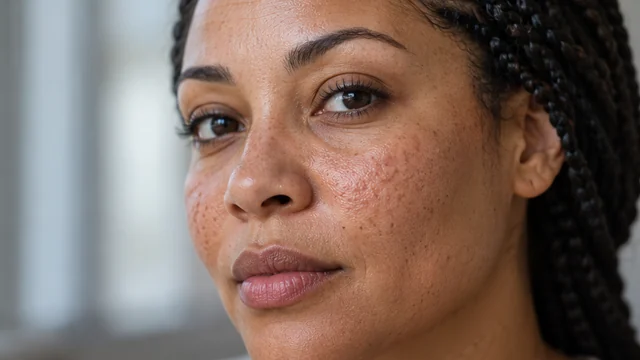
How to Treat Under-Eye Hollows: Tear Trough Options
You slept well, yet a curved shadow remains below your lower eyelid, especially in photographs under overhead light. It may be a tear trough: a depression along the junction of the lower eyelid and cheek. Unlike pigmentation, its appearance depends on shape and tissue volume. Carefully selected hyaluronic acid filler, restoration of support in the midface or surgical repositioning of fat can sometimes soften the trough. The choice depends on nearby bags, swelling, excess skin and lower-eyelid support.
A tear trough is a normal anatomical feature, not a diagnosis that always needs treatment. If you want to soften the shadow slightly while keeping natural expression, a perfectly flat lid–cheek junction need not be the goal; that can increase the risk of a puffy, overfilled appearance. This article focuses on a confirmed hollow. If the main concern is color, itching or fluctuating puffiness, first review the different under-eye concerns.
Why does a trough develop even when the skin is healthy?
The junction of the lid and cheek is shaped by the eye socket's bony support, ligaments, fat pads, skin and muscles. For some, a hollow has been visible since youth because of inherited proportions. For others, it appears as midface fullness and soft-tissue position change with age. Sometimes lower-eyelid fat bulges immediately beside the depression, producing a transition from a raised bag to a shadow. Filling that shadow is much easier in a diagram than on a living face.
The trough cannot be assessed separately from the cheeks. Lack of midface support can emphasize the lid–cheek border, and placing filler directly under thin eyelid skin may not be the best choice. Conversely, when the cheeks are already full, adding volume merely to remove a shadow can create a heavy contour. A proper examination looks straight on and in profile, while smiling and under different lighting.
How can you tell whether it is really a hollow?
Notice whether the dark line changes in soft, diffuse light. Shadows cast by a depression often fade somewhat, whereas actual pigment remains more apparent. Consider whether the hollow is constant or the area becomes puffy in the morning. Swelling can temporarily hide a trough while making bags more visible. Dryness, irritation and prominent vessels introduce other causes that restoring volume will not treat.
This is not a diagnostic test to perform at home. A recent, especially one-sided change accompanied by tenderness, redness, a bulging eye, changed vision or a different lid position needs medical assessment before a cosmetic appointment. Sudden vision loss or severe pain inside the eye is an emergency. Do not try to disguise new medical symptoms with an injection.
How do you choose between observation, filler and surgery?
| Starting situation | Options worth discussing | Why not to rush |
|---|---|---|
| Shallow trough, good lid support, no marked bags or swelling | Observation, optical camouflage or a cautious assessment for suitable filler | Even a small volume can show through thin skin |
| Trough accentuated by reduced support in the midface | Assessment of the whole cheek–lid junction and sometimes a different volume-deficient area | The darkest line is not necessarily the appropriate injection site |
| Trough with prominent bags or excess skin | Oculoplastic or plastic surgeon consultation about surgical options | Filler cannot move protruding fat and might increase puffiness |
| Tendency to persistent swelling or malar/festoon-type puffiness | Investigate causes and carefully reconsider whether an injection is worthwhile | Hyaluronic acid binds water; swelling may persist or recur |
| Mainly pigmentation, with no anatomical depression | Dermatology assessment and gentle skincare | Added volume will not remove melanin |
Ask the clinician to name exactly which feature they aim to change and how they will know when enough has been done. Under the lower eyelid, a little undercorrection may look more natural than erasing every anatomical boundary. This is not an obligatory progression from cream to filler to surgery; these are different goals, with different degrees of intervention.
When can filler give a subtle result?
Hyaluronic acid gel restores some fullness and changes how light falls where eyelid meets cheek. In carefully chosen anatomy, it may soften a shallow trough without surgery. But “a tiny injection” understates the procedure: this is a highly vascular area with thin skin, and placement and material properties matter. The result depends on facial structure and on the clinician knowing when to stop, not merely on the product.
In the United States, FDA authorization for the infraorbital hollow was extended to the specific Juvéderm Volbella XC formulation for adults older than 21. That decision cannot be applied to every gel and does not determine whether a product can legally be used in Armenia. Nor does it mean everyone with under-eye shadows qualifies. Ask for the full product name, composition, labeling, applicable local authorization and instructions or restrictions before consenting.
An unsatisfactory cosmetic result may be minor or quite distressing: lumps, a visible ridge, persistent puffiness, blue discoloration through the skin or asymmetry. Inflammatory nodules and delayed swelling can appear months after injection. Hyaluronidase can sometimes reduce unwanted hyaluronic acid filler, but dissolving filler is itself a medical procedure with risks and does not always solve a difficult problem immediately. “Reversible” does not mean you can always recover exactly your previous appearance easily.
What is the vascular risk, and what should a safety plan include?
Accidental injection into a blood vessel, blocking blood flow, is rare but potentially devastating. It can damage skin, impair or destroy vision and occasionally cause a stroke. Using a cannula does not eliminate the risk. Treatment in this area requires suitable medical qualifications, expertise in periocular anatomy, good patient selection and an established emergency route to hospital care including ophthalmology.
Sudden vision changes, unusual severe pain, abrupt whitening of skin, weakness on one side of the body or impaired speech during or after injection need emergency medical help immediately, not a message to the clinic or home treatment. A multidisciplinary UK consensus published in 2026 recommends immediate transfer to an emergency department when eye or brain vascular involvement is suspected. If the injector has no emergency plan, that alone is a reason not to proceed.
Could your own fat be used to restore volume?
Fat grafting is a surgical technique: tissue is collected from another area and transferred to restore contour. It is different from filler, with another preparation process, a donor site and more uncertainty about how much volume persists. Some fat may not survive; lumps or asymmetry can occur. A surgeon may discuss it for appropriate anatomy and goals, but it is not a guaranteed “natural, permanent” substitute for injections.
If a bulging fat pad creates most of the shadow, lower blepharoplasty may involve repositioning the person's own orbital fat. A surgeon considers whether to move protruding tissue to smooth the junction. It is more than simply “removing bags”; removing too much fat can worsen hollowness. Surgery carries risks including dry eyes, lid malposition, bleeding, infection, incomplete eyelid closure and rare serious vision complications. It is not suitable for everybody and needs real recovery time.
Why will neither cream nor device lifting solve every trough?
Moisturizers can improve how the skin feels and looks at the surface, and makeup can disguise a shadow; neither replaces volume in a deep anatomical depression. Energy-based treatments may address aspects of skin firmness but are not equivalent to rebuilding lost fullness. With thin tissues and an already hollow midface, poorly chosen deep heating can be especially undesirable. Do not purchase a treatment package just because a machine is marketed for the neighboring area.
Too little sleep or fluid changes can alter the appearance, but a stable anatomical trough will not disappear after a single mask. That does not mean you are “doing nothing” unless you get injections. Reducing irritation, protecting the skin from sunlight, using concealer and adjusting lighting for video calls are real choices. For many people, a modest optical change without medical risk is preferable to pursuing a perfectly flat contour.
What recovery should you plan for before an important occasion?
Filler rarely requires a holiday from work, but injection points, redness, tenderness, bruises and swelling may be visible socially. Their intensity and duration vary; nobody can promise a flawless appearance by a particular morning. The contour may look smooth initially but later develop fluid retention or unevenness. Follow personal aftercare advice and know whom to contact about a new change, even months later.
Surgery usually involves more noticeable bruising and swelling, eye care, physical-activity restrictions and follow-up visits. The preoperative lid condition, extent of surgery and tendency to swell all affect recovery. Do not organize a wedding or photo shoot around a promise that swelling will disappear “in a couple of days.” Ask about the likely range of social visibility, not just the earliest date you may technically return to work.
| Option | When a change becomes apparent | What to allow for |
|---|---|---|
| Makeup and skincare | Immediate optical effect from makeup; gradual skin effects from care | Does not change the contour; low risk with products your skin tolerates |
| Hyaluronic acid filler in suitable anatomy | Volume changes soon; final assessment after tissue reactions settle | Bruising, swelling or later irregularities possible; temporary and not completely predictable |
| Surgical adjustment of fat or tissue position | Contour assessed after healing and swelling subside | More invasive, with recovery and specific surgical risks |
How long does the effect last, and should it be repeated?
Filler is not a permanent part of your anatomy. Its visible effect depends on the gel's formulation, placement, volume, individual tissue response and changes in the face over time. The FDA reports that the effect of Juvéderm Volbella XC in the infraorbital hollow study could last up to 12 months; this is not a personal guarantee or a figure applicable to other products. Residual filler and visible benefit can last for different periods, and adding more without checking existing material increases the risk of overfilling.
Surgical repositioning of fat does not require the same repeated gel injections, but facial aging continues and no individual's duration of benefit can be predicted exactly. Fat grafting adds uncertainty about graft survival. Do not compare these options simply by asking which lasts “forever”; weigh the intended change, recovery, possibility of revision and whether you can accept the chosen risks.
How can you judge before-and-after photos without borrowing someone else's expectations?
Ask for images taken with comparable head position, expression, lighting and camera distance. A hollow can look shallower because of side lighting or retouching; early post-injection swelling can temporarily fill a line. Ask when each picture was taken and whether the cheeks or eyelids were treated in other ways. Even accurate photographs cannot replace assessment of your skin thickness, tendency to swell and tissue volume.
Five useful consultation questions: Is this a true trough or the shadow beneath a bag? Is there sufficient midface support? Why choose this treatment instead of observing? What early and late unwanted changes are possible? Who will help, and how, if a complication occurs? Do not agree to repeatedly “top up until perfect” without reassessment. A clinician who recommends no injection for now may be making a careful decision.
When is it better not to correct the trough?
Significant recurrent periocular swelling, active inflammation, unexplained new asymmetry or an uncertain diagnosis are reasons to pause cosmetic plans. Elective filler treatment is generally deferred during pregnancy and breastfeeding because convincing safety data for a non-essential intervention are insufficient. Severe allergy to a product component, infection and other label-specific contraindications demand medical assessment, not social-media advice. Also tell the clinician about bleeding disorders, medicines that increase bleeding, and previous severe allergic reactions; do not stop prescribed medicines on your own.
Doing nothing is reasonable if you like your everyday appearance and the shadow only bothers you under certain lighting. Seek a second opinion from a lower-eyelid specialist if you are immediately offered a large filler volume or combined surgery. You need not undergo a procedure to prove you care about yourself. The aim is not the flattest possible photograph but a change proportionate to your goal and risks you knowingly accept.
Frequently asked questions
Can weight loss deepen the hollows?
Yes. Changes in soft-tissue volume can make the lid–cheek junction more prominent. However, the effect cannot be predicted from weight change alone; underlying anatomy and tissue quality matter.
If filler was injected years ago, can I simply add more?
Not without examination. Some material can remain, and new swelling or irregularities may relate to earlier injections. A clinician may sometimes use ultrasound to assess where the filler lies.
Can only one side be corrected?
Mild facial asymmetry is normal. One-sided correction may be considered after evaluating both sides and the reason for the difference. New or rapidly developing asymmetry needs medical explanation first.
Sources
- Termanini & Alghoul, 2026 — Tear trough anatomy and management
- FDA — Juvéderm Volbella XC, infraorbital hollow
- FDA — Dermal Fillers: risks, approved uses and removal
- Baytaroğlu & Hoşal, 2025 — Periorbital filler complications
- UK consensus 2026 — Tissue filler induced vision loss
- ASPS — Eyelid surgery risks
- ASPS — Eyelid surgery recovery