Sun and Age Spots: Can a Laser Remove Them?
You noticed new brown marks on your cheekbones or the backs of your hands after summer and wonder whether a laser could remove them. Some are solar lentigines: benign, flat pigmented marks associated with cumulative ultraviolet exposure. Creams may fade them and selected office procedures may remove or lighten them. But identify the lesion first; a changing or unexplained mark should never be destroyed cosmetically as a trial.
You do not have to treat spots that do not bother you. If you want a more even complexion, the appropriate approach depends on the diagnosis, pigment depth, skin phototype, recent tanning, tendency to post-inflammatory darkening and whether visible flaking or crusts would be acceptable.
What are “sun spots” and “age spots”, really?
A solar lentigo is usually a well-defined, flat, light- to dark-brown mark, commonly on skin exposed to sun for years: the face, backs of hands, shoulders and décolletage. “Age spot” is imprecise because cumulative UV exposure, not age alone, matters. A true solar lentigo is benign, but its colour and location alone cannot establish a diagnosis from a photograph.
Freckles are not identical. They often appear in childhood, darken after sun and fade in winter; solar lentigines usually persist more consistently. See the separate explanation of freckles versus lentigines. This page instead helps you decide what to do about a mark you want changed without missing a medical condition. The separate freckle-laser page focuses on a procedure; laser selection cannot replace an examination.
When is a brown mark more than a cosmetic concern?
Not every brown lesion is harmless pigment. Sun-exposed skin can also develop seborrhoeic keratosis (often a slightly raised benign growth), actinic keratosis (a potentially precancerous change, sometimes rough), pigmented moles and, less commonly, melanoma, including its early forms. Some can resemble a lentigo. Treating an uncertain lesion with laser or acid may obscure important signs and delay diagnosis.
See a dermatologist before cosmetic treatment if a mark is new and unusual for you, enlarges quickly, changes shape or shows several colours, has irregular edges, bleeds, ulcerates or differs visibly from other marks. Itch or tenderness also merit assessment, although their absence does not mean a lesion is safe. Do not try to bleach a changing mark to see whether it disappears.
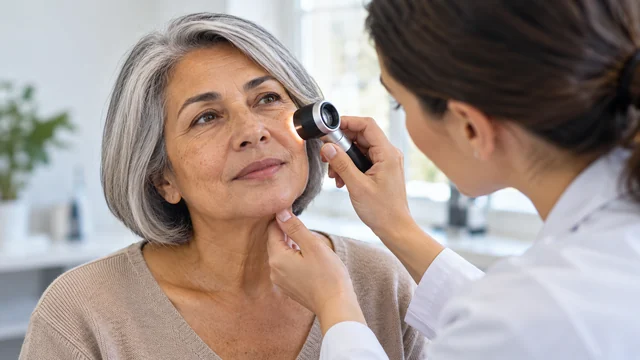
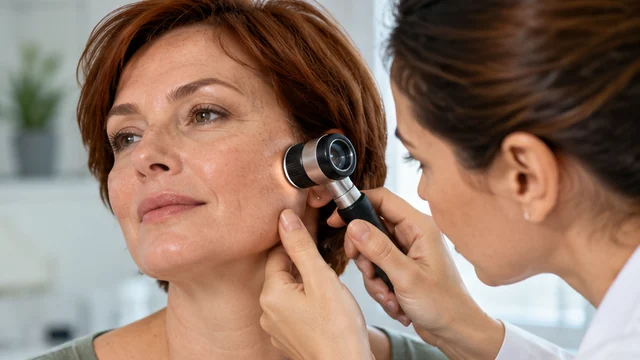
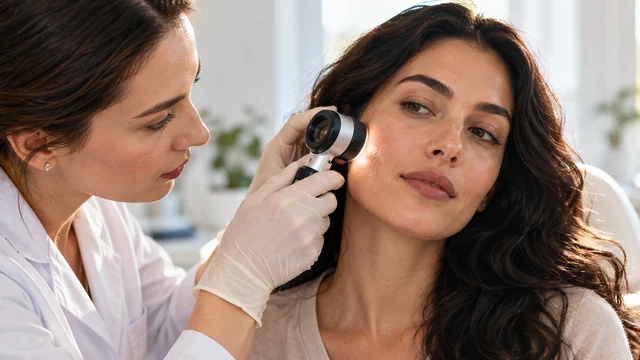
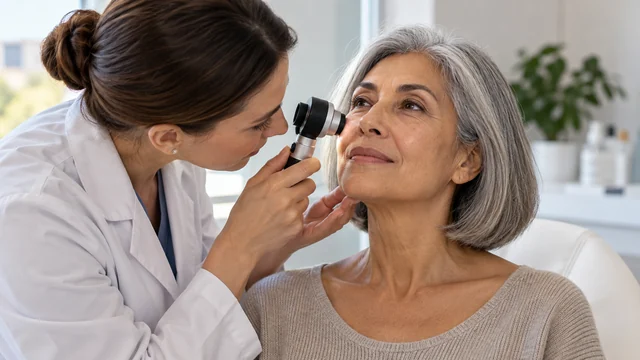
The doctor will review how it developed and examine your skin, using dermoscopy—a magnified examination of skin structures—when appropriate. If skin cancer remains a possibility, the clinician decides the diagnostic pathway, sometimes including a biopsy and tissue analysis. A laser should not destroy tissue needed for diagnosis. Online photographs and automated mole-checking apps do not replace this assessment.
Similar appearances, different next steps
| What you see | Possible explanation | Sensible next step |
|---|---|---|
| A stable, even-coloured spot on sun-exposed skin | Possibly a solar lentigo | Confirm the diagnosis, then choose observation, skin care or treatment |
| Tiny dots that darken in summer and fade in winter | Possibly freckles | Decide whether treatment is worthwhile; recurrence is common |
| Diffuse, fairly symmetrical brown patches on cheeks or forehead | Possibly melasma | Do not copy a spot-laser protocol; pigment control needs a different plan |
| Marks remaining after acne, irritation or a burn | Possibly post-inflammatory hyperpigmentation | Address ongoing inflammation and discuss gentle care first |
| A changing, bleeding, rough or distinctly different lesion | Precancerous or malignant change needs exclusion | Dermatologist first; do not cosmetically destroy it |
This table cannot diagnose a lesion at home; features overlap. Melasma and post-inflammatory pigmentation have their own treatment principles. Do not automatically apply a lentigo protocol to either.
Once the diagnosis is confirmed, what can actually lighten spots?
Topical products tend to change appearance gradually and need consistent use. Clinician-directed procedures may target pigment more rapidly, but temporary visible marks are more likely. Neither route prevents all future spots. Choose by the improvement you want and the risk your own skin can reasonably tolerate—not by the strongest-sounding treatment.
| Option | When to discuss it | Main limitation |
|---|---|---|
| Sun protection and observation | Stable spots that do not trouble you or when you prefer no procedure | May only modestly fade existing lentigines, though it helps prevent new ones |
| Lightening treatments, retinoids and prescription preparations | You prefer slow improvement without a device | Weeks or months may be needed; irritation and product-specific pregnancy or skin-condition restrictions matter |
| Pigment-targeting lasers and IPL (intense pulsed light) | Confirmed, localised spots and a preference for potentially faster fading | Initial darkening, crusts, burns or light/dark marks; risk depends on phototype, tan, equipment and settings |
| Cryotherapy (freezing) | Selected confirmed lentigines in suitable skin | Blistering, scabbing and sometimes lasting colour change; not an effortless universal choice |
| Chemical peels | Appropriate cases involving broader changes in tone and texture | Irritation, recovery and pigmentation risks; peel depth is crucial |
Clinical reviews find benefits from several approaches, particularly certain lasers and combinations, but devices, skin types, success measures and follow-up periods differ. That is not proof of one best laser for everybody. With darker phototypes or a recent tan, discuss post-inflammatory hyperpigmentation—darkening after skin injury—in particular.
Laser or cream: how do you choose?
Compare two situations: one long-stable spot on the hand, examined and diagnosed as a lentigo, may reasonably prompt a conversation about a targeted procedure. Patchy pigmentation across the whole face that worsens with sun and heat may have another cause; trying to burn off every dot could leave the underlying process untouched or make tone less even. Tell the clinician whether your goal is one spot or the complexion overall before discussing device brands.
Active tanning and an impaired skin barrier often justify postponing treatment until recovery and assessment. Avoid stacking strong acids, scrubs, brighteners and light procedures without guidance: irritation can intensify pigmentation. Mention pregnancy, breastfeeding, photosensitising medicines, scarring tendency, herpes near the planned site and previous treatment reactions. These are not identical contraindications for every option; the choice depends on the product and circumstances.
What will your skin look like afterward—and at a meeting?
A treated spot may initially look darker, not lighter. Redness, swelling, dryness, surface scabs or peeling may follow; freezing may produce a blister. Visibility varies by skin and procedure. “Friday treatment, invisible by Monday” is not a dependable promise. Being well enough to work is different from having no marks detectable in close conversation or photographs.
Do not schedule your first pigment procedure close to a wedding, holiday in the sun, photo session or presentation. Ask about normal healing and the possibility that marks will persist longer, when makeup is safe, how to wash the area and which signs need attention. Do not pick at scabs or scrub treated skin; settle an already irritated barrier first.
Sun sensitivity can complicate travel. Shade, clothing, a broad-brimmed hat and broad-spectrum SPF 30 or higher on exposed skin, reapplied according to its instructions, remain foundational. Protection matters well beyond the first days: previous UV exposure cannot be undone, and new lentigines can appear elsewhere.
Expected reactions versus warning signs
Limited redness, a temporarily darker treated mark and mild peeling may be expected only if your clinician explained these as likely for that exact method. Increasing pain, a significant burn, spreading redness, pus, fever or worsening general health warrant prompt contact with the treating clinician. A new unusual pigmented lesion next to the area needs assessment as a new lesion, not an automatic diagnosis of “returning pigment”.
After pigment removal, a darker shadow or a pale patch may remain, sometimes longer than a crust. Scars are less common but your history of scarring matters. Do not add powerful acids on your own to speed fading; irritation does not signal better effectiveness.
Natural-looking results—and assessing promises and costs
A natural result need not mean absolutely every mark disappears. You may want just less contrast in one spot while preserving normal skin variation. Compare before-and-after photographs only under similar lighting, with the interval and any concurrent treatments disclosed. Bright filters and different camera exposure can manufacture impressive changes.
When comparing offers, ask whether the fee covers diagnosis and dermoscopy, the specific area and technology, any proposed test spot, repeat visits and care for an adverse reaction. A device name or headline price cannot tell you how appropriately an uncertain mark has been assessed. Avoid promises of guaranteed, permanent, scar-free clearance.
Questions to ask before consenting
- What is the diagnosis of each spot, and does any lesion need investigation rather than removal?
- Why does this method suit my skin phototype and recent tanning; how likely is prolonged darkening or lightening?
- Will there be crusts, flaking or redness; when are makeup, exercise, sun exposure and travel reasonable?
- Is the goal targeted fading or a more even overall tone; what if pigment persists or returns?
- Whom do I contact for an unusual reaction, and how will help be arranged?
Vague answers, or an offer to destroy a suspicious lesion without examination, are reasons to pause and seek another opinion. Observation and sun protection are legitimate choices for a stable benign lentigo.
Other questions
Can an age spot appear on a lip?
Pigmented lip lesions exist, but the differential diagnosis there is different. Show any new or changing lip mark to a dermatologist instead of treating it like a lentigo on a hand.
Why did one treated spot remain when the others faded?
Depth and origin of pigmentation may differ. Ask for re-evaluation of the diagnosis and response before increasing treatment intensity.
Can I put foundation over a fresh crust?
Not on damaged skin without the treating clinician's approval. Irritation and trauma depend on the procedure and how far the skin has healed.
Can a home IPL device remove a lentigo?
Home devices cannot diagnose pigmented lesions, and their intended uses and settings differ from professional systems. Never use one on an unidentified or changing mark.
If my spots have disappeared, can I stop SPF?
No. Fading does not eliminate your tendency to further UV-related spots. Continue protection appropriate to your exposure.