
Skin tags (acrochordons): when to remove them and how
Perhaps a tiny, soft growth on your neck keeps catching on a necklace. Or you notice a bump beneath your arm and worry about nicking it while shaving. In English these are often called skin tags; the medical term is acrochordons, sometimes called soft fibromas or fibroepithelial polyps. A typical skin tag is benign and does not necessarily need removal. Yet a description or phone photograph cannot reliably establish the diagnosis: warts, moles and some tumors may look similar. Your first decision is to identify the growth; the second, separate decision is whether the discomfort justifies removal and a possible skin mark.
What does a skin tag look like, and what could be mistaken for it?
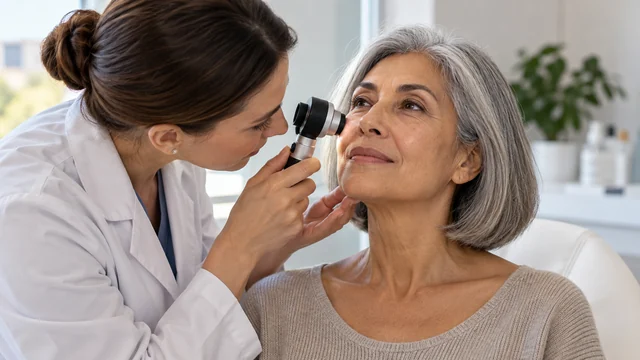
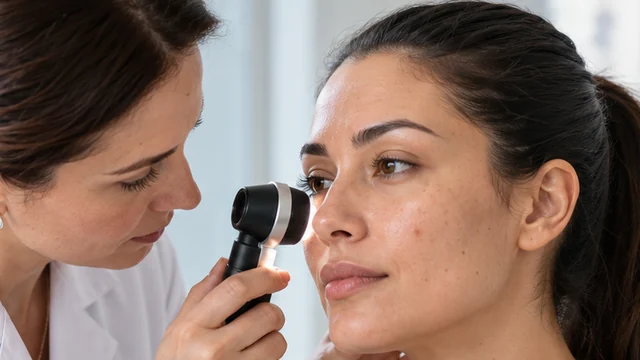
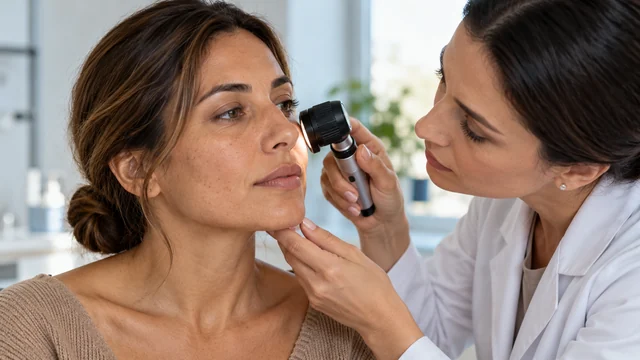
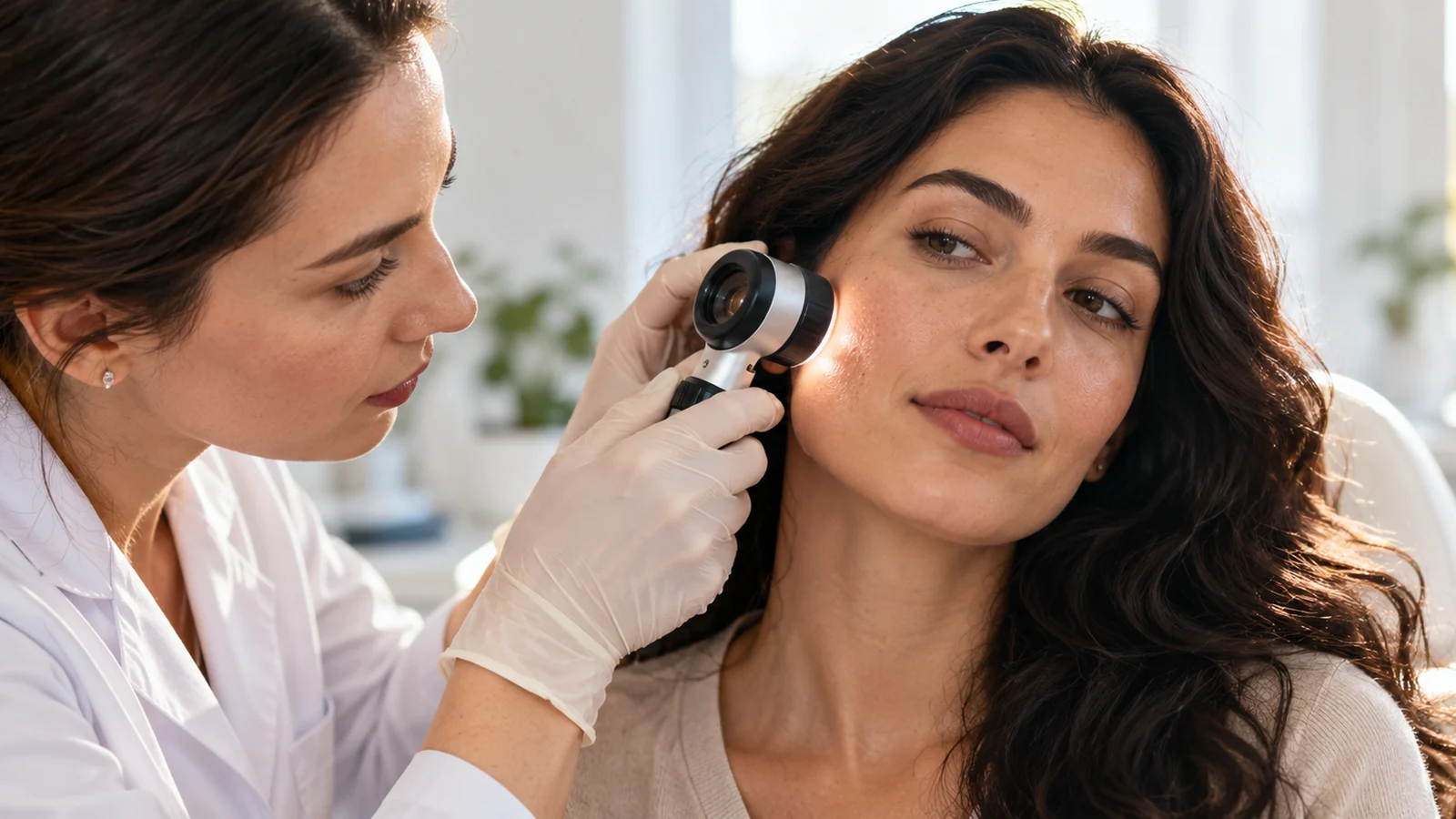
It is typically soft and skin-colored, pink or darker, often attached by a narrow stalk. Common locations include neck creases, armpits, beneath breasts and the groin; eyelids and other sites are possible. Sizes vary, and rubbing clothing can irritate the surface. A dermatologist assesses shape, color, surface and history and may use a dermatoscope—an instrument for magnifying skin structures. A reassuring appearance does not replace clinical examination, especially for a newly discovered lesion.
People sometimes call every raised lesion a “papilloma,” but that is not a diagnosis. An acrochordon is not necessarily a viral wart and does not prove human papillomavirus (HPV) infection. A growth might instead be seborrheic keratosis, a nevus (mole), molluscum contagiosum or something else. Some skin cancers can also be raised or nodular. Even if you have familiar skin tags elsewhere, a new lesion that looks different should not automatically receive the same label.
| What you notice | What it could mean | A reasonable next step |
|---|---|---|
| A soft, longstanding stalked growth in a friction area, with no change | Compatible with an ordinary skin tag but not proof of the diagnosis | See a dermatologist if you want it removed or are uncertain |
| Rapid change in size, color or shape, or new pigmentation | Do not explain it away as a change in an “ordinary papilloma” | Arrange an in-person dermatology assessment promptly |
| Bleeding without injury, an ulcer or unusual pain | Could represent trauma, inflammation or a different condition | Do not cauterize or snip it; seek medical assessment |
| A new eyelid growth that obstructs vision | The eye’s safety and precise diagnosis matter | Assessment by a professional experienced with this area |
A single injury from a necklace may explain minor bleeding, but it does not establish that the lesion is harmless. If a suspected skin tag grows quickly, changes or bleeds repeatedly, do not delay examination in favor of a gentle-sounding home remedy. For brisk bleeding that will not stop with pressure from a clean cloth, seek urgent medical help rather than a cosmetic consultation.
Why do skin tags develop? Do you need tests for another illness?
No single cause has been established for every acrochordon. They commonly appear where skin rubs against skin, jewelry or clothing. They may become more common with age, and family history contributes. Professional sources describe associations with higher body weight, insulin resistance, type 2 diabetes and changes during pregnancy. But association does not mean that any one factor causes every lesion: a skin tag alone cannot diagnose diabetes or a hormonal disorder.
One or a few longstanding, unchanged, symptom-free tags usually do not justify extensive tests without other indications. If many lesions appear suddenly, a clinician may suggest reviewing general symptoms and risk factors with your primary-care doctor. Rather than ordering broad “hormone panels” yourself, report when the lesions appeared, whether they change, diabetes, pregnancy, medication changes and other skin symptoms. If you have many tags, especially alongside other risk factors for diabetes, ask your clinician whether a blood-glucose check would be appropriate; skin tags cannot replace a test or establish a diagnosis.
No cream, vitamin regimen or “detox” reliably prevents every skin tag. Reducing ongoing friction may make an existing tag more comfortable but does not ensure new ones will not appear. Comfortable clothing and gentle care are for your wellbeing; they do not treat a hidden illness, and skin changes are not a reason for self-blame.
When is doing nothing reasonable, and when might removal help?
If a clinician has confirmed a benign skin tag and it is not painful, injured or bothersome, observation is a complete and valid choice. There is no medical obligation to remove every visible tag. Removal can be useful when it repeatedly catches on jewelry, becomes irritated by shaving, rubs against underwear or affects the eyelid area. Wanting a smoother appearance is also legitimate, but there may be a light or dark mark or a small scar afterward.
Location influences the decision. On the neck, the visibility of a mark and clothing friction matter; in an armpit, sweat and movement; beneath a breast, moisture; on an eyelid, thin skin and the nearby eye. Do not self-diagnose projections on genital skin as skin tags: other diagnoses, including infections, require different assessment. Children and people with atypical lesions also need an individualized clinical plan, not an internet template.
How does a clinician remove a confirmed skin tag?
After examination, a dermatologist chooses based on size, stalk, blood supply, position and whether another diagnosis is possible. One option is careful snipping with sterile instruments, sometimes with local anesthesia, followed by appropriate control of bleeding. Electrodesiccation destroys tissue with controlled electrical energy and usually leaves a scab. Cryotherapy freezes a lesion with liquid nitrogen; a blister or scab may develop and the growth may fall off later. Methods can be combined. Not every technique suits every growth.
| Method | What it involves | Possible mark or limitation |
|---|---|---|
| Snipping with medical scissors or a blade | Generally removes the lesion promptly; anesthesia and bleeding control may be needed | Small wound, with some risk of bleeding, infection or a scar |
| Electrodesiccation | Destroys tissue with controlled electrical energy | Scab, possible pigment change or visible mark |
| Liquid-nitrogen cryotherapy | Freezing; the lesion may not detach immediately | Possible blister, scab or light/dark patch |
| Observation without removal | No procedure is needed for a reliably benign, non-bothersome lesion | The growth stays; new changes call for reassessment |
Laser treatment is not universally superior and cannot guarantee a mark-free result. Separate material covers laser treatment for skin tags and specific removal methods. The crucial issue here is the boundary between diagnosis and cosmetic action: if the clinician questions the diagnosis, a biopsy—a sample examined under a microscope—may be needed rather than destroying tissue that could have been examined.
Why is tying off a skin tag at home a bad idea?
Even a tiny growth contains blood vessels. Tying it with thread or hair, cutting it with nail scissors, applying acid or trying to freeze it yourself can cause bleeding, burns, infection or scarring. Eyelid and genital lesions are especially unsafe to treat this way. There is also the danger of misdiagnosis: destroying a suspicious growth can remove material needed for timely analysis and delay recognition of serious disease, especially if it is actually a mole or tumor.
The American Academy of Dermatology advises against wart removers for skin tags: soft tissue responds differently, and chemical products can injure surrounding skin. The FDA has not approved over-the-counter medicinal products for people to remove moles and this type of skin growth themselves in the United States. That describes US regulation, not automatically the legal status of every product in every country. Nevertheless, the physical risks of home procedures do not change at a border.
If shaving accidentally cuts a tag, gently press it with a clean cloth to control bleeding and do not attempt to finish cutting it off. Seek care if bleeding continues, redness spreads, pain becomes marked or pus appears. Avoid caustic “disinfectants” and unknown products on eyelids or mucous membranes.
How will it heal, and when can you plan a special event?
Removal usually leaves a small treated area that may be pink, mildly tender, bandaged or covered with a scab. For electrodesiccation, the American Academy of Dermatology describes scab healing over about one to three weeks; other methods and sites have different timelines. Do not pick the scab to speed up the cosmetic result: that can increase irritation and the chance of a mark. Wound size, your individual healing and pigmentation tendency affect the final appearance.
| Situation | What may be visible | Practical planning |
|---|---|---|
| On removal day | A pinpoint wound or small raw area, a dressing and mild swelling | Do not expect instantly flawless skin |
| Over the next few days | Scab, sensitivity to friction, occasionally a small bruise | Avoid shaving, jewelry and seams that rub the area |
| After the wound closes | Temporary pink, light or dark coloration | Ask about sun protection on exposed skin and follow aftercare instructions |
| If healing is unusual | Increasing pain, pus, spreading redness or fever | Contact a clinician instead of waiting for it to “dry out” |
You might return to work quickly, but the mark will not necessarily disappear that evening. Before a wedding, photoshoot or wearing an open neckline, avoid treatment on the eve of the event. Ask for clear instructions on cleansing, bandage changes, and restrictions involving swimming, saunas and makeup around the wound. Eyelids, necks and skin folds need different care; there is no single day on which “everything is allowed.”
Will there be a scar? Can skin tags return?
A correctly selected procedure often leaves a small mark, but scarring, hypopigmentation (lighter skin) and hyperpigmentation (darker skin) cannot be ruled out. A tendency to keloid scars, rubbing, inflammation, treatment depth and lesion location matter. A tag fully removed from one spot may not return at that spot, but new ones can appear in other folds. Promising to “remove all papillomas permanently” would therefore be misleading.
Tell the clinician if acne or small scratches tend to leave dark patches: pigment marks may outweigh the cosmetic benefit. Likewise, discuss a history of large, raised scars after surgery before proceeding. For a tiny lesion that does not bother you, even a small permanent mark may be more of a burden than leaving it alone. You are not required to change your skin to match anyone else’s idea of smoothness.
What should you ask before consenting?
- How confident is the diagnosis of acrochordon? Which findings would change it?
- Would dermoscopy or histology—microscopic analysis of tissue—be useful before or after removal?
- Why was this method chosen for my site, and what sort of mark could remain on my face or in a skin fold?
- What if I take medicines that affect bleeding or have poor wound healing? Do not stop prescriptions on your own.
- When should the dressing come off? How should the wound be cleaned? Which symptoms warrant calling, and what is the follow-up plan?
- Can I leave the growth alone and watch for change if it causes no trouble?
Skin tags are a subject for dermatological diagnosis and informed choice, not a promise that a particular aesthetic center provides a service. This informational page does not establish who performs removal in Yerevan or at what cost. The priority is to identify the growth safely, then decide whether any intervention is worthwhile.
Frequently asked questions
Can I cover a skin tag with concealer?
If the skin is intact and the product is non-irritating, covering it may be possible, but rubbing or makeup removal can injure the tag. Do not apply makeup to an inflamed, bleeding or recently treated lesion without advice from your clinician.
Do I need an HPV test because of one skin tag?
A typical acrochordon alone does not prove HPV infection or automatically justify testing. That decision depends on your other circumstances and a clinical assessment, not the informal label “papilloma.”
Can a twisted skin tag turn black?
Reduced blood flow through a twisted stalk can change the color, but that cause cannot be confirmed remotely. Sudden darkening, pain, bleeding or an atypical appearance warrants an in-person examination, not self-removal.
Sources
- American Academy of Dermatology: skin tags, causes and removal.
- American Academy of Dermatology: five reasons to see a dermatologist.
- DermNet: Skin tag (Acrochordon).
- NCBI Bookshelf: Skin Tag (Acrochordon), diagnosis and treatment.
- US FDA: unapproved OTC mole and skin-tag removal products.
- American Academy of Dermatology: skin tags as a possible diabetes warning sign